
Science
Innovative Kirigami Technique Enhances Solar Sail Maneuverability

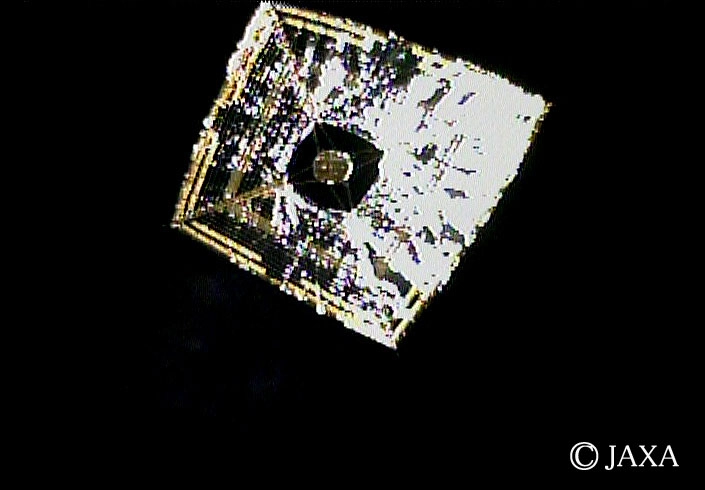
Recent research from the University of Pennsylvania has introduced a groundbreaking method for improving the maneuverability of solar sails. In a pre-print paper authored by Gulzhan Aldan and Igor Bargatin, the team presents a technique that utilizes kirigami, an ancient Japanese art of paper cutting, to enable solar sails to turn effectively without relying on traditional propulsion methods.
Solar sails operate by harnessing light pressure from the Sun, offering a propellant-free alternative to conventional spacecraft propulsion. However, the challenge has always been how to adjust their orientation efficiently. Traditional methods, such as reaction wheels and tip vanes, have limitations that can hinder functionality. Reaction wheels, common in stationary satellites, are heavy and consume propellant, while tip vanes are mechanically complex and prone to failure.
The innovative kirigami approach involves creating intentional cuts in the sail material, allowing it to buckle and change shape when tension is applied. Each “unit cell” of the solar sail is designed with these strategic cuts in both axial and diagonal directions, facilitating a transformation into a three-dimensional surface. This buckling effect enables individual segments of the sail to tilt at varying angles relative to the incoming light source, effectively creating miniature mirrors that reflect light differently.
The principle of momentum conservation dictates that as light is reflected, the sail will be propelled in the opposite direction. This design allows for precise control over the sail’s trajectory, directing it with remarkable efficiency. While some electrical power is required to initiate the buckling using servo motors, this approach is significantly more power-efficient compared to the liquid crystal panels used in previous solar sail missions, such as IKAROS in 2010, which drained batteries even when not in use.
To validate their technique, Aldan and Bargatin conducted simulations using COMSOL, a standard physics simulation software, followed by physical experiments in a controlled environment. The simulations indicated that the force generated by the sail, measured at 1 nN per Watt of sunlight, is sufficient for maneuvering small solar sails. In practical tests, they illuminated a stretched kirigami film with a laser, confirming that the observed angles matched predictions for varying degrees of strain.
While the potential of this technology is promising for the future of solar sailing, the landscape is competitive, with various other methods vying for similar advancements. Current experimental missions are limited, suggesting that practical applications of this kirigami technique in space may still be some time away. Nevertheless, as research progresses, the anticipated outcomes could revolutionize solar sailing, offering a visually stunning and efficient means of navigation in the cosmos.
As the scientific community continues to explore the intricacies of solar sail technology, the work of Aldan and Bargatin stands out as a significant step forward. The implications of their findings could reshape our approach to space travel, enhancing our ability to navigate the vastness of space with minimal energy requirements.

Super Bowl Champion Prince Amukamara Transitions to Kids’ Influencer

Ree Drummond’s 20-Minute Cacio e Pepe Ravioli Recipe Shocks Fans

AARP Warns of Major Social Security, Medicare Changes in 2026

Carrie Fisher’s Autopsy Reveals Drug Use at Time of Death

Providence St. Joseph Hospital Promotes Lung Cancer Screening in Humboldt

Urgent Credit Card Strategies for 2026: Rates Remain High

Trump Demands Democrats Named in Epstein Files, Calls it ‘Witch Hunt’

Trump’s Outburst Over Epstein Documents Raises Urgent Questions

Georgia Tech vs. BYU: Pop-Tarts Bowl Kicks Off Today at 3:30 PM ET

New Gel Offers Hope for Regrowing Tooth Enamel in Dentistry

University of Hawaiʻi at Mānoa Joins $25.6M AI Initiative for Disaster Monitoring

ALMA Discovers Companion Orbiting Red Giant Star π 1 Gruis

Park Jung Min’s Endearing Moment with Hwasa Steals Show at Awards

IROS 2025 to Showcase Cutting-Edge Robotics Innovations in China

Stone Island’s Logo Worn by Extremists Sparks Brand Dilemma

Sampson County Celebrates Susie Faison’s 100th Birthday Milestone

Startup Liberate Bio Secures $31 Million for Next-Gen Therapies

Mary Morgan Jackson Crowned Little Miss National Peanut Festival 2025
-
 Health2 months ago
New Gel Offers Hope for Regrowing Tooth Enamel in Dentistry
-
Science2 months ago
University of Hawaiʻi at Mānoa Joins $25.6M AI Initiative for Disaster Monitoring
-
 Science1 month ago
ALMA Discovers Companion Orbiting Red Giant Star π 1 Gruis
-
 Lifestyle1 month ago
Park Jung Min’s Endearing Moment with Hwasa Steals Show at Awards
-
 Science2 months ago
IROS 2025 to Showcase Cutting-Edge Robotics Innovations in China
-
 Lifestyle2 months ago
Stone Island’s Logo Worn by Extremists Sparks Brand Dilemma
-
 Lifestyle2 months ago
Sampson County Celebrates Susie Faison’s 100th Birthday Milestone
-
 Health2 months ago
Startup Liberate Bio Secures $31 Million for Next-Gen Therapies
-
 Lifestyle2 months ago
Mary Morgan Jackson Crowned Little Miss National Peanut Festival 2025
-

 Health2 months ago
Top Hyaluronic Acid Serums for Radiant Skin in 2025
-

 Politics2 months ago
Judge Considers Dismissal of Chelsea Housing Case Citing AI Flaws
-

 World2 months ago
Bravo Company Veterans Honored with Bronze Medals After 56 Years