
Science
ALMA Discovers Companion Orbiting Red Giant Star π 1 Gruis

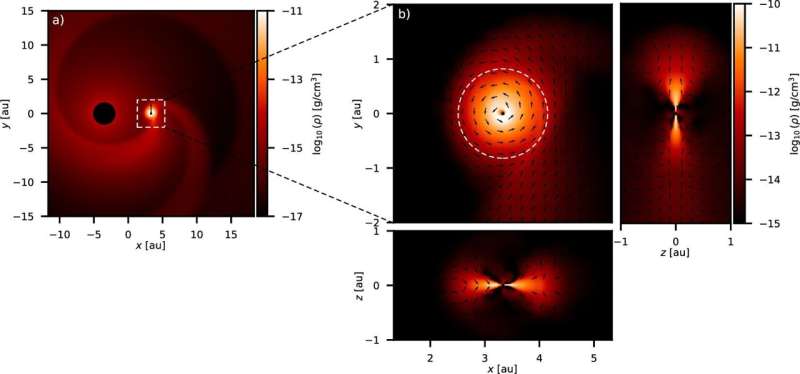
A team of international scientists has successfully identified a companion star orbiting the red giant star known as π 1 Gruis, located approximately 530 light-years from Earth. Utilizing advanced observational techniques through the Atacama Large Millimeter/submillimeter Array (ALMA) in Chile, the researchers have unveiled significant insights into the dynamics of this celestial system, challenging existing models of stellar evolution.
Unraveling Stellar Mysteries
The red giant star, π 1 Gruis, is classified as an asymptotic giant branch (AGB) star, a stage in stellar evolution characterized by significant changes. Once similar to the sun, π 1 Gruis has expanded to over 400 times the sun’s size and now emits light thousands of times brighter than our sun. This extreme luminosity complicates the detection of any close companion stars, which can easily be outshone.
In a groundbreaking paper published in the journal Nature Astronomy, the team, including Yoshiya Mori, a Ph.D. candidate in astrophysics at Monash University, provided direct observational evidence of the companion’s orbit. Mori highlighted the importance of accurately determining the mass of π 1 Gruis to understand the companion’s influence, stating, “A key part of understanding the orbit of the companion is knowing the mass of the AGB star.”
Revising Stellar Evolution Models
The research presented a notable deviation from previous predictions. While earlier models suggested that the companion star would have an elliptical orbit, observations revealed an almost circular path. This finding implies that the orbital evolution may occur more rapidly than previously understood, prompting a reevaluation of how companions interact with giant stars.
Project lead Mats Esseldeurs from KU Leuven emphasized the broader implications of this discovery. “Understanding how close companions behave under these conditions helps us better predict what will happen to the planets around the sun, and how the companion influences the evolution of the giant star itself,” he said.
The findings suggest that existing models may have underestimated the rates at which orbits circularize. This revelation opens new avenues for research into tidal interactions and the behavior of binary stars, potentially altering our understanding of the life cycles of stars and their companions.
The international collaboration showcases the significance of utilizing sophisticated technology to explore the cosmos. As scientists continue to investigate the complexities of stars like π 1 Gruis, the knowledge gained will enhance our comprehension of stellar life cycles and their implications for planetary systems.
The research, published on November 14, 2025, marks a milestone in astrophysics, offering insights that could reshape established theories and deepen our understanding of the universe. For further details, refer to the publication: Mats Esseldeurs et al, “Evidence for the Keplerian orbit of a close companion around a giant star,” in Nature Astronomy.

Robinhood Stock Surges 2.5% Today Amid Tech Market Recovery

Philadelphia’s Earth Month Kicks Off with Free Events in Parks

GSK’s Inhaler Decision Sparks Health Concerns for Children

Bradford’s Fish Fry Fridays Offer Community Spirit and Flavor

Speculation Rises on Shutdowns During Trump’s Potential Presidency

Samsung Galaxy Watch 9 to Feature Larger Battery, Report Reveals

Inventors Find New Purpose Through Unconventional Paths

UConn Huskies Aim for Back-to-Back Titles in 2026 NCAA Tournament

U.S. Mine Countermeasure Ships Dock in Malaysia for Logistics Stop

University of Hawaiʻi at Mānoa Joins $25.6M AI Initiative for Disaster Monitoring

$2.2 Million Boost for Cancer Research and Training in Hawaiʻi

ALMA Discovers Companion Orbiting Red Giant Star π 1 Gruis

Sacituzumab Govitecan Shows Promise for HR+/HER2− Breast Cancer

币安人生 Sees $15.92 Million in Trading Volume Amid Market Fluctuations

New Gel Offers Hope for Regrowing Tooth Enamel in Dentistry

CAVA Group Shares Surge 5.1% Amid Mixed Analyst Ratings

Christian Bale in Talks to Join Leonardo DiCaprio in Heat 2

Supreme Court to Review Birthright Citizenship for Children of Immigrants
-
Science9 months ago
University of Hawaiʻi at Mānoa Joins $25.6M AI Initiative for Disaster Monitoring
-
 Health8 months ago
$2.2 Million Boost for Cancer Research and Training in Hawaiʻi
-
 Health8 months ago
Sacituzumab Govitecan Shows Promise for HR+/HER2− Breast Cancer
-
Politics6 months ago
币安人生 Sees $15.92 Million in Trading Volume Amid Market Fluctuations
-
 Health9 months ago
New Gel Offers Hope for Regrowing Tooth Enamel in Dentistry
-
 Business8 months ago
CAVA Group Shares Surge 5.1% Amid Mixed Analyst Ratings
-
 Entertainment9 months ago
Christian Bale in Talks to Join Leonardo DiCaprio in Heat 2
-
 Politics8 months ago
Supreme Court to Review Birthright Citizenship for Children of Immigrants
-

 Lifestyle9 months ago
Art Deco and Traditional Designs Set to Transform Homes in 2026
-

 Lifestyle8 months ago
Fernando Mendoza Secures Maxwell and O’Brien Awards Ahead of Heisman
-

 World9 months ago
Swiss Residents Reject 50% Inheritance Tax on Wealthy
-

 Top Stories8 months ago
William S. Ditmer, 80, Passes Away on Thanksgiving Morning