
Science
New Research Reveals Ice Deposits Hold Mars’ Climate History

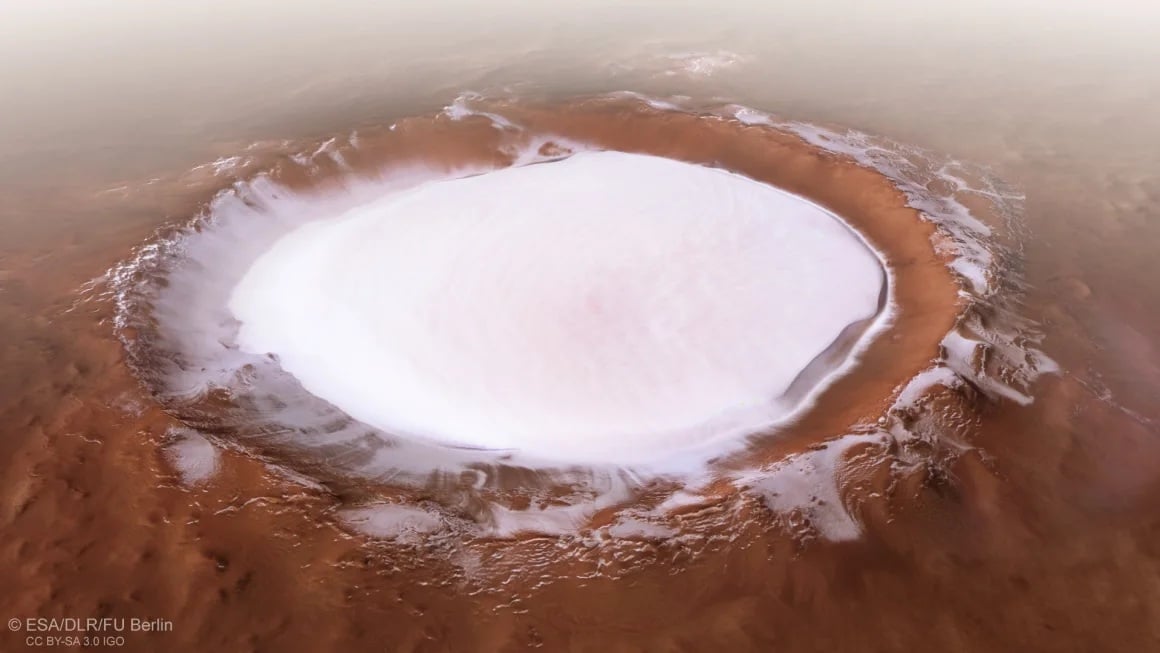
Recent research indicates that ice deposits within Martian craters may provide crucial insights into the planet’s climatic history. A team of Japanese scientists, led by Trishit Ruj from the Institute for Planetary Materials at Okayama University, has discovered that these ice layers serve as a record of Mars’ past, revealing that the planet underwent multiple ice ages over hundreds of millions of years. This study, published in the journal Geology, could reshape our understanding of Martian climate evolution and offer practical applications for future exploration.
The surface of Mars is marked by various geological features that hint at a time when the planet was warmer and wetter, supporting rivers, lakes, and a vast ocean in its northern hemisphere. Evidence of this past includes river channels, delta fans, and clay-rich sedimentary deposits. Understanding the extent and duration of water on Mars, as well as the factors leading to its current arid state, has been an ongoing pursuit for scientists over the past half-century.
The research team focused on glacial landforms preserved in craters located between 20°N and 45°N latitude. Using high-resolution images from the Mars Reconnaissance Orbiter, they identified craters exhibiting signs of glaciation, such as ridges and maze-like pit formations. Their findings revealed that ice consistently accumulated in the shadowed southwestern walls of these craters, a pattern that persisted throughout multiple glacial periods during the Amazonian period, which dates from approximately 640 to 98 million years ago.
Dr. Ruj explained, “Like Earth, shifts in Mars’ climate were driven by changes in the planet’s axial tilt, or obliquity.” Mars’ axial tilt varies significantly over geological timescales, which has influenced the planet’s climate, triggering cycles of glaciation and thawing that gradually reduced its ice deposits. This ongoing process highlights how Mars has transitioned to its current cold, dry state.
The implications of this research extend beyond planetary science. As humanity prepares for potential crewed missions to Mars, understanding the distribution of water ice will be vital for sustaining astronauts. In-situ resource utilization (ISRU) will be crucial, as spacecraft take between six to nine months to travel from Earth to Mars using conventional propulsion systems. Water ice could be converted into drinking water, oxygen, and even fuel for return trips.
Moreover, the techniques and tools used to analyze Martian climates may also prove beneficial on Earth. With climate change leading to the rapid melting of glaciers and ice caps, the modeling methods developed for Mars could help scientists monitor changes in Earth’s frozen landscapes.
Dr. Hasegawa from Kochi University emphasized the broader significance of this research, stating, “Mars serves as a natural laboratory for understanding how ice behaves over vast timescales. The insights we gain here can sharpen our understanding of climate processes on Earth as well.”
The study not only enhances our understanding of Mars but also serves as a reminder of the interconnectedness of planetary science and Earth-based environmental challenges. As researchers continue to explore the Red Planet, the knowledge gained may provide critical insights for both future exploration and current global climate issues.

New Book “Black Moses” Reveals Fight for Black State in 1891

German Tourist Dies After Ski Lift Collision in Montenegro

Gold Prices Surge to Record Highs, Raising Economic Questions

Tom Cruise and Ana de Armas Split Over Family Plans

STAAR Surgical and Spotlight Innovation: A Comparative Stock Analysis

Shoppers Embrace Post-Christmas Sales with Gift Cards in Hand

Retired Air Force Sergeant Critiques GOP’s Direction Amid Controversy

New Findings: Why 6000MHz RAM is the ‘Sweet Spot’ for Users

Trump and Zelenskyy Meet in Florida to Forge Ukraine Peace Plan

University of Hawaiʻi at Mānoa Joins $25.6M AI Initiative for Disaster Monitoring

New Gel Offers Hope for Regrowing Tooth Enamel in Dentistry

ALMA Discovers Companion Orbiting Red Giant Star π 1 Gruis

Park Jung Min’s Endearing Moment with Hwasa Steals Show at Awards

IROS 2025 to Showcase Cutting-Edge Robotics Innovations in China

Stone Island’s Logo Worn by Extremists Sparks Brand Dilemma

Sampson County Celebrates Susie Faison’s 100th Birthday Milestone

Mary Morgan Jackson Crowned Little Miss National Peanut Festival 2025

Startup Liberate Bio Secures $31 Million for Next-Gen Therapies
-
Science2 months ago
University of Hawaiʻi at Mānoa Joins $25.6M AI Initiative for Disaster Monitoring
-
 Health2 months ago
New Gel Offers Hope for Regrowing Tooth Enamel in Dentistry
-
 Science1 month ago
ALMA Discovers Companion Orbiting Red Giant Star π 1 Gruis
-
 Lifestyle1 month ago
Park Jung Min’s Endearing Moment with Hwasa Steals Show at Awards
-
 Science2 months ago
IROS 2025 to Showcase Cutting-Edge Robotics Innovations in China
-
 Lifestyle2 months ago
Stone Island’s Logo Worn by Extremists Sparks Brand Dilemma
-
 Lifestyle2 months ago
Sampson County Celebrates Susie Faison’s 100th Birthday Milestone
-
 Lifestyle2 months ago
Mary Morgan Jackson Crowned Little Miss National Peanut Festival 2025
-
 Health2 months ago
Startup Liberate Bio Secures $31 Million for Next-Gen Therapies
-

 Health2 months ago
Top Hyaluronic Acid Serums for Radiant Skin in 2025
-

 Science2 months ago
Arizona State University Transforms Programming Education Approach
-

 Politics2 months ago
Judge Considers Dismissal of Chelsea Housing Case Citing AI Flaws