
Science
NASA’s Webb Telescope Unveils Extraordinary New Exoplanet

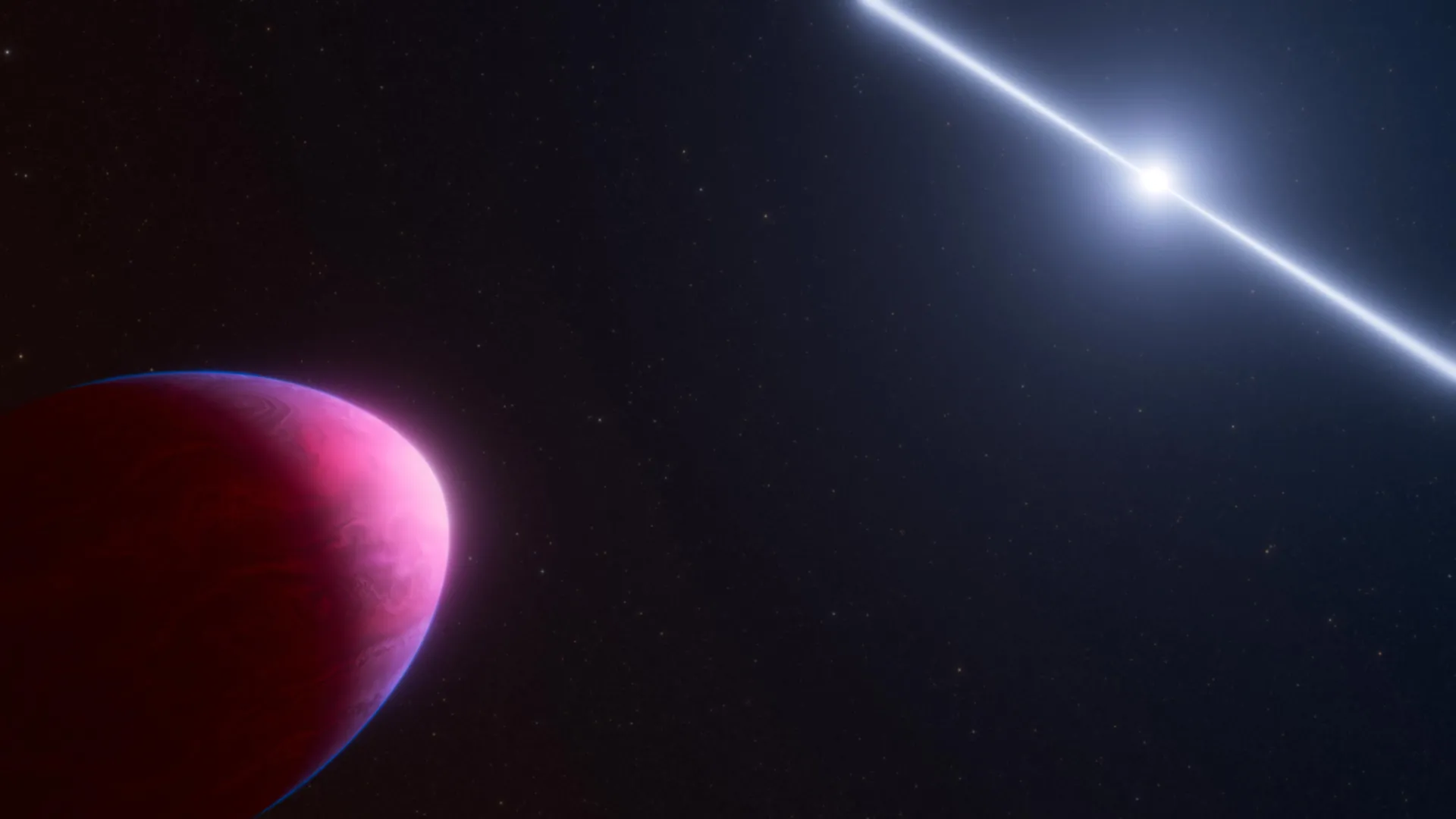
NASA’s James Webb Space Telescope has made a groundbreaking discovery, identifying a peculiar exoplanet that challenges existing astronomical theories. Named PSR J2322-2650b, this planet orbits a neutron star and possesses a unique carbon-rich atmosphere, potentially containing diamonds deep within. Its unusual characteristics have left scientists baffled, as no current models adequately explain its existence.
A Planet Unlike Any Other
The newly discovered exoplanet has a mass comparable to Jupiter and exhibits a strikingly elongated, lemon-like shape due to the intense gravitational forces exerted by its host star. Michael Zhang, an astrophysicist at the University of Chicago and lead researcher on this study, noted, “This is a new type of planet atmosphere that nobody has ever seen before.” The planet’s atmosphere is dominated by helium and carbon, diverging significantly from the more familiar gases found on other known exoplanets.
PSR J2322-2650b orbits incredibly close to its neutron star, just 1 million miles away, completing a full orbit in a mere 7.8 hours. This proximity allows for a unique observation opportunity, as the planet is illuminated by its host star without overwhelming its detection systems.
Revolutionary Observations
The James Webb Space Telescope’s advanced infrared capabilities made this discovery possible, allowing researchers to analyze the planet’s atmospheric composition in detail. Contrary to expectations, instead of detecting common molecules like water and methane, scientists found molecular carbon, specifically C3 and C2. Under the extreme pressure conditions within the planet, this carbon may crystallize into diamond formations.
“This was an absolute surprise,” said Peter Gao of the Carnegie Earth and Planets Laboratory. After analyzing the data, the collective reaction among the research team was one of astonishment. Such a high concentration of carbon poses significant questions regarding the planet’s formation, with Zhang emphasizing, “It seems to rule out every known formation mechanism.”
The discovery of PSR J2322-2650b represents a significant milestone in exoplanet research, as its characteristics blur the lines between planets and stars. The planetary system may belong to a rare category known as black widow systems, where a pulsar gradually consumes its companion, leading to unusual atmospheric compositions.
Research conducted by Zhang and his colleagues, including Jacob Bean, Brandon Park Coy, and Rafael Luque, received funding from NASA and the Heising-Simons Foundation. The findings are set to be published in The Astrophysical Journal Letters, providing further insights into this extraordinary exoplanet and its implications for our understanding of planetary formation.
The scientific community eagerly anticipates additional research that may elucidate the mysteries surrounding PSR J2322-2650b, as experts like Roger Romani of Stanford University propose theories about the planet’s unique atmospheric composition. As scientists continue to unravel the complexities of this new exoplanet, it serves as a reminder of the vast and intriguing possibilities within our universe.

U.S. Postal Service Changes Spark Urgent Concerns Over Mail Reliability

Richard A. Weiherer Passes Away: Community Mourns Loss

Schaumburg Family Fights Urgently for Access to Medical Marijuana

Dallas City Council Urgently Debates New Winter Shelter Plan

Lamar Jackson Responds to Critics Ahead of Crucial Steelers Clash

New Express Lanes Open on US 183, Tolls Increase Starting Today

Experts Urge Realistic Goals for New Year’s Resolutions Now

Urgent Update: Immigrants Face Health Care Gamble in California

ACA Subsidies Expire; Insurance Premiums Set to Surge 26%

University of Hawaiʻi at Mānoa Joins $25.6M AI Initiative for Disaster Monitoring

New Gel Offers Hope for Regrowing Tooth Enamel in Dentistry

ALMA Discovers Companion Orbiting Red Giant Star π 1 Gruis

Park Jung Min’s Endearing Moment with Hwasa Steals Show at Awards

IROS 2025 to Showcase Cutting-Edge Robotics Innovations in China

Stone Island’s Logo Worn by Extremists Sparks Brand Dilemma

Sampson County Celebrates Susie Faison’s 100th Birthday Milestone

Startup Liberate Bio Secures $31 Million for Next-Gen Therapies

Mary Morgan Jackson Crowned Little Miss National Peanut Festival 2025
-
Science2 months ago
University of Hawaiʻi at Mānoa Joins $25.6M AI Initiative for Disaster Monitoring
-
 Health2 months ago
New Gel Offers Hope for Regrowing Tooth Enamel in Dentistry
-
 Science2 months ago
ALMA Discovers Companion Orbiting Red Giant Star π 1 Gruis
-
 Lifestyle1 month ago
Park Jung Min’s Endearing Moment with Hwasa Steals Show at Awards
-
 Science3 months ago
IROS 2025 to Showcase Cutting-Edge Robotics Innovations in China
-
 Lifestyle3 months ago
Stone Island’s Logo Worn by Extremists Sparks Brand Dilemma
-
 Lifestyle2 months ago
Sampson County Celebrates Susie Faison’s 100th Birthday Milestone
-
 Health3 months ago
Startup Liberate Bio Secures $31 Million for Next-Gen Therapies
-
 Lifestyle3 months ago
Mary Morgan Jackson Crowned Little Miss National Peanut Festival 2025
-

 Science3 months ago
Arizona State University Transforms Programming Education Approach
-
 Science2 months ago
Interstellar Comet 3I/ATLAS Approaches Sun, No Threat to Earth
-

 Health3 months ago
Top Hyaluronic Acid Serums for Radiant Skin in 2025