
Science
Interstellar Comet 3I/ATLAS Approaches Sun, No Threat to Earth

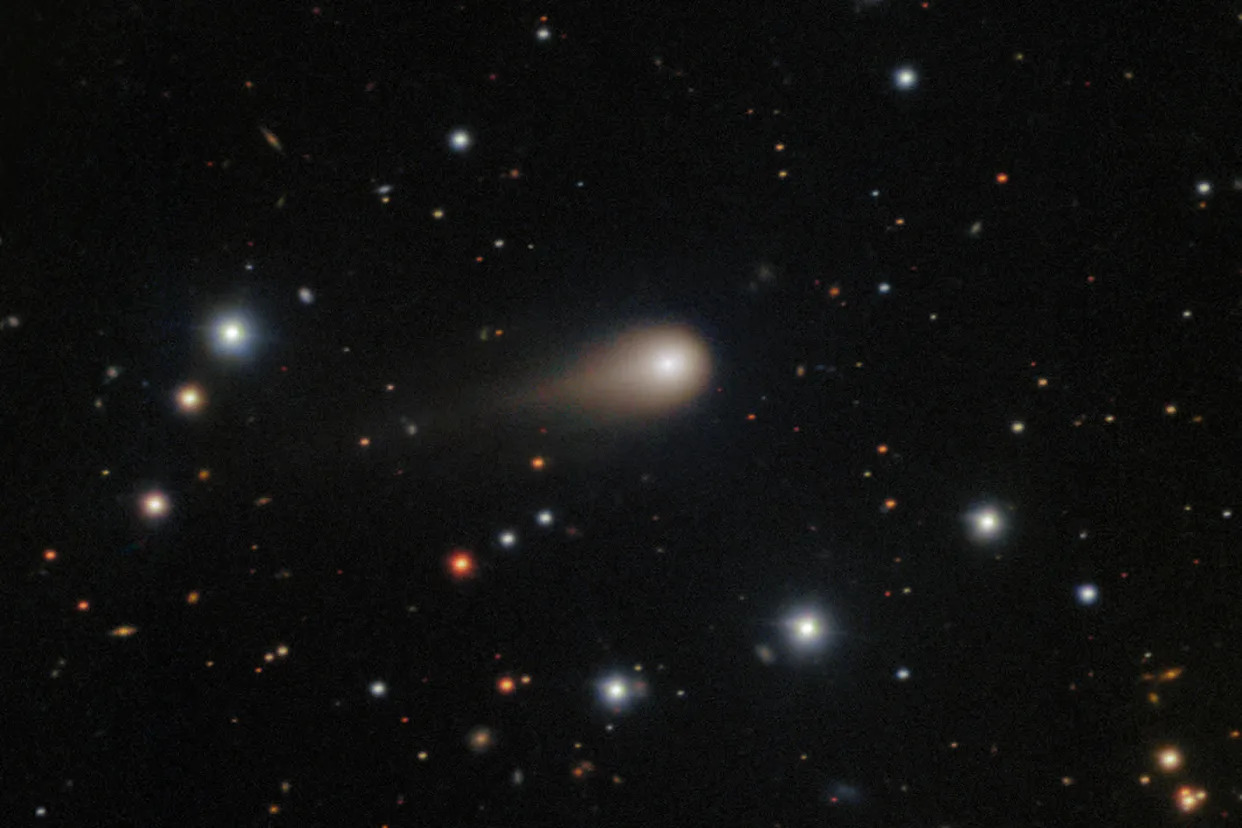
An interstellar comet, designated as 3I/ATLAS, is set to reach its closest point to the sun on October 30, 2025. Despite its proximity to the sun, astronomers confirm it poses no threat to Earth, as it will remain at least 170 million miles away from our planet.
Discovered on July 1, 2025, by the NASA-funded Asteroid Terrestrial-impact Last Alert System (ATLAS) survey telescope in Rio Hurtado, Chile, this comet has intrigued scientists due to its potential age and unique trajectory. Initial observations revealed that it might be older than our own solar system, leading to significant interest in its composition and origin.
Characteristics and Classification of 3I/ATLAS
Astronomers have classified 3I/ATLAS as a comet based on its physical characteristics. Using advanced telescopes, researchers noted that the comet is composed of ice and has a bright halo of gas and dust around it, known as a coma. As the comet approaches the sun, the ice and dust vaporize, creating a fuzzy appearance and potentially a tail.
The name 3I/ATLAS signifies that it is the third interstellar object identified within our solar system, following the earlier discoveries of 1I/’Oumuamua in 2017 and 2I/Borisov in 2019. The “3I” indicates its sequence, while “ATLAS” references the survey responsible for its detection.
Significantly, the comet is on a hyperbolic trajectory, which means it does not follow a typical orbital path around the sun. It travels at an impressive speed of approximately 137,000 miles per hour, making it impossible for the sun’s gravity to capture it.
Scientific Significance and Observations
The study of 3I/ATLAS offers invaluable insights into the conditions of other star systems. Scientists regard interstellar objects as cosmic time capsules, containing clues about the chemical and physical environments from which they originated.
Recent observations from the Hubble Telescope have revealed unexpected atomic nickel vapor emanating from the comet, even in the extreme cold beyond the sun’s influence. This phenomenon raises questions, as solid metals like nickel typically require high temperatures to vaporize. Researchers propose that the nickel may be interacting with carbon monoxide or other organic compounds, allowing it to release nickel atoms at significantly lower temperatures.
As the comet nears its closest approach, it will travel just inside the orbit of Mars. Following this event, it will continue its journey, reappearing on the opposite side of the sun by early December 2025. However, it will be too faint to observe without specialized telescopes during that time.
The data gathered from 3I/ATLAS will not only enhance our understanding of this particular comet but also contribute to broader knowledge regarding the formation and evolution of comets and other celestial bodies. As astronomers continue to monitor its journey, they remain hopeful that further discoveries await.

Robinhood Stock Surges 2.5% Today Amid Tech Market Recovery

Philadelphia’s Earth Month Kicks Off with Free Events in Parks

GSK’s Inhaler Decision Sparks Health Concerns for Children

Bradford’s Fish Fry Fridays Offer Community Spirit and Flavor

Speculation Rises on Shutdowns During Trump’s Potential Presidency

Samsung Galaxy Watch 9 to Feature Larger Battery, Report Reveals

Inventors Find New Purpose Through Unconventional Paths

UConn Huskies Aim for Back-to-Back Titles in 2026 NCAA Tournament

U.S. Mine Countermeasure Ships Dock in Malaysia for Logistics Stop

University of Hawaiʻi at Mānoa Joins $25.6M AI Initiative for Disaster Monitoring

ALMA Discovers Companion Orbiting Red Giant Star π 1 Gruis

$2.2 Million Boost for Cancer Research and Training in Hawaiʻi

New Gel Offers Hope for Regrowing Tooth Enamel in Dentistry

Sacituzumab Govitecan Shows Promise for HR+/HER2− Breast Cancer

Christian Bale in Talks to Join Leonardo DiCaprio in Heat 2

Park Jung Min’s Endearing Moment with Hwasa Steals Show at Awards

CAVA Group Shares Surge 5.1% Amid Mixed Analyst Ratings

币安人生 Sees $15.92 Million in Trading Volume Amid Market Fluctuations
-
Science6 months ago
University of Hawaiʻi at Mānoa Joins $25.6M AI Initiative for Disaster Monitoring
-
 Science6 months ago
ALMA Discovers Companion Orbiting Red Giant Star π 1 Gruis
-
 Health5 months ago
$2.2 Million Boost for Cancer Research and Training in Hawaiʻi
-
 Health6 months ago
New Gel Offers Hope for Regrowing Tooth Enamel in Dentistry
-
 Health4 months ago
Sacituzumab Govitecan Shows Promise for HR+/HER2− Breast Cancer
-
 Entertainment6 months ago
Christian Bale in Talks to Join Leonardo DiCaprio in Heat 2
-
 Lifestyle6 months ago
Park Jung Min’s Endearing Moment with Hwasa Steals Show at Awards
-
 Business5 months ago
CAVA Group Shares Surge 5.1% Amid Mixed Analyst Ratings
-
Politics2 months ago
币安人生 Sees $15.92 Million in Trading Volume Amid Market Fluctuations
-

 Lifestyle6 months ago
Sampson County Celebrates Susie Faison’s 100th Birthday Milestone
-

 Lifestyle6 months ago
Art Deco and Traditional Designs Set to Transform Homes in 2026
-

 Lifestyle5 months ago
Fernando Mendoza Secures Maxwell and O’Brien Awards Ahead of Heisman