
Science
Indigenous-Led Hunting Proves Key to Managing Deer Populations in B.C.

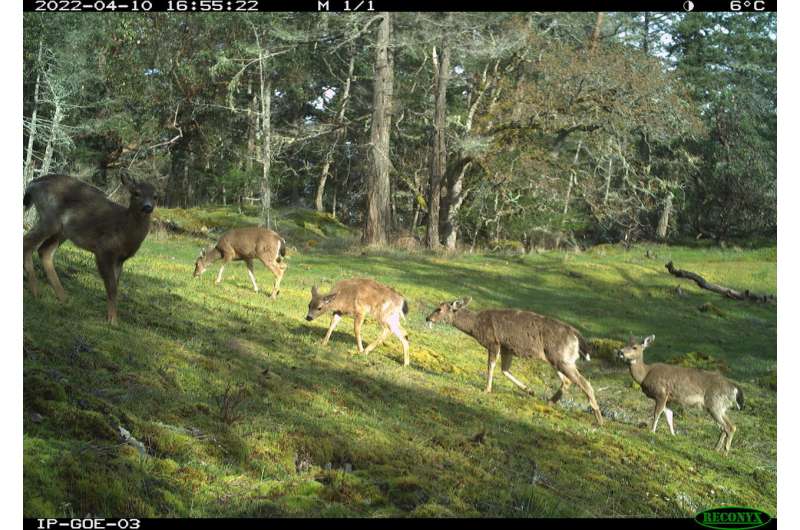
A recent study conducted by the University of British Columbia (UBC) reveals that Indigenous-led hunting is the most effective strategy for managing the overabundance of black-tailed deer on the Southern Gulf Islands in British Columbia. Published in the journal People and Nature on November 21, 2025, the research highlights the urgent need to address ecological degradation caused by unchecked deer populations.
Over the past century, black-tailed deer populations in the region have surged to levels estimated to be up to ten times higher than historical numbers. This dramatic increase is attributed to human-altered landscapes, restrictions on hunting, and the elimination of natural predators. As a result, deer have overgrazed vegetation, leading to severe consequences for local ecosystems, including the endangered Garry Oak meadow, which faces the threat of irreversible collapse.
Dr. Tara Martin, a leading researcher from UBC’s Faculty of Forestry, emphasizes the visual contrast between the islands’ perceived beauty and their ecological degradation. “For most people, these islands look beautiful and natural, but they are entirely degraded,” she states. “We’ve found hyperabundant deer are one of the major drivers of this change.”
Indigenous Knowledge as a Solution
The study underscores the importance of integrating Indigenous and Western knowledge systems in wildlife management. It identifies various strategies for deer management, including Indigenous-led hunting, improving predator viability, and increasing licensed hunting. Among these options, Indigenous-led hunting emerged as the most promising approach, significantly increasing the likelihood of enhancing both ecological and cultural benefits by nearly 60%.
Lead author and doctoral student Sofie McComb notes the complexity of developing effective deer management strategies that balance ecological health with the well-being of local communities. “This study offers a roadmap to help unpack complicated problems where many values and goals compete, often leading to decision paralysis and inaction,” she explains.
Research shows that while strategies like increased licensed hunting may be cost-effective from a Western perspective, they are less likely to yield long-term ecological benefits. In contrast, Indigenous-led hunting is projected to maximize project uptake and implementation goals by more than 50%.
Consequences of Inaction
Experts warn that maintaining the current status quo will not lead to improved ecosystem functions, and delaying action could have dire consequences. “If we don’t do something soon, the ecosystems will not be recoverable, because there will be nothing left,” McComb cautions. She adds that inaction is, in itself, a choice that exacerbates the suffering of both ecosystems and deer populations.
The study presents a comprehensive framework for communities globally facing similar challenges with hyperabundant herbivores. By valuing diverse knowledge systems and considering feasibility alongside ecological and cultural benefits, decision-makers can pursue effective, socially grounded recovery strategies.
“This work shows that restoring cultural sovereignty and ecosystem health can go hand in hand,” concludes Dr. Martin. The findings highlight the potential for collaborative approaches to address ecological crises while honoring Indigenous rights and knowledge.
For further reading, access the full study: Sofie McComb et al, “Decision analysis rooted in Indigenous and Western scientific knowledge identifies cost‐effective strategies for managing hyperabundant deer to restore keystone places,” published in People and Nature in 2025. DOI: 10.1002/pan3.70136.

Urgent Study Reveals Shark Teeth Insights to Combat Extinction

Church Members Rally Together After Thanksgiving Day Fire

Trump Promises to Release MRI Results from October Scan

U.S. Investors Boost Canadian Oil Firms Despite Falling Prices

Nick Jonas Unveils Solo Album Title and Release Date at Las Vegas Brunch

Researchers Call for Low-Alcohol Drink Label Changes for Pregnant Women

Community Aims for Record in World’s Largest Christmas Cookie Exchange

Mayor Appoints Alan Wong to District 4 Supervisor Position

Mayor Names Alan Wong as New District 4 Supervisor Amid Controversy

University of Hawaiʻi at Mānoa Joins $25.6M AI Initiative for Disaster Monitoring

IROS 2025 to Showcase Cutting-Edge Robotics Innovations in China

ALMA Discovers Companion Orbiting Red Giant Star π 1 Gruis

Stone Island’s Logo Worn by Extremists Sparks Brand Dilemma

Startup Liberate Bio Secures $31 Million for Next-Gen Therapies

Mary Morgan Jackson Crowned Little Miss National Peanut Festival 2025

Bravo Company Veterans Honored with Bronze Medals After 56 Years

Judge Considers Dismissal of Chelsea Housing Case Citing AI Flaws

Top Hyaluronic Acid Serums for Radiant Skin in 2025
-
Science4 weeks ago
University of Hawaiʻi at Mānoa Joins $25.6M AI Initiative for Disaster Monitoring
-
 Science2 months ago
IROS 2025 to Showcase Cutting-Edge Robotics Innovations in China
-
 Science2 weeks ago
ALMA Discovers Companion Orbiting Red Giant Star π 1 Gruis
-
 Lifestyle2 months ago
Stone Island’s Logo Worn by Extremists Sparks Brand Dilemma
-
 Health2 months ago
Startup Liberate Bio Secures $31 Million for Next-Gen Therapies
-
 Lifestyle2 months ago
Mary Morgan Jackson Crowned Little Miss National Peanut Festival 2025
-
 World2 months ago
Bravo Company Veterans Honored with Bronze Medals After 56 Years
-
 Politics2 months ago
Judge Considers Dismissal of Chelsea Housing Case Citing AI Flaws
-
 Health2 months ago
Top Hyaluronic Acid Serums for Radiant Skin in 2025
-

 Sports2 months ago
Yamamoto’s Mastery Leads Dodgers to 5-1 Victory in NLCS Game 2
-

 Science2 months ago
Arizona State University Transforms Programming Education Approach
-

 Business2 months ago
Truist Financial Increases Stake in Global X Variable Rate ETF