
Science
Scientist Explores Effects of Small Black Holes on Human Body

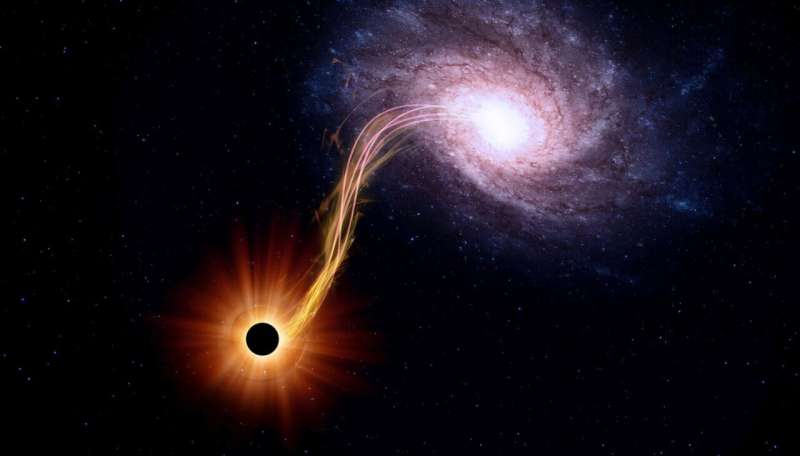
A recent study by physicist Robert Scherrer at Vanderbilt University investigates the potential effects of a primordial black hole passing through the human body. Published in the International Journal of Modern Physics D, the research aims to deepen understanding of dark matter, specifically focusing on the gravitational forces that a small black hole could exert on human tissues.
Primordial black holes, theorized to have formed shortly after the Big Bang, vary significantly in mass, ranging from less than that of a paperclip to over 100,000 times the mass of the sun. Some scientists believe these black holes could account for a portion of the universe’s dark matter. Scherrer’s study specifically examines the minimum size required for a primordial black hole to inflict serious harm upon a person.
Understanding the Impacts of Black Holes
In his research, Scherrer builds upon earlier work conducted with colleagues Jagjit Singh Sidhu and Glenn Starkman from Case Western Reserve University. Their previous study explored macroscopic dark matter (MACROs), which are larger particles that could potentially cause significant destruction to the human body. Notably, no fatalities attributed to MACROs have been reported, allowing researchers to set limits on their properties.
“I knew that I could carry over some of those calculations to the study of primordial black holes,” Scherrer stated. His interest was piqued by recent observations of gravitational waves from black hole mergers and the resurgence of public interest in black holes, which he links to a science fiction narrative he encountered in the 1970s.
Scherrer’s article highlights two primary gravitational phenomena caused by a primordial black hole: supersonic shock waves and tidal gravitational forces. When a black hole moves faster than sound, it generates shock waves that can cause severe tissue damage, similar to a bullet’s impact. Additionally, tidal gravitational forces create a differential pull that can stretch and tear human cells, particularly affecting sensitive brain cells.
Should We Be Concerned?
While the findings may assist scientists in determining the mass of primordial black holes as dark matter, Scherrer emphasizes that the likelihood of such an event is minimal. “Primordial black holes are theoretically possible, but they might not even exist,” he remarked. A sufficiently large black hole, comparable to the size of an asteroid, could indeed cause fatal injuries. However, a smaller black hole could pass through the human body without noticeable effects.
The density of primordial black holes is extremely low, making encounters virtually impossible. Scherrer’s research not only addresses the physical implications of black holes but also contributes to the ongoing exploration of dark matter’s properties.
For more details, refer to the study: Robert J. Scherrer, “Gravitational effects of a small primordial black hole passing through the human body,” International Journal of Modern Physics D (2025). DOI: 10.1142/s0218271825410032.

Urgent Study Reveals Shark Teeth Insights to Combat Extinction

Church Members Rally Together After Thanksgiving Day Fire

Trump Promises to Release MRI Results from October Scan

U.S. Investors Boost Canadian Oil Firms Despite Falling Prices

Nick Jonas Unveils Solo Album Title and Release Date at Las Vegas Brunch

Researchers Call for Low-Alcohol Drink Label Changes for Pregnant Women

Community Aims for Record in World’s Largest Christmas Cookie Exchange

Mayor Appoints Alan Wong to District 4 Supervisor Position

Mayor Names Alan Wong as New District 4 Supervisor Amid Controversy

University of Hawaiʻi at Mānoa Joins $25.6M AI Initiative for Disaster Monitoring

IROS 2025 to Showcase Cutting-Edge Robotics Innovations in China

ALMA Discovers Companion Orbiting Red Giant Star π 1 Gruis

Stone Island’s Logo Worn by Extremists Sparks Brand Dilemma

Startup Liberate Bio Secures $31 Million for Next-Gen Therapies

Bravo Company Veterans Honored with Bronze Medals After 56 Years

Mary Morgan Jackson Crowned Little Miss National Peanut Festival 2025

Judge Considers Dismissal of Chelsea Housing Case Citing AI Flaws

Top Hyaluronic Acid Serums for Radiant Skin in 2025
-
Science4 weeks ago
University of Hawaiʻi at Mānoa Joins $25.6M AI Initiative for Disaster Monitoring
-
 Science2 months ago
IROS 2025 to Showcase Cutting-Edge Robotics Innovations in China
-
 Science2 weeks ago
ALMA Discovers Companion Orbiting Red Giant Star π 1 Gruis
-
 Lifestyle2 months ago
Stone Island’s Logo Worn by Extremists Sparks Brand Dilemma
-
 Health2 months ago
Startup Liberate Bio Secures $31 Million for Next-Gen Therapies
-
 World2 months ago
Bravo Company Veterans Honored with Bronze Medals After 56 Years
-
 Lifestyle2 months ago
Mary Morgan Jackson Crowned Little Miss National Peanut Festival 2025
-
 Politics2 months ago
Judge Considers Dismissal of Chelsea Housing Case Citing AI Flaws
-
 Health2 months ago
Top Hyaluronic Acid Serums for Radiant Skin in 2025
-

 Science2 months ago
Arizona State University Transforms Programming Education Approach
-

 Sports2 months ago
Yamamoto’s Mastery Leads Dodgers to 5-1 Victory in NLCS Game 2
-

 Sports2 months ago
Mel Kiper Jr. Reveals Top 25 Prospects for 2026 NFL Draft