
Science
Astronomers Unravel Mysteries of Cosmic ‘Radio Relics’

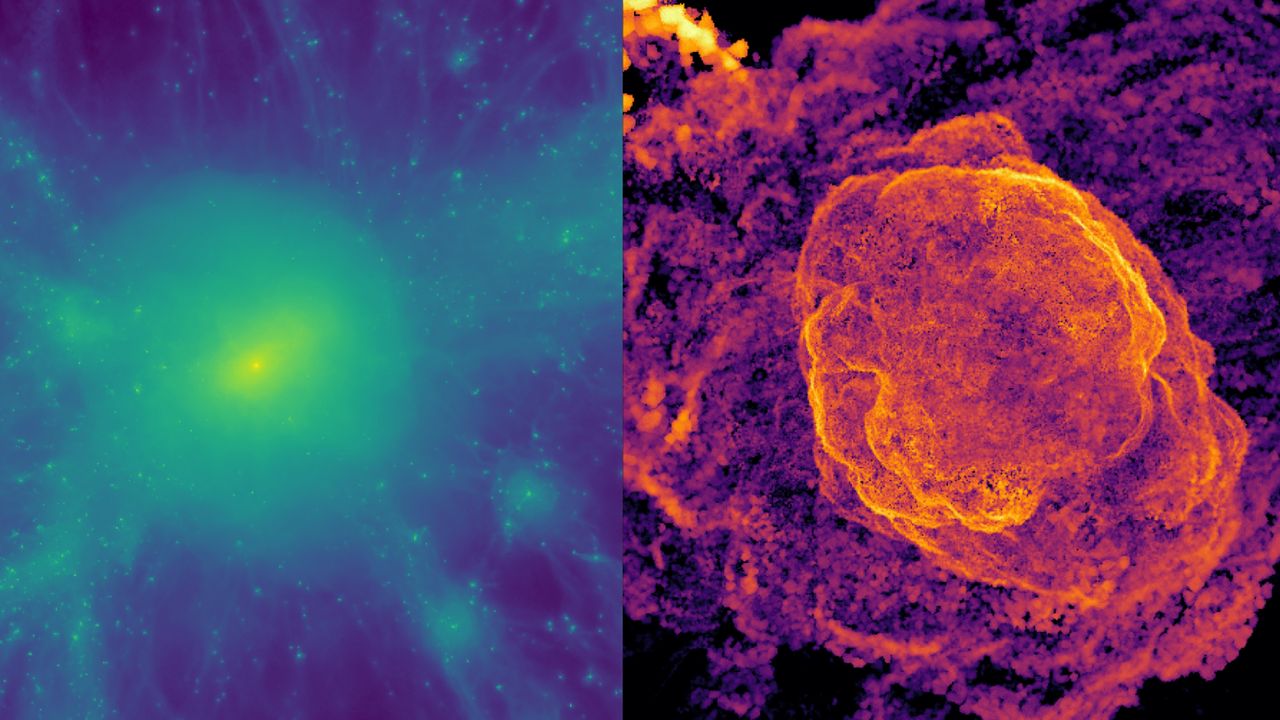
Astrophysicists have made significant strides in understanding the enigmatic structures known as “radio relics,” which are vast, ghostly arcs of radio emissions resulting from colossal cosmic events. These relics form when galaxy clusters collide, creating shock waves that accelerate electrons to nearly the speed of light. Despite extensive observations from prominent telescopes such as NASA’s Chandra X-ray Observatory and Europe’s XMM-Newton, the underlying physics governing these structures remained elusive.
Recent research led by the Leibniz Institute for Astrophysics Potsdam (AIP) in Germany provides new insights, using advanced simulations to elucidate the formation and evolution of radio relics. The findings, published on November 18, 2023, in the journal Astronomy & Astrophysics, offer a clearer understanding of these cosmic phenomena.
New Simulations Shed Light on Cosmic Phenomena
The study utilized high-resolution simulations to explore the merging of galaxy clusters over billions of years. The research team focused on a particularly energetic merger involving two clusters, one approximately 2.5 times the mass of the other. As they merged, the clusters generated massive shock waves, stretching nearly 7 million light-years across.
By employing a suite of cosmological simulations, the researchers were able to trace how these shock waves form and evolve. The initial simulations revealed that shock waves not only accelerate electrons but also interact with incoming cold gas from the cosmic web, leading to the formation of dense plasma sheets. This process amplifies the magnetic fields within the clusters, matching the unexpectedly high values observed in radio emissions.
Resolving Longstanding Discrepancies
The research team, including lead author Joseph Whittingham, a postdoctoral researcher at AIP, emphasized the importance of using a multi-scale approach. They crafted higher-resolution “shock-tube” simulations to isolate the physics of individual shock waves. This meticulous approach allowed them to model electron acceleration at the shock front, providing a plausible explanation for the intense radio emissions.
The study also addressed previous inconsistencies between radio and X-ray observations. While X-ray telescopes measure the average strength of shock waves, radio emissions predominantly arise from localized patches of the shock front, which are significantly stronger. This difference accounts for the long-noted discrepancies in the behavior of these cosmic structures.
“The whole mechanism generates turbulence, twisting and compressing the magnetic field up to the observed strengths, thereby solving the first puzzle,” said Christoph Pfrommer, co-author of the study. The research offers a comprehensive framework that reconciles the complex interplay of magnetic fields, shock waves, and particle acceleration, paving the way for future investigations into the nature of radio relics.
The team plans to continue their research to address remaining mysteries surrounding these cosmic phenomena. Their findings not only enhance our understanding of galaxy cluster dynamics but also contribute to the broader field of astrophysics, revealing the intricate processes that shape our universe.

Urgent Study Reveals Shark Teeth Insights to Combat Extinction

Church Members Rally Together After Thanksgiving Day Fire

Trump Promises to Release MRI Results from October Scan

U.S. Investors Boost Canadian Oil Firms Despite Falling Prices

Nick Jonas Unveils Solo Album Title and Release Date at Las Vegas Brunch

Researchers Call for Low-Alcohol Drink Label Changes for Pregnant Women

Community Aims for Record in World’s Largest Christmas Cookie Exchange

Mayor Appoints Alan Wong to District 4 Supervisor Position

Mayor Names Alan Wong as New District 4 Supervisor Amid Controversy

University of Hawaiʻi at Mānoa Joins $25.6M AI Initiative for Disaster Monitoring

IROS 2025 to Showcase Cutting-Edge Robotics Innovations in China

ALMA Discovers Companion Orbiting Red Giant Star π 1 Gruis

Stone Island’s Logo Worn by Extremists Sparks Brand Dilemma

Startup Liberate Bio Secures $31 Million for Next-Gen Therapies

Bravo Company Veterans Honored with Bronze Medals After 56 Years

Mary Morgan Jackson Crowned Little Miss National Peanut Festival 2025

Judge Considers Dismissal of Chelsea Housing Case Citing AI Flaws

Top Hyaluronic Acid Serums for Radiant Skin in 2025
-
Science4 weeks ago
University of Hawaiʻi at Mānoa Joins $25.6M AI Initiative for Disaster Monitoring
-
 Science2 months ago
IROS 2025 to Showcase Cutting-Edge Robotics Innovations in China
-
 Science2 weeks ago
ALMA Discovers Companion Orbiting Red Giant Star π 1 Gruis
-
 Lifestyle2 months ago
Stone Island’s Logo Worn by Extremists Sparks Brand Dilemma
-
 Health2 months ago
Startup Liberate Bio Secures $31 Million for Next-Gen Therapies
-
 World2 months ago
Bravo Company Veterans Honored with Bronze Medals After 56 Years
-
 Lifestyle2 months ago
Mary Morgan Jackson Crowned Little Miss National Peanut Festival 2025
-
 Politics2 months ago
Judge Considers Dismissal of Chelsea Housing Case Citing AI Flaws
-
 Health2 months ago
Top Hyaluronic Acid Serums for Radiant Skin in 2025
-

 Sports2 months ago
Yamamoto’s Mastery Leads Dodgers to 5-1 Victory in NLCS Game 2
-

 Science2 months ago
Arizona State University Transforms Programming Education Approach
-

 Sports2 months ago
Mel Kiper Jr. Reveals Top 25 Prospects for 2026 NFL Draft