
Science
Doctoral Student Trivanni Yadav Advances Battery Research at UTulsa

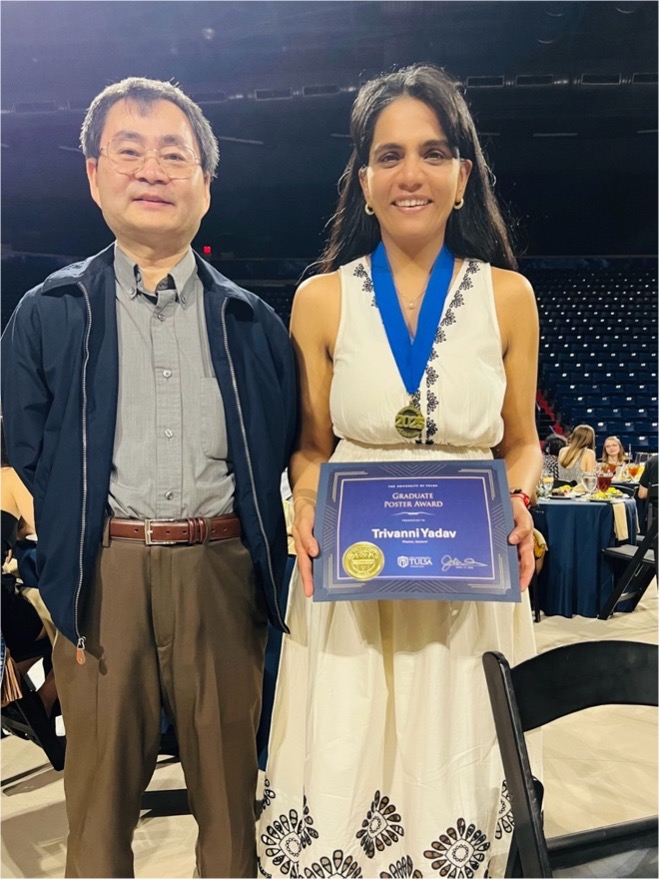
Trivanni Yadav, a doctoral candidate in physics at the University of Tulsa, is making significant strides in battery research. After earning her master’s degree at Central Michigan University, she discovered the University of Tulsa’s robust Department of Physics & Engineering Physics, which offered diverse research opportunities. Yadav applied for a graduate assistantship and received financial support, allowing her to pursue her academic goals.
Beyond academic achievements, Yadav has published peer-reviewed papers and presented her research at notable conferences. In September 2025, she shared her findings in Washington, D.C., and is set to present again in Denver in 2026. An international student from Delhi, India, Yadav has found a supportive community in Tulsa. She currently serves as president of the Physics Graduate Student Association and represents the university as one of 118 American Physical Society (APS) Student Ambassadors. In February 2026, she will attend the exclusive APS Annual Leadership Meeting on Capitol Hill, joining leaders from the physics field.
Yadav expressed her gratitude for the welcoming environment at UTulsa. “Living in this community has taught me so much and given me a deeper sense of humility and gratitude,” she stated. She appreciates the university’s architecture and surroundings, which enhance her daily life and learning experience.
Innovative Battery Research with Real-World Applications
Her research focuses on improving battery technology, aiming for safer, cleaner, and smarter solutions. Traditional lithium-ion batteries use liquid electrolytes that pose safety risks, including flammability and leakage. Yadav is investigating an alternative known as Lithium Lanthanum Zirconium Oxide (LLZO), a solid electrolyte that is non-flammable and stable even under extreme conditions. It effectively conducts lithium ions, which is vital for battery performance.
“Using first-principles quantum simulations, I investigate how atomic-scale defects within LLZO influence the movement of lithium ions,” Yadav explained. She aims to uncover how specific defects can act as “express lanes” for ion mobility, crucial for enhancing battery efficiency. This research has implications for space exploration, where radiation can create defects affecting lithium-ion movement, potentially influencing battery performance in extreme environments.
Yadav’s work has garnered recognition, leading to several awards. She has published two peer-reviewed papers in the *Journal of Applied Physics* and *Ceramics International*, with another manuscript currently in final edits. Her outstanding efforts earned her the Distinguished Graduate Research Poster Award, where she ranked first among 70 participants from various disciplines at UTulsa.
In addition, she received the prestigious Iris M. Ovshinsky Travel Award from the American Physical Society’s Division of Materials Physics, which supports only 21 students globally to attend the APS Global Physics Summit 2025.
Acknowledgments and Community Support
Yadav credits her success to her mentor, Sanwu Wang, Ph.D., the Ruth and William Kistler Jr. Endowed Chair in Physics & Engineering Physics. She also appreciates the guidance of Scott Holmstrom, Ph.D., dean of the Graduate School and professor of physics & engineering physics. Their mentorship has been instrumental in shaping her both academically and personally.
In addition to her research, Yadav enjoys teaching. She has taught General Physics I for several years at UTulsa and developed online supplemental materials accessed by over 300 undergraduate students. These resources include videos, examples, and self-assessment quizzes, contributing to the educational experience of her peers.
“The entire Physics Department feels like a second family to me,” Yadav said. “They are always supportive, encouraging, and ready to help whenever needed.”
For those inspired by her journey, Yadav emphasizes the importance of perseverance and communication in research. “You have to show up and be vocal about your work, because doing a doctorate isn’t just about research and papers; it’s also about learning to communicate your science,” she advised. “The journey can feel intimidating at first, but don’t let that stop you. Remind yourself that you’re not here by accident. You’ve earned your place. Stay strong and have faith in yourself.”

Tottenville Falls Short in PSAL 4A Title Bid Against Erasmus Hall

Urgent Study Reveals Shark Teeth Insights to Combat Extinction

Church Members Rally Together After Thanksgiving Day Fire

Trump Promises to Release MRI Results from October Scan

U.S. Investors Boost Canadian Oil Firms Despite Falling Prices

Nick Jonas Unveils Solo Album Title and Release Date at Las Vegas Brunch

Researchers Call for Low-Alcohol Drink Label Changes for Pregnant Women

Community Aims for Record in World’s Largest Christmas Cookie Exchange

Mayor Appoints Alan Wong to District 4 Supervisor Position

University of Hawaiʻi at Mānoa Joins $25.6M AI Initiative for Disaster Monitoring

IROS 2025 to Showcase Cutting-Edge Robotics Innovations in China

ALMA Discovers Companion Orbiting Red Giant Star π 1 Gruis

Stone Island’s Logo Worn by Extremists Sparks Brand Dilemma

Startup Liberate Bio Secures $31 Million for Next-Gen Therapies

Mary Morgan Jackson Crowned Little Miss National Peanut Festival 2025

Bravo Company Veterans Honored with Bronze Medals After 56 Years

Judge Considers Dismissal of Chelsea Housing Case Citing AI Flaws

Top Hyaluronic Acid Serums for Radiant Skin in 2025
-
Science4 weeks ago
University of Hawaiʻi at Mānoa Joins $25.6M AI Initiative for Disaster Monitoring
-
 Science2 months ago
IROS 2025 to Showcase Cutting-Edge Robotics Innovations in China
-
 Science2 weeks ago
ALMA Discovers Companion Orbiting Red Giant Star π 1 Gruis
-
 Lifestyle2 months ago
Stone Island’s Logo Worn by Extremists Sparks Brand Dilemma
-
 Health2 months ago
Startup Liberate Bio Secures $31 Million for Next-Gen Therapies
-
 Lifestyle2 months ago
Mary Morgan Jackson Crowned Little Miss National Peanut Festival 2025
-
 World2 months ago
Bravo Company Veterans Honored with Bronze Medals After 56 Years
-
 Politics2 months ago
Judge Considers Dismissal of Chelsea Housing Case Citing AI Flaws
-
 Health2 months ago
Top Hyaluronic Acid Serums for Radiant Skin in 2025
-

 Sports2 months ago
Yamamoto’s Mastery Leads Dodgers to 5-1 Victory in NLCS Game 2
-

 Science2 months ago
Arizona State University Transforms Programming Education Approach
-

 Business2 months ago
Truist Financial Increases Stake in Global X Variable Rate ETF