
Sports
Calls to Change University of North Dakota’s “Fighting Sioux” Nickname

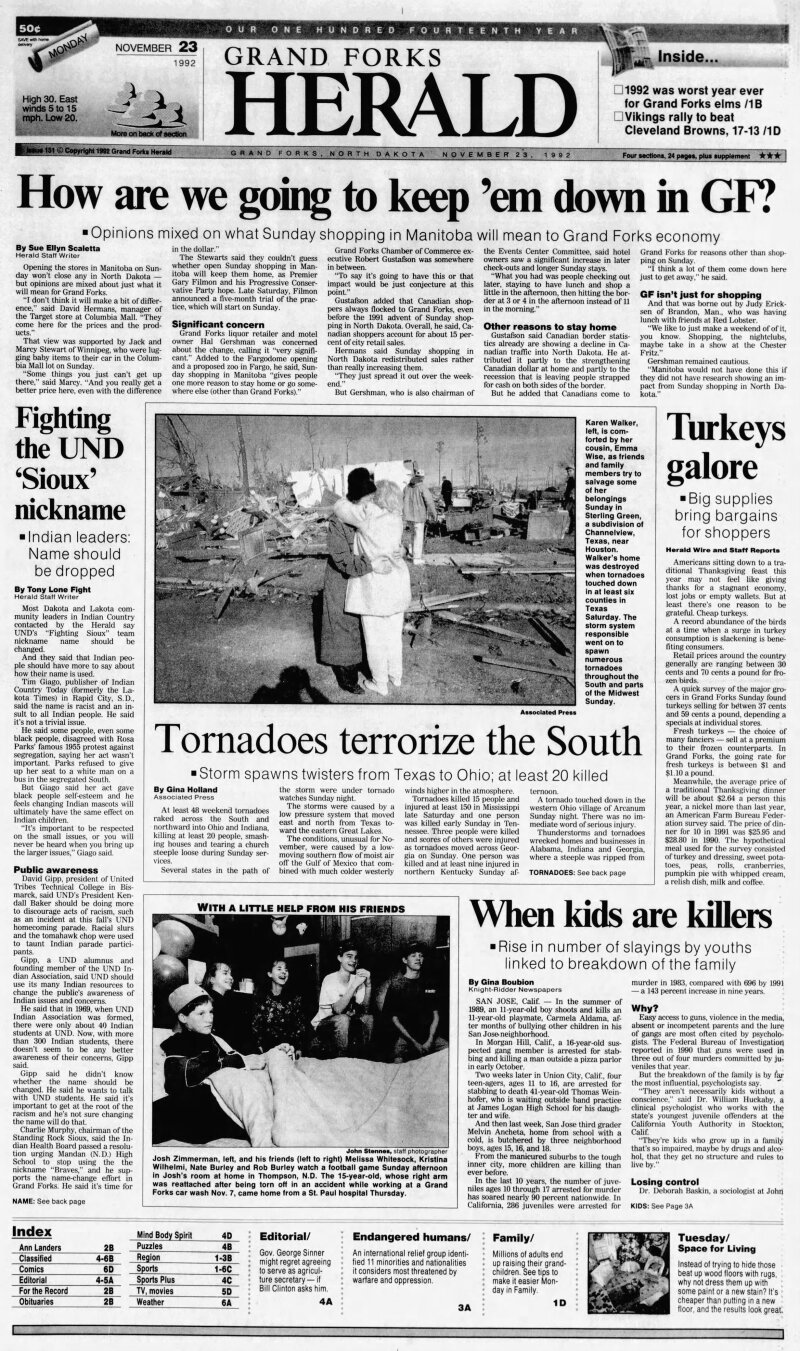
On November 23, 1992, the Grand Forks Herald reported significant calls for the University of North Dakota (UND) to reconsider its controversial “Fighting Sioux” nickname. The push comes from various Dakota and Lakota community leaders who argue that the moniker perpetuates racism and harms Indigenous identity.
The sentiment among many Native American leaders is clear: the use of the Fighting Sioux name should be reassessed, with greater involvement from Indigenous voices in the discussion. Tim Giago, publisher of Indian Country Today, emphasized the damaging implications of the nickname, calling it an insult to all Native Americans. He argued that changing such names could provide a sense of self-worth to Indigenous children, similar to how Rosa Parks’ actions in 1955 empowered African Americans.
Public awareness has become a focal point in this ongoing debate. David Gipp, president of United Tribes Technical College in Bismarck, criticized UND President Kendall Baker for not doing enough to combat racism. He referenced a troubling incident during UND’s homecoming parade, where racial slurs and the tomahawk chop were directed at Native participants. Gipp, an alumnus of UND, noted that while the number of Indigenous students has increased from around 40 in 1969 to over 300 today, awareness of their issues remains insufficient.
Gipp expressed uncertainty about whether changing the nickname alone would address the deeper roots of racism. He is keen to engage in discussions with current students to understand their perspectives fully.
Support for a name change is echoed by other Indigenous leaders. Charlie Murphy, chairman of the Standing Rock Sioux, highlighted a resolution passed by the Indian Health Board advocating for Mandan High School to discontinue its use of the “Braves” nickname. He believes the time has come for UND students to take a stand and advocate for change. “The name bothers a whole lot of Indian people,” Murphy stated.
In contrast, Randy Cavanaugh, vocational education director at Little Hoop Community College, offered a nuanced perspective. While he acknowledged that the Fighting Sioux name could reflect the ongoing struggles of Indigenous people, he also recounted instances of racism associated with it, such as derogatory slogans directed at Sioux people during his time at North Dakota State University. Cavanaugh ultimately supports changing the nickname.
The debate extends to political leaders as well. Ben Nighthorse Campbell, the only Native American U.S. senator at that time, voiced his opposition to the use of any Indian nicknames or slurs, including “Chiefs” and “Redskins.” He argued that such terms and caricatures are harmful, although he acknowledged that names like the Florida State Seminoles are acceptable if the tribe consents. Campbell asserted that the decision regarding the Fighting Sioux nickname should be made by the Sioux Nation itself.
Opinions vary within the community regarding the nickname’s significance. Peter Belgarde, chairman of the Devils Lake Sioux, expressed mixed feelings. He noted that while the term “Sioux” is not an official tribal designation, it represents how the outside world identifies his people. He believes that the Dakota and Lakota nations should play a central role in any discussions about the nickname’s future.
This conversation surrounding the Fighting Sioux nickname underscores a larger dialogue about representation and respect for Indigenous identities. As the University of North Dakota navigates this issue, the voices of those directly impacted will be vital in shaping a more inclusive future.

Robinhood Stock Surges 2.5% Today Amid Tech Market Recovery

Philadelphia’s Earth Month Kicks Off with Free Events in Parks

GSK’s Inhaler Decision Sparks Health Concerns for Children

Bradford’s Fish Fry Fridays Offer Community Spirit and Flavor

Speculation Rises on Shutdowns During Trump’s Potential Presidency

Samsung Galaxy Watch 9 to Feature Larger Battery, Report Reveals

Inventors Find New Purpose Through Unconventional Paths

UConn Huskies Aim for Back-to-Back Titles in 2026 NCAA Tournament

U.S. Mine Countermeasure Ships Dock in Malaysia for Logistics Stop

University of Hawaiʻi at Mānoa Joins $25.6M AI Initiative for Disaster Monitoring

$2.2 Million Boost for Cancer Research and Training in Hawaiʻi

ALMA Discovers Companion Orbiting Red Giant Star π 1 Gruis

Sacituzumab Govitecan Shows Promise for HR+/HER2− Breast Cancer

币安人生 Sees $15.92 Million in Trading Volume Amid Market Fluctuations

New Gel Offers Hope for Regrowing Tooth Enamel in Dentistry

CAVA Group Shares Surge 5.1% Amid Mixed Analyst Ratings

Christian Bale in Talks to Join Leonardo DiCaprio in Heat 2

Supreme Court to Review Birthright Citizenship for Children of Immigrants
-
Science9 months ago
University of Hawaiʻi at Mānoa Joins $25.6M AI Initiative for Disaster Monitoring
-
 Health8 months ago
$2.2 Million Boost for Cancer Research and Training in Hawaiʻi
-
 Science9 months ago
ALMA Discovers Companion Orbiting Red Giant Star π 1 Gruis
-
 Health7 months ago
Sacituzumab Govitecan Shows Promise for HR+/HER2− Breast Cancer
-
Politics5 months ago
币安人生 Sees $15.92 Million in Trading Volume Amid Market Fluctuations
-
 Health9 months ago
New Gel Offers Hope for Regrowing Tooth Enamel in Dentistry
-
 Business8 months ago
CAVA Group Shares Surge 5.1% Amid Mixed Analyst Ratings
-
 Entertainment9 months ago
Christian Bale in Talks to Join Leonardo DiCaprio in Heat 2
-
 Politics8 months ago
Supreme Court to Review Birthright Citizenship for Children of Immigrants
-

 Lifestyle9 months ago
Art Deco and Traditional Designs Set to Transform Homes in 2026
-

 Lifestyle8 months ago
Fernando Mendoza Secures Maxwell and O’Brien Awards Ahead of Heisman
-

 World8 months ago
Swiss Residents Reject 50% Inheritance Tax on Wealthy