
Science
Charles Darwin’s Personal Address Book Revealed for First Time

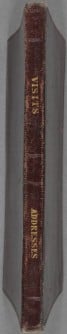
The National University of Singapore has unveiled a significant addition to the history of science: the personal Address Book of Charles Darwin. This newly published resource provides an intimate look into the life and work of the renowned naturalist, offering a unique perspective that extends beyond his well-documented scientific contributions.
The Address Book, a small leather notebook spanning just 48 pages, contains around 500 entries that reveal a rich tapestry of Darwin’s personal connections, interests, and daily life. Begun by his wife, Emma Darwin, shortly after their marriage in January 1839, the notebook continued to evolve as Darwin added entries while living in London and later in the village of Down, where the family moved in 1842. It remained in use throughout his life, providing a snapshot of his extensive social network.
Insights into Darwin’s Personal and Professional Life
Among the most notable aspects of the Address Book is the inclusion of numerous contacts and references not found in the extensive Darwin Correspondence Project, which produced 30 volumes of letters exchanged by Darwin. While that project documented approximately 15,000 surviving letters, it overlooked countless others that once existed. The Address Book fills in some of these gaps, shedding light on relationships with breeders, tradesmen, and even influential figures like the father of Oscar Wilde and social reformer Octavia Hill.
The notebook doesn’t merely contain names and addresses; it offers insights into Darwin’s daily life and interests. For instance, it includes references to articles from the Gardeners’ Chronicle, recipes for rat poison, and instructions for cleaning animal skeletons. Notable entries also detail purchases such as scientific labels, clay for gardening, and even plans for a fireworks display in his village.
One fascinating find is the entry for Dixey & Son, an optician that supplied eyewear to notable figures including Queen Victoria. Interestingly, the company’s records were destroyed during World War II, leaving them unaware of Darwin’s patronage. The Address Book also contains references to Darwin’s copyist, Ebenezer Norman, who assisted in drafting key works, including the preliminary sketch of Darwin’s theory of evolution sent to American botanist Asa Gray in 1857.
Connections to Alfred Russel Wallace and More
A particularly striking entry lists the address for Alfred Russel Wallace‘s shipping agent in Singapore, underscoring a significant link between the two naturalists. Wallace, who independently developed a theory of evolution by natural selection, used this address as a base during his years of exploration in Southeast Asia. This connection is pivotal, as Darwin and Wallace’s ideas were presented together to the scientific community in 1858, marking the first public announcement of their groundbreaking theory.
The Address Book has been preserved within the family after Darwin’s death, with most of his papers and manuscripts eventually donated to Cambridge University Library in 1942. In 1948, it was deemed more suitable for exhibition at Down House, Darwin’s former home, where it remains today.
Dr. John van Wyhe, a historian of science at the Department of Biological Sciences at NUS, expressed excitement over the publication of this Address Book. He noted, “It’s incredible that this little treasure-trove of details by Darwin has remained unpublished until now. It offers fascinating new insights into his life and the way he worked.”
The Darwin Online project, which has been active since 2005, aims to transcribe and edit nearly the entirety of the Darwin Archive, along with all of Darwin’s publications. The complete library was launched online to international acclaim in 2024. The Address Book is now accessible to the public online, marking a significant milestone in the study of Darwin’s life and work.

Church Members Rally Together After Thanksgiving Day Fire

Trump Promises to Release MRI Results from October Scan

U.S. Investors Boost Canadian Oil Firms Despite Falling Prices

Nick Jonas Unveils Solo Album Title and Release Date at Las Vegas Brunch

Researchers Call for Low-Alcohol Drink Label Changes for Pregnant Women

Community Aims for Record in World’s Largest Christmas Cookie Exchange

Mayor Appoints Alan Wong to District 4 Supervisor Position

Mayor Names Alan Wong as New District 4 Supervisor Amid Controversy

South Korea Takes Urgent Action to Stabilize FX Market

University of Hawaiʻi at Mānoa Joins $25.6M AI Initiative for Disaster Monitoring

IROS 2025 to Showcase Cutting-Edge Robotics Innovations in China

ALMA Discovers Companion Orbiting Red Giant Star π 1 Gruis

Stone Island’s Logo Worn by Extremists Sparks Brand Dilemma

Startup Liberate Bio Secures $31 Million for Next-Gen Therapies

Bravo Company Veterans Honored with Bronze Medals After 56 Years

Mary Morgan Jackson Crowned Little Miss National Peanut Festival 2025

Judge Considers Dismissal of Chelsea Housing Case Citing AI Flaws

Top Hyaluronic Acid Serums for Radiant Skin in 2025
-
Science4 weeks ago
University of Hawaiʻi at Mānoa Joins $25.6M AI Initiative for Disaster Monitoring
-
 Science2 months ago
IROS 2025 to Showcase Cutting-Edge Robotics Innovations in China
-
 Science2 weeks ago
ALMA Discovers Companion Orbiting Red Giant Star π 1 Gruis
-
 Lifestyle2 months ago
Stone Island’s Logo Worn by Extremists Sparks Brand Dilemma
-
 Health2 months ago
Startup Liberate Bio Secures $31 Million for Next-Gen Therapies
-
 World2 months ago
Bravo Company Veterans Honored with Bronze Medals After 56 Years
-
 Lifestyle2 months ago
Mary Morgan Jackson Crowned Little Miss National Peanut Festival 2025
-
 Politics2 months ago
Judge Considers Dismissal of Chelsea Housing Case Citing AI Flaws
-
 Health2 months ago
Top Hyaluronic Acid Serums for Radiant Skin in 2025
-
 Sports2 months ago
Yamamoto’s Mastery Leads Dodgers to 5-1 Victory in NLCS Game 2
-

 Science2 months ago
Arizona State University Transforms Programming Education Approach
-

 Sports2 months ago
Mel Kiper Jr. Reveals Top 25 Prospects for 2026 NFL Draft