
Science
University of Konstanz Develops Innovative Method to Remove Liquids

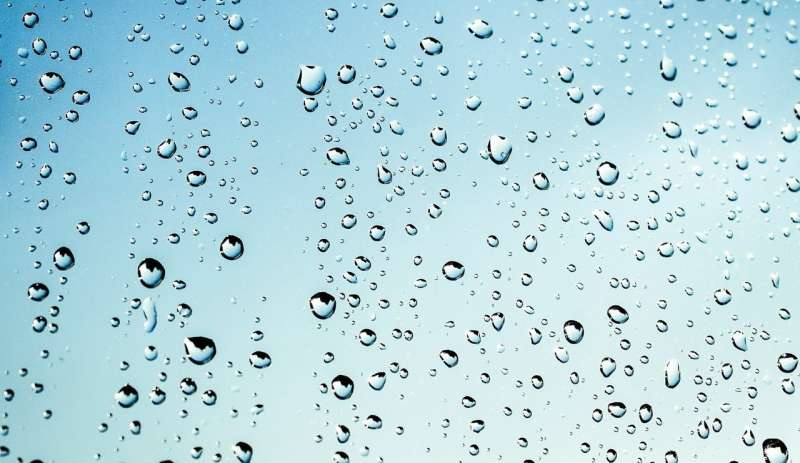
Researchers at the University of Konstanz have unveiled a groundbreaking method for collecting and removing liquids from delicate microstructures without direct contact. This innovative technique employs vapor condensation to create surface currents that efficiently transport droplets off surfaces. The findings, published on January 13, 2026, in the journal Proceedings of the National Academy of Sciences, could significantly impact industries relying on microfabrication, such as electronics and biotechnology.
Understanding the Challenges of Microfabrication
Many technologies, particularly those in the realm of electronics, depend on microscopic components like microchips. The manufacturing process for these components typically exposes them to various liquids, which must be entirely removed to ensure functionality and reliability. Stefan Karpitschka, who leads the research team, emphasizes the challenges faced during this process. “Manufacturing microchips involves complex steps that often require wet processing. For example, silicon wafers must undergo etching in acid baths and then be dried thoroughly,” he explains.
Conventional methods of removing liquids, such as wiping or boiling, are problematic. Wiping can cause damage to sensitive structures, while boiling may leave behind contaminants. Karpitschka’s team sought a more refined approach that could protect the integrity of these fragile materials.
Harnessing Surface Tension for Liquid Removal
The research team developed a contact-free method that utilizes the Marangoni force, a phenomenon that arises from differences in surface tension. Karpitschka describes it as a “tug-of-war”: when adjacent areas of a surface exhibit varying tension levels, the stronger side pushes the weaker one, effectively moving liquids along the surface.
To create the necessary difference in surface tension, the team introduced additional liquid during their experiments. By evaporating alcohol, which has a lower surface tension than water, they generated vapor that condenses on the existing liquid. This process creates the desired tension difference, allowing liquids to be moved across the surface. “We guide the resulting currents to gather tiny amounts of liquid into larger droplets,” Karpitschka explains. This method mirrors how raindrops coalesce on a window, but with precise control over the droplets’ movement.
The implications of this research extend across various fields that utilize micropatterned surfaces. The ability to dry small structures without damage enhances the production efficiency of micro- and nanomaterials, potentially leading to advancements in numerous applications, from electronics to pharmaceuticals.
The study offers a promising solution to a persistent challenge in the manufacture of microcomponents, highlighting the importance of continued innovation in material science and engineering. With further development, this technique could streamline processes in industries where precision is paramount.
For those interested in the technical details, the study is documented in the article titled “Vapor-mediated wetting and imbibition control on micropatterned surfaces.” This research not only underscores the University of Konstanz’s commitment to scientific advancement but also marks a significant step forward in the quest for more efficient manufacturing processes.

Robinhood Stock Surges 2.5% Today Amid Tech Market Recovery

Philadelphia’s Earth Month Kicks Off with Free Events in Parks

GSK’s Inhaler Decision Sparks Health Concerns for Children

Bradford’s Fish Fry Fridays Offer Community Spirit and Flavor

Speculation Rises on Shutdowns During Trump’s Potential Presidency

Samsung Galaxy Watch 9 to Feature Larger Battery, Report Reveals

Inventors Find New Purpose Through Unconventional Paths

UConn Huskies Aim for Back-to-Back Titles in 2026 NCAA Tournament

U.S. Mine Countermeasure Ships Dock in Malaysia for Logistics Stop

University of Hawaiʻi at Mānoa Joins $25.6M AI Initiative for Disaster Monitoring

$2.2 Million Boost for Cancer Research and Training in Hawaiʻi

ALMA Discovers Companion Orbiting Red Giant Star π 1 Gruis

Sacituzumab Govitecan Shows Promise for HR+/HER2− Breast Cancer

币安人生 Sees $15.92 Million in Trading Volume Amid Market Fluctuations

New Gel Offers Hope for Regrowing Tooth Enamel in Dentistry

CAVA Group Shares Surge 5.1% Amid Mixed Analyst Ratings

Christian Bale in Talks to Join Leonardo DiCaprio in Heat 2

Supreme Court to Review Birthright Citizenship for Children of Immigrants
-
Science9 months ago
University of Hawaiʻi at Mānoa Joins $25.6M AI Initiative for Disaster Monitoring
-
 Health7 months ago
$2.2 Million Boost for Cancer Research and Training in Hawaiʻi
-
 Science8 months ago
ALMA Discovers Companion Orbiting Red Giant Star π 1 Gruis
-
 Health7 months ago
Sacituzumab Govitecan Shows Promise for HR+/HER2− Breast Cancer
-
Politics5 months ago
币安人生 Sees $15.92 Million in Trading Volume Amid Market Fluctuations
-
 Health9 months ago
New Gel Offers Hope for Regrowing Tooth Enamel in Dentistry
-
 Business7 months ago
CAVA Group Shares Surge 5.1% Amid Mixed Analyst Ratings
-
 Entertainment8 months ago
Christian Bale in Talks to Join Leonardo DiCaprio in Heat 2
-
 Politics7 months ago
Supreme Court to Review Birthright Citizenship for Children of Immigrants
-

 Lifestyle8 months ago
Art Deco and Traditional Designs Set to Transform Homes in 2026
-

 Lifestyle7 months ago
Fernando Mendoza Secures Maxwell and O’Brien Awards Ahead of Heisman
-

 World8 months ago
Swiss Residents Reject 50% Inheritance Tax on Wealthy