
World
Decline in Canadian Traffic Hits Grand Forks Businesses Hard

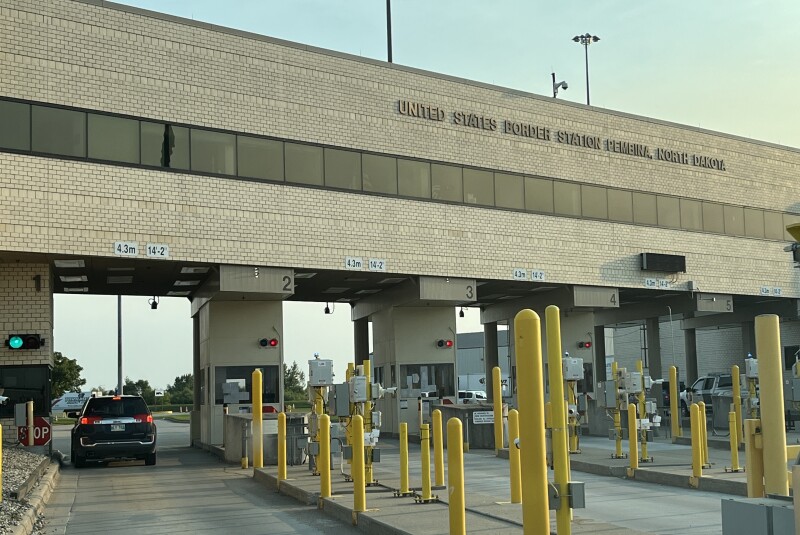
Traffic from Canada at the Pembina border crossing has sharply declined, leaving businesses in Grand Forks, North Dakota, grappling with the consequences. According to local reports, the decrease in visitors has been significant over the past year, raising concerns about the economic impacts on the area, which has traditionally relied on Canadian shoppers.
Notable Decrease in Border Crossings
Statistics reveal that 2025 was a challenging year for the Pembina port of entry, which experienced a drop of 202,077 passengers compared to 2024. The total number of border crossings fell to 376,905, marking the lowest figure since 2022. This trend has not gone unnoticed by local business owners, particularly those who have historically benefited from Canadian traffic.
Greg Rixen, general manager of Happy Harry’s in Grand Forks, has observed a marked reduction in the number of Manitoba license plates in his parking lot. “You can definitely see and feel the difference,” he noted. “In previous years, it wouldn’t be odd to see one out of three cars with Manitoba plates, but now it might be one out of ten.”
January 2026 continued this downward trend, with only 8,904 border crossings recorded at Pembina. This figure starkly contrasts with the more than 12,000 crossings reported in January of both 2025 and 2024.
Economic Impact on Local Businesses
The decline in Canadian visitors has had tangible effects on local businesses. Rixen estimates that approximately 3-5% of Happy Harry’s business comes from Canadian customers. He noted a significant dip in sales from their popular penny wine sale, attributing this to the reduced number of Canadian visitors. “We’ve certainly seen a lot less in the last 13 months,” said Dustin Mitzel, CEO of Happy Harry’s.
Barry Wilfahrt, president of the Grand Forks Chamber of Commerce, has been tracking Canadian traffic trends for years. He remarked on the noticeable decline since the early years of the decade. “If you go back to 2011, 2012, 2013, and 2014, that was our real boom time in terms of Canadian traffic,” he said, referencing peaks during those years when over 130,000 passengers crossed the border each August.
The decline can, in part, be attributed to fluctuations in the value of the Canadian dollar. Currently, the Canadian dollar is valued at approximately $1.30 against the U.S. dollar, meaning that for Canadians, their currency is worth only about 70 cents when shopping in the United States. Wilfahrt emphasized that when the exchange rate falls below 85 cents, it significantly impacts traffic from Manitoba.
The repercussions of this decline extend beyond border states. Cities like Las Vegas have reported a 30% drop in Canadian visitors, and the housing market in Mesa, Arizona, has also suffered due to Canadians selling properties and relocating.
Future Outlook and Potential Solutions
According to a survey by Nanos Research, 43% of Canadians indicated they are less likely to visit the United States in the near future, leaving the next steps for cities like Grand Forks uncertain. Some local businesses are exploring the option of accepting the Canadian dollar at par to attract more visitors. The Las Vegas Review-Journal recently reported that over 15,000 Canadians visited certain casinos shortly after implementing an “at par” promotion.
As for marketing efforts, Mitzel believes that pursuing Canadian customers may not be beneficial at this time. “We’re in a wait-and-see period for now,” he stated. Wilfahrt acknowledged the increased value of the Canadian dollar as a contributing factor but expressed hope for a revival in Canadian trade, which would benefit local businesses, restaurants, and retailers.
The upcoming 2026 North Dakota Travel Industry Conference, set for April at the Grand Forks Alerus Center, will address topics such as Canadian traffic among state leaders in the tourism sector. Rixen remains cautiously optimistic about the future, noting a slight uptick in Canadian visitors since the recent lifting of reciprocal tariffs. “We’ve seen a few more Canadian visitors in the parking lot,” he remarked. “I’m hoping that the February numbers from the border crossings show that the decline is at least flat, if not recovered a little.”

Robinhood Stock Surges 2.5% Today Amid Tech Market Recovery

Philadelphia’s Earth Month Kicks Off with Free Events in Parks

GSK’s Inhaler Decision Sparks Health Concerns for Children

Bradford’s Fish Fry Fridays Offer Community Spirit and Flavor

Speculation Rises on Shutdowns During Trump’s Potential Presidency

Samsung Galaxy Watch 9 to Feature Larger Battery, Report Reveals

Inventors Find New Purpose Through Unconventional Paths

UConn Huskies Aim for Back-to-Back Titles in 2026 NCAA Tournament

U.S. Mine Countermeasure Ships Dock in Malaysia for Logistics Stop

University of Hawaiʻi at Mānoa Joins $25.6M AI Initiative for Disaster Monitoring

$2.2 Million Boost for Cancer Research and Training in Hawaiʻi

ALMA Discovers Companion Orbiting Red Giant Star π 1 Gruis

Sacituzumab Govitecan Shows Promise for HR+/HER2− Breast Cancer

币安人生 Sees $15.92 Million in Trading Volume Amid Market Fluctuations

New Gel Offers Hope for Regrowing Tooth Enamel in Dentistry

CAVA Group Shares Surge 5.1% Amid Mixed Analyst Ratings

Christian Bale in Talks to Join Leonardo DiCaprio in Heat 2

Supreme Court to Review Birthright Citizenship for Children of Immigrants
-
Science9 months ago
University of Hawaiʻi at Mānoa Joins $25.6M AI Initiative for Disaster Monitoring
-
 Health7 months ago
$2.2 Million Boost for Cancer Research and Training in Hawaiʻi
-
 Science9 months ago
ALMA Discovers Companion Orbiting Red Giant Star π 1 Gruis
-
 Health7 months ago
Sacituzumab Govitecan Shows Promise for HR+/HER2− Breast Cancer
-
Politics5 months ago
币安人生 Sees $15.92 Million in Trading Volume Amid Market Fluctuations
-
 Health9 months ago
New Gel Offers Hope for Regrowing Tooth Enamel in Dentistry
-
 Business8 months ago
CAVA Group Shares Surge 5.1% Amid Mixed Analyst Ratings
-
 Entertainment8 months ago
Christian Bale in Talks to Join Leonardo DiCaprio in Heat 2
-
 Politics8 months ago
Supreme Court to Review Birthright Citizenship for Children of Immigrants
-

 Lifestyle8 months ago
Art Deco and Traditional Designs Set to Transform Homes in 2026
-

 Lifestyle8 months ago
Fernando Mendoza Secures Maxwell and O’Brien Awards Ahead of Heisman
-

 World8 months ago
Swiss Residents Reject 50% Inheritance Tax on Wealthy