
Science
Study Reveals Moons of Rogue Planets May Host Life for Billions of Years

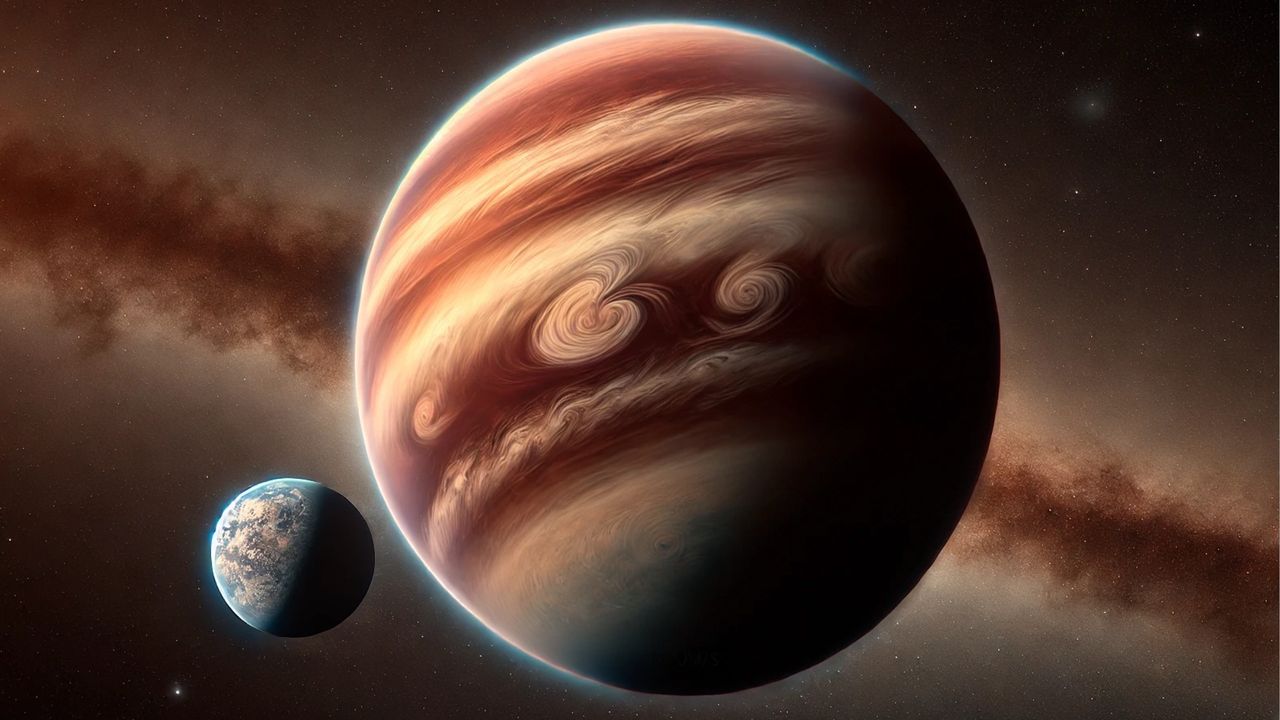
Research indicates that moons orbiting starless “rogue” planets could maintain conditions suitable for liquid water for billions of years. This finding, published in the journal Monthly Notices of the Royal Astronomical Society, suggests that these celestial bodies could serve as long-lived habitats for potential life in the vastness of space.
Using advanced computer models, scientists discovered that an Earth-sized moon orbiting a Jupiter-like rogue planet might sustain temperatures conducive to liquid water for up to 4.3 billion years. This duration is nearly equivalent to the age of Earth itself. According to David Dahlbüdding, the study’s lead author and a researcher at the Ludwig Maximilian University of Munich, “The cradle of life does not necessarily require a sun.”
The research specifically examines exomoons, which are natural satellites of exoplanets, focusing on those associated with free-floating rogue planets. While astronomers have yet to definitively confirm the existence of an exomoon, growing circumstantial evidence suggests that the first discovery may be imminent. Rogue planets often result from the chaotic dynamics of young planetary systems, where gravitational interactions can eject worlds from their host stars into interstellar space.
Recent studies suggest that rogue planets have a considerable chance of retaining their moons even after being expelled. However, the ejection process can significantly alter the orbits of these moons, stretching them into elongated paths. As a result, moons may experience fluctuating distances from their planets, leading to gravitational forces that flex and deform their interiors.
This phenomenon, termed tidal heating, generates internal heat through friction. Similar processes are responsible for the volcanic activity on Jupiter’s moon Io and for maintaining subsurface oceans on icy moons like Europa and Saturn’s Enceladus. The new study posits that tidal heating could produce sufficient warmth to prevent liquid water from freezing, even in the cold of interstellar space.
The research highlights that the ability of a moon to retain warmth largely depends on its atmosphere. Previous studies indicated that carbon dioxide could provide enough greenhouse warming to sustain habitability for up to 1.6 billion years. However, in the extreme cold of space, carbon dioxide can condense, leading to atmospheric collapse and heat loss.
In contrast, the study suggests that hydrogen behaves differently under high-pressure conditions. The team’s simulations demonstrate that when hydrogen molecules collide, they can temporarily absorb heat intended to radiate into space. This creates a dense hydrogen atmosphere that functions as an insulating blanket, effectively trapping warmth.
The findings imply that under these specific conditions, certain exomoons could remain warm enough to support liquid water and potentially foster life as we know it for billions of years. The implications of this research significantly broaden the scope of environments that might harbor life, suggesting that biological existence could endure even in the darkest corners of the galaxy.

Robinhood Stock Surges 2.5% Today Amid Tech Market Recovery

Philadelphia’s Earth Month Kicks Off with Free Events in Parks

GSK’s Inhaler Decision Sparks Health Concerns for Children

Bradford’s Fish Fry Fridays Offer Community Spirit and Flavor

Speculation Rises on Shutdowns During Trump’s Potential Presidency

Samsung Galaxy Watch 9 to Feature Larger Battery, Report Reveals

Inventors Find New Purpose Through Unconventional Paths

UConn Huskies Aim for Back-to-Back Titles in 2026 NCAA Tournament

U.S. Mine Countermeasure Ships Dock in Malaysia for Logistics Stop

University of Hawaiʻi at Mānoa Joins $25.6M AI Initiative for Disaster Monitoring

$2.2 Million Boost for Cancer Research and Training in Hawaiʻi

ALMA Discovers Companion Orbiting Red Giant Star π 1 Gruis

Sacituzumab Govitecan Shows Promise for HR+/HER2− Breast Cancer

币安人生 Sees $15.92 Million in Trading Volume Amid Market Fluctuations

Christian Bale in Talks to Join Leonardo DiCaprio in Heat 2

CAVA Group Shares Surge 5.1% Amid Mixed Analyst Ratings

Supreme Court to Review Birthright Citizenship for Children of Immigrants

Art Deco and Traditional Designs Set to Transform Homes in 2026
-
Science10 months ago
University of Hawaiʻi at Mānoa Joins $25.6M AI Initiative for Disaster Monitoring
-
 Health8 months ago
$2.2 Million Boost for Cancer Research and Training in Hawaiʻi
-
 Science10 months ago
ALMA Discovers Companion Orbiting Red Giant Star π 1 Gruis
-
 Health8 months ago
Sacituzumab Govitecan Shows Promise for HR+/HER2− Breast Cancer
-
Politics6 months ago
币安人生 Sees $15.92 Million in Trading Volume Amid Market Fluctuations
-
 Entertainment9 months ago
Christian Bale in Talks to Join Leonardo DiCaprio in Heat 2
-
 Business9 months ago
CAVA Group Shares Surge 5.1% Amid Mixed Analyst Ratings
-
 Politics9 months ago
Supreme Court to Review Birthright Citizenship for Children of Immigrants
-
 Lifestyle9 months ago
Art Deco and Traditional Designs Set to Transform Homes in 2026
-

 Health10 months ago
New Gel Offers Hope for Regrowing Tooth Enamel in Dentistry
-

 Lifestyle9 months ago
Fernando Mendoza Secures Maxwell and O’Brien Awards Ahead of Heisman
-

 World9 months ago
Swiss Residents Reject 50% Inheritance Tax on Wealthy