
Science
International Team Unveils Nanocourier for Molecular Delivery

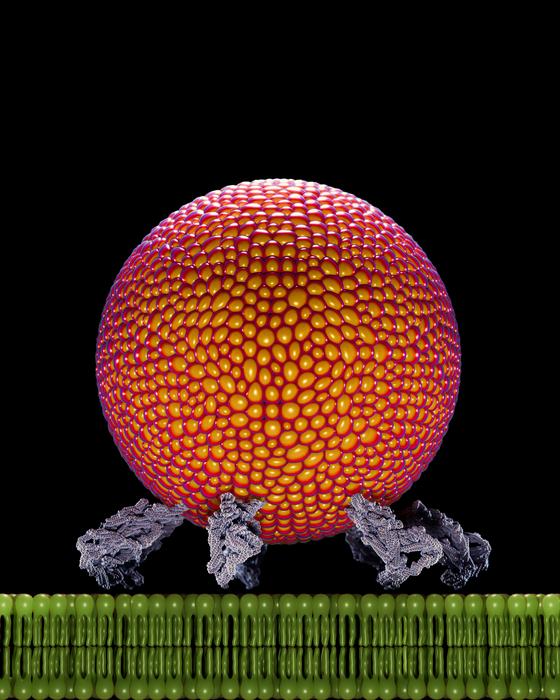
A team of international researchers, led by scientists from Pompeu Fabra University in Spain, has unveiled significant findings regarding a nanomachine involved in a crucial biological process known as constitutive exocytosis. This process facilitates the continuous transport of spherical molecular packages to the cell membrane, a function critical for maintaining cellular health and enabling essential activities such as communication, growth, and division.
The study, published in the journal Cell, focuses on the yeast Saccharomyces cerevisiae and presents a detailed resolution of the architecture of this unique nanocourier. The researchers employed advanced microscopy techniques and artificial intelligence to gain insights into a process that occurs billions of times each day within our bodies.
Understanding exocytosis could have significant implications for the treatment of infections and rare diseases. According to the study’s lead author, Oriol Gallego, PhD, who heads the Biophysics in Cell Biology Group at the UPF Department of Medicine and Life Sciences, capturing the dynamic nature of this nanocourier presented substantial challenges due to its fleeting existence.
Revealing the Nanocourier’s Structure
Gallego and his colleagues, including researchers from the Universitat de Vic, the Instituto Biofisika, and Max Perutz Labs, combined sophisticated light and electron microscopy with AI-driven image analysis. This collaborative effort allowed them to visualize the three-dimensional organization of the nanocourier, which they named ExHOS, short for exocyst higher-order structure.
Every cell in the human body transports between 10,000 and 100,000 of these molecular packages daily, performing various functions such as enzyme secretion, hormone release, and cell repair. The research team highlighted the importance of tethering, which is the precise docking of vesicles loaded with cargo to the plasma membrane.
Gallego remarked on the significance of the ExHOS, stating, “The function of this nanocourier is so important that it is very rare to find it mutated in patients, as such alterations typically impair the viability of the embryo.”
At the heart of this nanomachine lies a coordinated movement of seven protein assemblies known as exocysts, forming a flexible ring that secures the vesicles upon their arrival at the cell surface.
Broader Implications for Science and Medicine
The implications of this research extend beyond basic science. The ExHOS plays a vital role in plant immunity, defending against microbial threats. Pathogens such as Magnaporthe oryzae, which causes substantial losses in rice production, have evolved mechanisms to disrupt this protective process.
In humans, various viruses, including SARS-CoV-2 and HIV, exploit the exocytosis pathway during infections. The study notes that the exocyst is not only central to the secretion of vesicles but is also involved in autophagy and host invasion by pathogens like Salmonella.
Even minor mutations in components of the ExHOS can lead to neurodevelopmental disorders and contribute to the mechanisms behind metastatic cancers.
The researchers concluded that their findings provide valuable insights into the biophysical principles governing vesicle tethering, which could advance understanding of the exocyst’s role across various biological systems.
Marta Puig-Tintó, PhD, a co-senior author, emphasized the potential of integrating advanced imaging technologies with computational tools to make previously invisible cellular processes observable.
Gallego stated, “We have unveiled a fundamental and vital cellular process. It’s like explaining how oxygen is exchanged during breathing. While immediate applications may not be evident, this discovery will pave the way for future research addressing critical biomedical and biotechnological challenges.”
The research marks a significant step forward in cell biology, shedding light on the intricate processes that sustain life at a microscopic level.

Robinhood Stock Surges 2.5% Today Amid Tech Market Recovery

Philadelphia’s Earth Month Kicks Off with Free Events in Parks

GSK’s Inhaler Decision Sparks Health Concerns for Children

Bradford’s Fish Fry Fridays Offer Community Spirit and Flavor

Speculation Rises on Shutdowns During Trump’s Potential Presidency

Samsung Galaxy Watch 9 to Feature Larger Battery, Report Reveals

Inventors Find New Purpose Through Unconventional Paths

UConn Huskies Aim for Back-to-Back Titles in 2026 NCAA Tournament

U.S. Mine Countermeasure Ships Dock in Malaysia for Logistics Stop

University of Hawaiʻi at Mānoa Joins $25.6M AI Initiative for Disaster Monitoring

$2.2 Million Boost for Cancer Research and Training in Hawaiʻi

ALMA Discovers Companion Orbiting Red Giant Star π 1 Gruis

Sacituzumab Govitecan Shows Promise for HR+/HER2− Breast Cancer

币安人生 Sees $15.92 Million in Trading Volume Amid Market Fluctuations

New Gel Offers Hope for Regrowing Tooth Enamel in Dentistry

CAVA Group Shares Surge 5.1% Amid Mixed Analyst Ratings

Christian Bale in Talks to Join Leonardo DiCaprio in Heat 2

Supreme Court to Review Birthright Citizenship for Children of Immigrants
-
Science9 months ago
University of Hawaiʻi at Mānoa Joins $25.6M AI Initiative for Disaster Monitoring
-
 Health7 months ago
$2.2 Million Boost for Cancer Research and Training in Hawaiʻi
-
 Science8 months ago
ALMA Discovers Companion Orbiting Red Giant Star π 1 Gruis
-
 Health7 months ago
Sacituzumab Govitecan Shows Promise for HR+/HER2− Breast Cancer
-
Politics5 months ago
币安人生 Sees $15.92 Million in Trading Volume Amid Market Fluctuations
-
 Health9 months ago
New Gel Offers Hope for Regrowing Tooth Enamel in Dentistry
-
 Business7 months ago
CAVA Group Shares Surge 5.1% Amid Mixed Analyst Ratings
-
 Entertainment8 months ago
Christian Bale in Talks to Join Leonardo DiCaprio in Heat 2
-
 Politics7 months ago
Supreme Court to Review Birthright Citizenship for Children of Immigrants
-

 Lifestyle8 months ago
Art Deco and Traditional Designs Set to Transform Homes in 2026
-

 Lifestyle7 months ago
Fernando Mendoza Secures Maxwell and O’Brien Awards Ahead of Heisman
-

 World8 months ago
Swiss Residents Reject 50% Inheritance Tax on Wealthy