
Politics
EU Considers Trade Retaliation as Trump Threatens New Tariffs

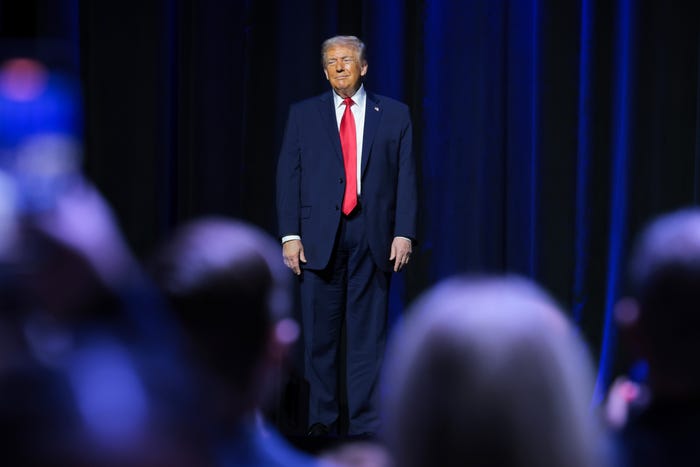
The European Union (EU) is contemplating a significant trade response, commonly referred to as a trade “bazooka,” in reaction to President Donald Trump‘s threats of new tariffs against EU nations. The potential escalation comes after Trump indicated plans to impose additional tariffs of up to 10% on European countries unless they agree to a deal concerning the control of Greenland.
French President Emmanuel Macron advocated for the activation of this anti-coercion mechanism during his address at the World Economic Forum in Davos. He stated, “The anti-coercion mechanism is a powerful instrument, and we should not hesitate to deploy it in today’s tough environment.” This tool, approved by the EU in 2023, would enable the bloc to impose tariffs on US imports and restrict specific services, targeting sectors where the US enjoys a competitive edge.
The potential impact of these tariffs on services could significantly affect the US economy. While the US has a trade deficit in goods, it boasts a surplus in services, exporting approximately $1.1 trillion in services in 2024, according to the St. Louis Federal Reserve. This figure underscores the US’s position as the world’s leading services exporter, specializing in sectors like pharmaceuticals, technology, and finance. The Bureau of Economic Analysis reported that the US exported $489 billion in services to Europe that same year.
Economists are expressing concern about the implications of escalating trade tensions. Alex Durante, a senior economist at the nonpartisan Tax Foundation, remarked that these developments represent “uncharted territory.” He noted that Trump’s push for control over Greenland could jeopardize the US’s international standing. Durante stated, “America really would lose whatever standing it still has in the world if it were to go forward and do something like that.”
White House spokesman Kush Desai defended the administration’s position, asserting that the Trump administration has honored its earlier trade commitments with the EU. Desai suggested that the EU should focus on fulfilling these commitments rather than issuing threats.
Trump’s trade strategy specifically targets eight European nations, including Denmark, Germany, France, and the United Kingdom, which he accused of opposing US control of Greenland. He warned that tariffs could increase to 25% by June 2024 if these nations do not comply with his demands.
The EU Commission has clarified that the anti-coercion tool is designed to allow a broad and efficient response to economic coercion with minimal impact on the EU economy. This mechanism could limit access to European markets for US-based service exporters, such as major technology firms and financial institutions.
Durante highlighted potential ramifications concerning intellectual property, suggesting that the EU could restrict certain IP licenses for US companies and limit the access of American banks to EU markets, which could increase operational costs domestically.
The Kiel Institute for the World Economy, a prominent German think tank, recently found that between January 2024 and November 2025, approximately 96% of US tariffs have been borne by American consumers. Should the EU proceed with its trade bazooka, the Commission indicated it would require up to four months to evaluate allegations and an additional six months to formulate an appropriate response.
As the situation unfolds, the Trump administration is also awaiting a ruling from the Supreme Court regarding the legality of several tariffs, which may influence future trade actions. Durante cautioned that a tit-for-tat approach could escalate tensions, ultimately diminishing economic well-being for citizens on both sides of the Atlantic. “When you have this kind of tit for tat policy, the US threatens something, the EU responds,” he said, warning that it could quickly spiral out of control.
In light of these developments, the global economic landscape remains precarious, with the potential for significant repercussions for both the US and European economies.

Robinhood Stock Surges 2.5% Today Amid Tech Market Recovery

Philadelphia’s Earth Month Kicks Off with Free Events in Parks

GSK’s Inhaler Decision Sparks Health Concerns for Children

Bradford’s Fish Fry Fridays Offer Community Spirit and Flavor

Speculation Rises on Shutdowns During Trump’s Potential Presidency

Samsung Galaxy Watch 9 to Feature Larger Battery, Report Reveals

Inventors Find New Purpose Through Unconventional Paths

UConn Huskies Aim for Back-to-Back Titles in 2026 NCAA Tournament

U.S. Mine Countermeasure Ships Dock in Malaysia for Logistics Stop

University of Hawaiʻi at Mānoa Joins $25.6M AI Initiative for Disaster Monitoring

$2.2 Million Boost for Cancer Research and Training in Hawaiʻi

ALMA Discovers Companion Orbiting Red Giant Star π 1 Gruis

Sacituzumab Govitecan Shows Promise for HR+/HER2− Breast Cancer

币安人生 Sees $15.92 Million in Trading Volume Amid Market Fluctuations

New Gel Offers Hope for Regrowing Tooth Enamel in Dentistry

CAVA Group Shares Surge 5.1% Amid Mixed Analyst Ratings

Christian Bale in Talks to Join Leonardo DiCaprio in Heat 2

Supreme Court to Review Birthright Citizenship for Children of Immigrants
-
Science9 months ago
University of Hawaiʻi at Mānoa Joins $25.6M AI Initiative for Disaster Monitoring
-
 Health7 months ago
$2.2 Million Boost for Cancer Research and Training in Hawaiʻi
-
 Science8 months ago
ALMA Discovers Companion Orbiting Red Giant Star π 1 Gruis
-
 Health7 months ago
Sacituzumab Govitecan Shows Promise for HR+/HER2− Breast Cancer
-
Politics5 months ago
币安人生 Sees $15.92 Million in Trading Volume Amid Market Fluctuations
-
 Health9 months ago
New Gel Offers Hope for Regrowing Tooth Enamel in Dentistry
-
 Business7 months ago
CAVA Group Shares Surge 5.1% Amid Mixed Analyst Ratings
-
 Entertainment8 months ago
Christian Bale in Talks to Join Leonardo DiCaprio in Heat 2
-
 Politics7 months ago
Supreme Court to Review Birthright Citizenship for Children of Immigrants
-

 Lifestyle8 months ago
Art Deco and Traditional Designs Set to Transform Homes in 2026
-

 Lifestyle7 months ago
Fernando Mendoza Secures Maxwell and O’Brien Awards Ahead of Heisman
-

 World8 months ago
Swiss Residents Reject 50% Inheritance Tax on Wealthy