
Science
Researchers Uncover Secrets of Monster Galaxies’ Star Formation

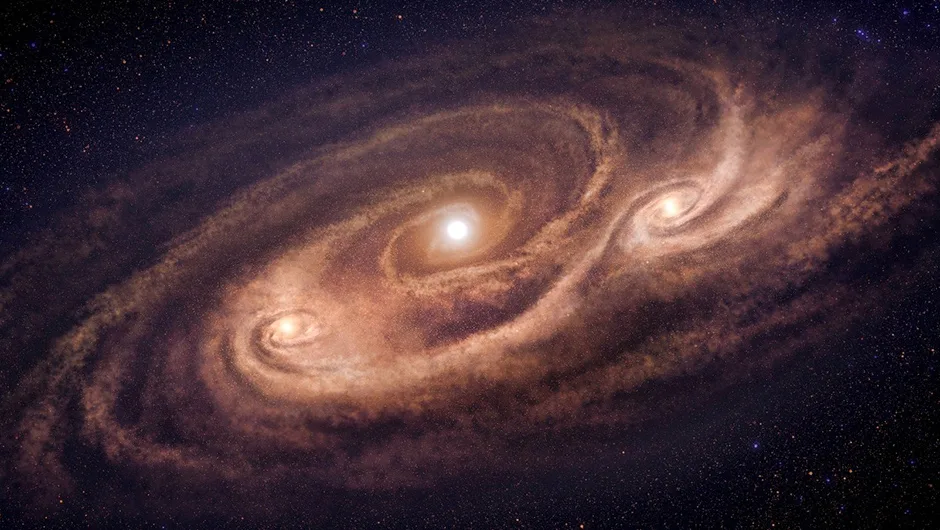
In a groundbreaking study, researchers have unveiled new insights into the formation of “monster galaxies,” which produced stars at rates far exceeding that of the Milky Way. These massive galaxies, existing between 10 and 12 billion years ago, are believed to be the predecessors of today’s giant elliptical galaxies. A team led by Ryota Ikeda at the National Astronomical Observatory of Japan has discovered that there are multiple pathways driving these galaxies’ rapid growth, challenging long-held assumptions in the field of astrophysics.
Advanced Observational Techniques Reveal Diverse Growth Patterns
Using advanced tools such as the Atacama Large Millimetre/submillimetre Array (ALMA) and the James Webb Space Telescope (JWST), the researchers examined three monster galaxies located in the Sextans constellation. The study stands out for its unprecedented ability to compare current star formation with historical data, achieving an extraordinary resolution of 0.06 arc-seconds. This level of detail provides clarity akin to having visual acuity 1,000 times better than human eyesight.
ALMA is particularly adept at detecting ongoing star formation obscured by dust, while JWST maps the distribution of already formed stars. By overlaying these complementary views, the research team was able to identify distinct architectural patterns across the three galaxies.
In the case of AzTEC-1, the observations revealed a star formation pattern that is spread throughout the galaxy, with existing stars clustered tightly at the center. This suggests that a significant collision between two large galaxies funneled gas inward, igniting a fierce starburst while scattering material across the system. The violent dynamics of this merger acted as a critical catalyst for star formation.
Unique Mechanisms Drive Star Formation in Different Galaxies
Conversely, AzTEC-4 presents a contrasting scenario. ALMA’s images reveal elegant spiral arms marked by active star formation, while JWST indicates that existing stars are arranged in a smooth disk without pronounced spiral features. This suggests that star formation was driven internally by the galaxy’s gravitational instability, rather than through an external collision.
Meanwhile, the architecture of AzTEC-8 displays concentrated star formation near its center, as shown by ALMA images, while JWST reveals a more extended stellar distribution with large clumps. This indicates a collision with a smaller companion galaxy that introduced fresh gas to the center, stimulating star formation without the full disruption associated with a major merger.
The research fundamentally alters the understanding of how monster galaxies evolve, emphasizing that there is not a singular mechanism at play, but rather a variety of pathways contributing to their rapid growth. The findings suggest that such diversity in formation processes could provide deeper insights into the evolution of galaxies similar to our own Milky Way.
The team plans to expand their sample size significantly, aiming to conduct comprehensive statistical tests on the observed diversity of growth mechanisms in these early galaxies. This ongoing research may yield further revelations about the formative processes that shaped the universe as we know it.
This study highlights the importance of integrating advanced observational techniques in astrophysics, paving the way for future discoveries about the nature and evolution of galaxies across the cosmos.

Robinhood Stock Surges 2.5% Today Amid Tech Market Recovery

Philadelphia’s Earth Month Kicks Off with Free Events in Parks

GSK’s Inhaler Decision Sparks Health Concerns for Children

Bradford’s Fish Fry Fridays Offer Community Spirit and Flavor

Speculation Rises on Shutdowns During Trump’s Potential Presidency

Samsung Galaxy Watch 9 to Feature Larger Battery, Report Reveals

Inventors Find New Purpose Through Unconventional Paths

UConn Huskies Aim for Back-to-Back Titles in 2026 NCAA Tournament

U.S. Mine Countermeasure Ships Dock in Malaysia for Logistics Stop

University of Hawaiʻi at Mānoa Joins $25.6M AI Initiative for Disaster Monitoring

$2.2 Million Boost for Cancer Research and Training in Hawaiʻi

ALMA Discovers Companion Orbiting Red Giant Star π 1 Gruis

Sacituzumab Govitecan Shows Promise for HR+/HER2− Breast Cancer

币安人生 Sees $15.92 Million in Trading Volume Amid Market Fluctuations

New Gel Offers Hope for Regrowing Tooth Enamel in Dentistry

CAVA Group Shares Surge 5.1% Amid Mixed Analyst Ratings

Christian Bale in Talks to Join Leonardo DiCaprio in Heat 2

Supreme Court to Review Birthright Citizenship for Children of Immigrants
-
Science9 months ago
University of Hawaiʻi at Mānoa Joins $25.6M AI Initiative for Disaster Monitoring
-
 Health7 months ago
$2.2 Million Boost for Cancer Research and Training in Hawaiʻi
-
 Science8 months ago
ALMA Discovers Companion Orbiting Red Giant Star π 1 Gruis
-
 Health7 months ago
Sacituzumab Govitecan Shows Promise for HR+/HER2− Breast Cancer
-
Politics5 months ago
币安人生 Sees $15.92 Million in Trading Volume Amid Market Fluctuations
-
 Health9 months ago
New Gel Offers Hope for Regrowing Tooth Enamel in Dentistry
-
 Business7 months ago
CAVA Group Shares Surge 5.1% Amid Mixed Analyst Ratings
-
 Entertainment8 months ago
Christian Bale in Talks to Join Leonardo DiCaprio in Heat 2
-
 Politics7 months ago
Supreme Court to Review Birthright Citizenship for Children of Immigrants
-

 Lifestyle8 months ago
Art Deco and Traditional Designs Set to Transform Homes in 2026
-

 Lifestyle7 months ago
Fernando Mendoza Secures Maxwell and O’Brien Awards Ahead of Heisman
-

 World8 months ago
Swiss Residents Reject 50% Inheritance Tax on Wealthy