
Science
Martian Storms Reveal Secrets of Water Loss on the Red Planet

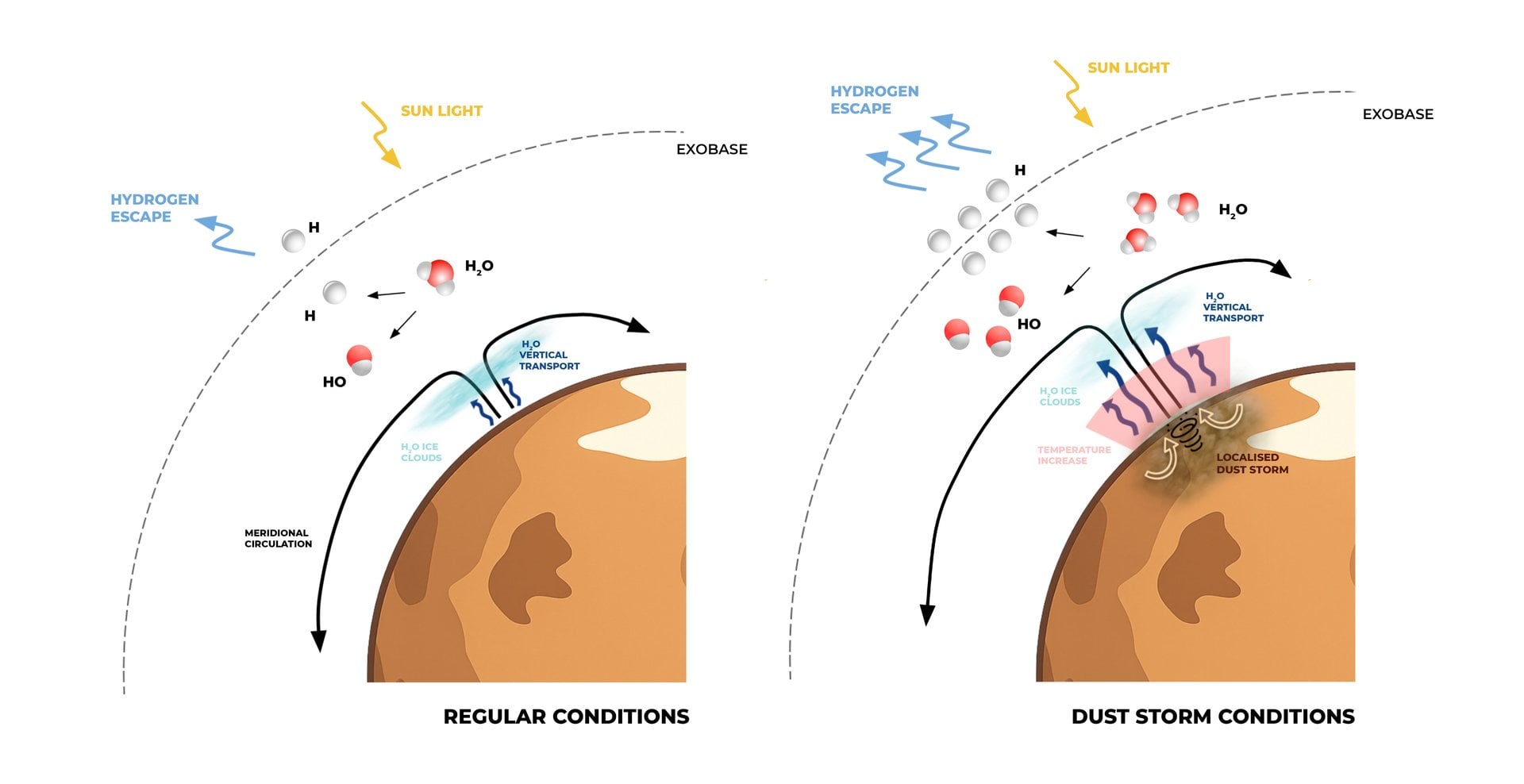
Mars has long puzzled scientists with its mysterious water loss. Recent research provides new insights, attributing the disappearance of water to dust storms that inject moisture into the atmosphere, where it is subsequently destroyed. Data collected from multiple instruments on three spacecraft, including the Perseverance and Curiosity rovers, have painted a clearer picture of how water dynamics have evolved on the Red Planet.
A paper published by a team of researchers utilized data from at least six different instruments, revealing that Mars once had sufficient water to potentially cover its surface to a depth of hundreds of meters. This estimation is based on measurements of the deuterium/hydrogen (D/H) ratio. Deuterium, a heavier isotope of hydrogen, is less likely to escape into the atmosphere compared to regular hydrogen. Consequently, as lighter hydrogen atoms are lost over time due to solar wind, the D/H ratio increases, indicating that Mars has experienced significant water loss.
Understanding where this water went requires examining Mars’ seasonal changes. Similar to Earth, Mars has an axial tilt that leads to seasonal variations. However, its more elliptical orbit creates pronounced differences between its southern and northern summers. Traditionally, scientists believed that water loss predominantly occurred during the warmer southern summers. This new research challenges that view, revealing a significant water loss event triggered by a powerful dust storm during the northern summer of Mars year 37, corresponding to the 2022-2023 period on Earth.
Insights from Recent Mars Storms
The study highlights an extraordinary “rocket storm” that occurred in the northern hemisphere. Warmer summers on Mars, particularly during this storm, enhanced the process of water escaping into the upper atmosphere. Typically, dust storms in the southern summer raise dust to mid-atmospheric layers, warming the atmosphere by approximately 15 degrees Celsius. This warming prevents the formation of water ice clouds that typically trap water vapor in lower atmospheric regions. As a result, water can travel to higher altitudes where it is exposed to ultraviolet radiation, leading to its destruction.
Previous assumptions held that this process was limited to the southern summer months. However, the data from the ExoMars, Emirates Mars Mission (EMM), and Mars Reconnaissance Orbiter revealed that the same atmospheric dynamics were at play during the northern summer, marking a year-round cycle of water loss rather than a seasonal one.
The strength of the observed storm raises intriguing questions about Mars’ climatic history. Researchers propose that Mars may have had a more pronounced axial tilt in the past, leading to warmer northern summers that could have facilitated similar storm formations. This additional pathway for water escape could help explain discrepancies between current water levels and past estimates of Mars’ hydrological state.
The findings have significant implications for our understanding of Mars’ climate evolution and its capacity to support life. As scientists continue to analyze data from ongoing missions, they hope to unravel the complex interactions between dust storms and water dynamics, shedding light on the history of this enigmatic planet.
Learn more about this research from the Royal Belgian Institute for Space Aeronomy and the study by A. Brines et al. on the impact of dust storms on Martian water loss.

Robinhood Stock Surges 2.5% Today Amid Tech Market Recovery

Philadelphia’s Earth Month Kicks Off with Free Events in Parks

GSK’s Inhaler Decision Sparks Health Concerns for Children

Bradford’s Fish Fry Fridays Offer Community Spirit and Flavor

Speculation Rises on Shutdowns During Trump’s Potential Presidency

Samsung Galaxy Watch 9 to Feature Larger Battery, Report Reveals

Inventors Find New Purpose Through Unconventional Paths

UConn Huskies Aim for Back-to-Back Titles in 2026 NCAA Tournament

U.S. Mine Countermeasure Ships Dock in Malaysia for Logistics Stop

University of Hawaiʻi at Mānoa Joins $25.6M AI Initiative for Disaster Monitoring

$2.2 Million Boost for Cancer Research and Training in Hawaiʻi

ALMA Discovers Companion Orbiting Red Giant Star π 1 Gruis

Sacituzumab Govitecan Shows Promise for HR+/HER2− Breast Cancer

币安人生 Sees $15.92 Million in Trading Volume Amid Market Fluctuations

New Gel Offers Hope for Regrowing Tooth Enamel in Dentistry

CAVA Group Shares Surge 5.1% Amid Mixed Analyst Ratings

Supreme Court to Review Birthright Citizenship for Children of Immigrants

Christian Bale in Talks to Join Leonardo DiCaprio in Heat 2
-
Science9 months ago
University of Hawaiʻi at Mānoa Joins $25.6M AI Initiative for Disaster Monitoring
-
 Health7 months ago
$2.2 Million Boost for Cancer Research and Training in Hawaiʻi
-
 Science8 months ago
ALMA Discovers Companion Orbiting Red Giant Star π 1 Gruis
-
 Health7 months ago
Sacituzumab Govitecan Shows Promise for HR+/HER2− Breast Cancer
-
Politics5 months ago
币安人生 Sees $15.92 Million in Trading Volume Amid Market Fluctuations
-
 Health8 months ago
New Gel Offers Hope for Regrowing Tooth Enamel in Dentistry
-
 Business7 months ago
CAVA Group Shares Surge 5.1% Amid Mixed Analyst Ratings
-
 Politics7 months ago
Supreme Court to Review Birthright Citizenship for Children of Immigrants
-
 Entertainment8 months ago
Christian Bale in Talks to Join Leonardo DiCaprio in Heat 2
-

 Lifestyle8 months ago
Art Deco and Traditional Designs Set to Transform Homes in 2026
-

 Lifestyle7 months ago
Fernando Mendoza Secures Maxwell and O’Brien Awards Ahead of Heisman
-

 World8 months ago
Swiss Residents Reject 50% Inheritance Tax on Wealthy