
Top Stories
Physicists Unveil Theoretical Spacetime Quasicrystals as Universe’s Building Blocks

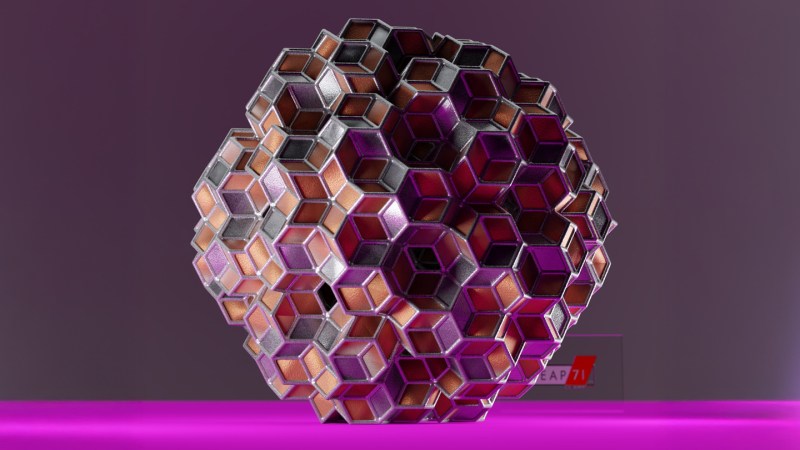
Physicists have proposed a groundbreaking concept known as **spacetime quasicrystals**, suggesting that these theoretical materials could play a fundamental role in the structure of the universe. Published on **January 12, 2024**, in a paper submitted to **arXiv.org**, the researchers argue that these quasicrystals exist in a realm transcending traditional two or three-dimensional structures, merging the dimensions of time and space.
Quasicrystals are unique materials characterized by their orderly structure without a repetitive pattern. They have been discovered in meteorites and remnants from early atomic tests. The new theoretical framework suggests that spacetime quasicrystals might emerge as a natural phenomenon, possibly underpinning the very fabric of the universe.
Understanding Quasicrystals and Their Implications
Traditional crystals consist of repeating patterns; for example, tiles on a bathroom floor align perfectly when shifted. In contrast, quasicrystals lack this regular repetition, resulting in a structure that maintains order across different locations. According to **Felix Flicker**, a theoretical physicist at the **University of Bristol**, the possibility of creating a proper spacetime quasicrystal seemed improbable. Yet, he acknowledges that the team’s findings reveal “the most elegant things you can have in spacetime as a combined entity.”
One of the significant attributes of spacetime quasicrystals is their adherence to **Lorentz symmetry**, a principle stating that the laws of physics are invariant regardless of the observer’s speed. This contrasts with previously known quasicrystals and standard crystals, where different observers would perceive distinct structures based on their relative velocities. In this new theoretical model, an ant stationary on a quasicrystal would observe the same structure as another ant traveling at near-light speed.
The researchers achieved their mathematical formulation by slicing through a higher-dimensional grid of points and projecting them onto a four-dimensional slice. This slice, characterized by an **irrational slope**, ensures that it never intersects the grid points directly, resulting in a non-repetitive structure.
Potential Applications and Future Research
The implications of spacetime quasicrystals extend beyond theoretical physics. They could have relevance in quantum gravity theories, which propose that spacetime is fragmented into discrete points at extremely small scales. **Sotiris Mygdalas** from the **Perimeter Institute** in Waterloo, Canada, co-author of the study, emphasizes that the quasicrystals’ unique structure could facilitate a framework for understanding the nature of spacetime while maintaining Lorentz symmetry.
Additionally, the research explores potential connections to **string theory**, which posits that fundamental particles are tiny vibrating strings and suggests the universe may possess ten dimensions. The theory often proposes that these extra dimensions are compacted to such an extent that they remain undetectable. The introduction of spacetime quasicrystals may offer a means for these ten dimensions to exist cohesively, while concurrently allowing the vast space and time that humans experience.
Despite the ambitious nature of these ideas, the authors acknowledge that more research is needed to validate their theories, describing their concepts as “admittedly half-baked” in their paper. Nevertheless, the allure of spacetime quasicrystals persists. **Gregory Moore**, a theoretical physicist at **Rutgers University**, who was not involved in the research, describes the mathematics as “beautiful” while noting that the physics remains highly speculative.
As scientists continue to explore these theoretical constructs, the journey into the nature of spacetime and the fundamental building blocks of the universe promises to yield fascinating insights into our understanding of reality.

Robinhood Stock Surges 2.5% Today Amid Tech Market Recovery

Philadelphia’s Earth Month Kicks Off with Free Events in Parks

GSK’s Inhaler Decision Sparks Health Concerns for Children

Bradford’s Fish Fry Fridays Offer Community Spirit and Flavor

Speculation Rises on Shutdowns During Trump’s Potential Presidency

Samsung Galaxy Watch 9 to Feature Larger Battery, Report Reveals

Inventors Find New Purpose Through Unconventional Paths

UConn Huskies Aim for Back-to-Back Titles in 2026 NCAA Tournament

U.S. Mine Countermeasure Ships Dock in Malaysia for Logistics Stop

University of Hawaiʻi at Mānoa Joins $25.6M AI Initiative for Disaster Monitoring

$2.2 Million Boost for Cancer Research and Training in Hawaiʻi

ALMA Discovers Companion Orbiting Red Giant Star π 1 Gruis

Sacituzumab Govitecan Shows Promise for HR+/HER2− Breast Cancer

币安人生 Sees $15.92 Million in Trading Volume Amid Market Fluctuations

New Gel Offers Hope for Regrowing Tooth Enamel in Dentistry

CAVA Group Shares Surge 5.1% Amid Mixed Analyst Ratings

Christian Bale in Talks to Join Leonardo DiCaprio in Heat 2

Supreme Court to Review Birthright Citizenship for Children of Immigrants
-
Science9 months ago
University of Hawaiʻi at Mānoa Joins $25.6M AI Initiative for Disaster Monitoring
-
 Health7 months ago
$2.2 Million Boost for Cancer Research and Training in Hawaiʻi
-
 Science8 months ago
ALMA Discovers Companion Orbiting Red Giant Star π 1 Gruis
-
 Health7 months ago
Sacituzumab Govitecan Shows Promise for HR+/HER2− Breast Cancer
-
Politics5 months ago
币安人生 Sees $15.92 Million in Trading Volume Amid Market Fluctuations
-
 Health8 months ago
New Gel Offers Hope for Regrowing Tooth Enamel in Dentistry
-
 Business7 months ago
CAVA Group Shares Surge 5.1% Amid Mixed Analyst Ratings
-
 Entertainment8 months ago
Christian Bale in Talks to Join Leonardo DiCaprio in Heat 2
-
 Politics7 months ago
Supreme Court to Review Birthright Citizenship for Children of Immigrants
-

 Lifestyle8 months ago
Art Deco and Traditional Designs Set to Transform Homes in 2026
-

 Lifestyle7 months ago
Fernando Mendoza Secures Maxwell and O’Brien Awards Ahead of Heisman
-

 World8 months ago
Swiss Residents Reject 50% Inheritance Tax on Wealthy