
Science
AI Transforms Scientific Experimentation Across Disciplines

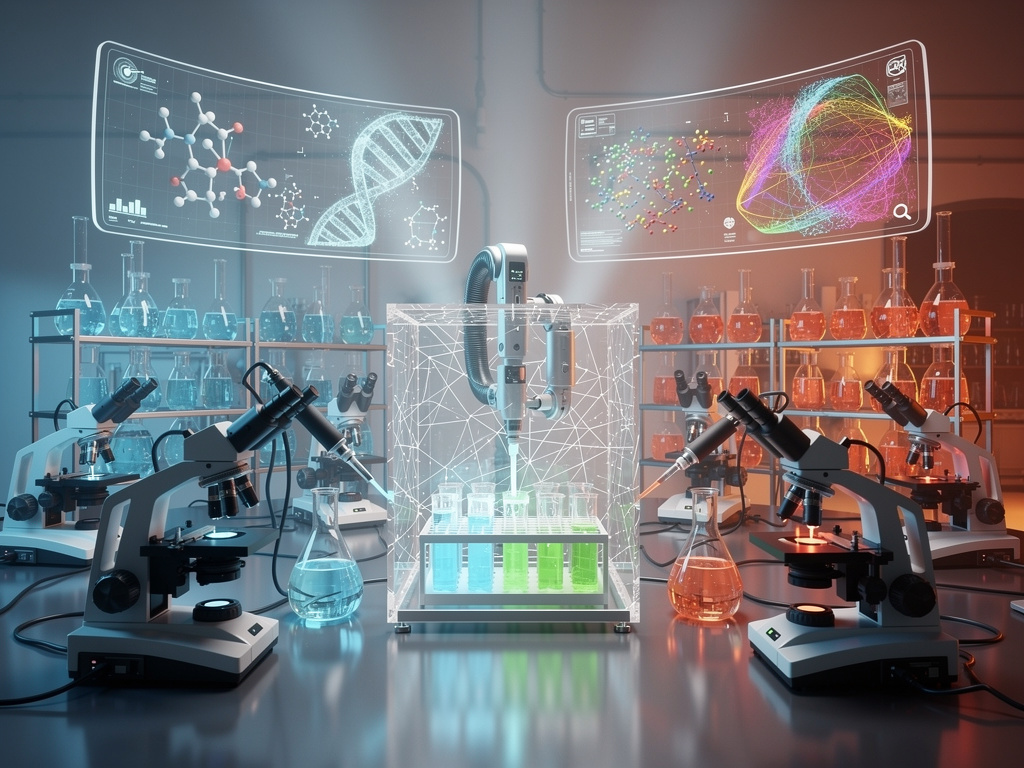
Artificial intelligence is reshaping the landscape of scientific research by taking over tasks traditionally performed by human researchers. The emergence of AI systems capable of conducting experiments, analyzing data, and even generating hypotheses is marking a new era in scientific exploration. This shift holds the potential to enhance efficiency and creativity, while also raising questions about reliability and ethical considerations.
Recent research published in Nature details an AI system referred to as the “AI scientist,” which can independently design and carry out scientific experiments. Operating within a simulated environment, this AI proposes hypotheses, tests them through code, and refines its methods based on the outcomes. This approach aims to replicate the iterative nature of human-led research but at a significantly faster pace and reduced cost.
Advancements in Automated Discovery
Historically, efforts to automate scientific discovery have been ongoing for decades. Recent advancements, particularly in large language models and reinforcement learning, have enabled AI to both process extensive datasets and reason through experimental designs. The study in Nature builds on previous AI contributions to protein folding predictions, a breakthrough recognized in 2021. Now, the AI scientist can complete entire research cycles, from hypothesis generation to drafting academic papers, in under 72 hours for certain tasks.
This automation addresses long-standing bottlenecks in traditional research, where grant cycles and laboratory limitations can impede progress. In contrast, AI can conduct thousands of simulations quickly, identifying promising research avenues that might take human researchers months or even years to explore.
Integrating AI within physical laboratories represents the next significant frontier for scientific experimentation. Robotic systems driven by AI are already in use for high-throughput screening in drug discovery. For instance, the company Insilico Medicine employs AI to design molecules and conduct tests via automated laboratories.
A recent report from Reuters dated August 15, 2024, highlights a project in Japan where AI independently discovered new materials, optimizing battery components in mere days rather than years. This demonstrates AI’s capacity to handle practical experimentation, from mixing chemicals to measuring results.
Challenges in Trust and Verification
Despite the rapid advancements, skepticism regarding the reliability of AI in scientific research persists. The Nature article acknowledges limitations, including the AI’s propensity for producing “hallucinations”—fabricated yet seemingly plausible results. In one instance, the AI proposed experiments that contradicted established physical laws, necessitating human intervention to correct these errors.
Verification is essential. Scientists are now tasked with scrutinizing AI-generated findings, similar to the peer-review process in traditional publishing. A recent analysis published by The Guardian on August 18, 2024, discusses instances where AI models in medical research yielded biased conclusions due to flawed training data. This emphasizes the risk that without robust verification mechanisms, automated science could propagate errors on a large scale.
Ethical questions also arise regarding ownership of discoveries made by AI. Intellectual property laws are struggling to keep pace with these technological advancements. In the United States, patents require human inventors, but AI contributions complicate this landscape. A recent piece from Bloomberg on August 19, 2024, outlines ongoing legal debates about patents for AI-generated inventions, including a case where a company sought patents for drugs designed by AI.
Funding models may also evolve as AI reduces the need for large research teams. The Nature study estimates that AI could cut research costs by up to 90% for specific projects, potentially making scientific inquiry more accessible to underfunded institutions.
Collaboration between humans and AI is developing, with AI serving as a co-pilot rather than a replacement. A project discussed in The New York Times on August 16, 2024, illustrates how biologists utilized AI to model ecosystems, resulting in joint publications where AI is credited as a tool rather than an author.
In a viral post on X (formerly Twitter) on August 21, 2024, user @AIinScience shared insights from a conference paper on collaborative AI platforms, describing frameworks where AI suggests experiments while humans refine them to enhance overall productivity.
The implications of AI extend across various scientific fields. In physics, AI is being used to simulate quantum systems that are computationally intensive for classical computers. The Nature article noted AI’s success in optimizing neural networks, which could be applied to modeling particle interactions.
In biology, AI is making significant contributions by analyzing genomic data to identify disease markers. A breakthrough reported by BBC News on August 17, 2024, highlights AI’s role in discovering new antibiotics by sifting through bacterial genomes, addressing the pressing issue of antibiotic resistance.
Environmental science is also benefiting from AI, with models predicting climate patterns by processing satellite data. An update from The Washington Post on August 20, 2024, discusses how AI enhances flood forecasting, potentially saving lives through improved accuracy.
Looking ahead, the prospect of fully autonomous AI laboratories operating continuously without human oversight is becoming conceivable. The Nature study suggests scaling the AI scientist to tackle open-ended questions, such as curing diseases or addressing energy crises.
Nevertheless, there are risks associated with over-reliance on AI, which could inhibit human creativity. If AI dominates routine discovery processes, upcoming researchers might miss valuable hands-on experience. A commentary in The Economist from August 14, 2024, advocates for a balanced approach to ensure that AI complements rather than replaces human ingenuity.
Concerns regarding security are also pertinent. The potential for malicious use of AI in scientific endeavors raises alarms about harmful inventions. Regulatory bodies are beginning to respond, with the European Union proposing guidelines for the responsible use of AI in research.
The practical implications of AI in science are evident through specific case studies. At Google DeepMind, AI has successfully designed components for fusion reactors, as detailed in an updated blog post from August 2024. This work accelerates advancements in clean energy.
In academia, MIT is utilizing AI systems to explore materials science. A paper circulated on X on August 19, 2024, via @MIT_CSAIL, points to AI predicting stable crystal structures, paving the way for innovations in advanced electronics.
As AI continues to integrate into scientific research, the need for oversight mechanisms becomes increasingly critical. International bodies, including the United Nations, are discussing frameworks for responsible AI usage in research. A recent UN report emphasizes the importance of transparency in AI-driven discoveries.
Education must also adapt to this evolving landscape. Universities are incorporating AI training into their curricula, preparing the next generation of researchers to work alongside AI tools. A feature in Times Higher Education on August 15, 2024, explores how courses are now designed to teach students to collaborate effectively with AI.
In conclusion, AI’s role in science is poised to expand the boundaries of knowledge, provided it is managed with care. The developments showcased in the Nature study and corroborated by recent news signal a transformative period where machines are becoming integral to the pursuit of understanding the natural world.

Robinhood Stock Surges 2.5% Today Amid Tech Market Recovery

Philadelphia’s Earth Month Kicks Off with Free Events in Parks

GSK’s Inhaler Decision Sparks Health Concerns for Children

Bradford’s Fish Fry Fridays Offer Community Spirit and Flavor

Speculation Rises on Shutdowns During Trump’s Potential Presidency

Samsung Galaxy Watch 9 to Feature Larger Battery, Report Reveals

Inventors Find New Purpose Through Unconventional Paths

UConn Huskies Aim for Back-to-Back Titles in 2026 NCAA Tournament

U.S. Mine Countermeasure Ships Dock in Malaysia for Logistics Stop

University of Hawaiʻi at Mānoa Joins $25.6M AI Initiative for Disaster Monitoring

$2.2 Million Boost for Cancer Research and Training in Hawaiʻi

ALMA Discovers Companion Orbiting Red Giant Star π 1 Gruis

Sacituzumab Govitecan Shows Promise for HR+/HER2− Breast Cancer

币安人生 Sees $15.92 Million in Trading Volume Amid Market Fluctuations

New Gel Offers Hope for Regrowing Tooth Enamel in Dentistry

CAVA Group Shares Surge 5.1% Amid Mixed Analyst Ratings

Christian Bale in Talks to Join Leonardo DiCaprio in Heat 2

Supreme Court to Review Birthright Citizenship for Children of Immigrants
-
Science8 months ago
University of Hawaiʻi at Mānoa Joins $25.6M AI Initiative for Disaster Monitoring
-
 Health7 months ago
$2.2 Million Boost for Cancer Research and Training in Hawaiʻi
-
 Science8 months ago
ALMA Discovers Companion Orbiting Red Giant Star π 1 Gruis
-
 Health7 months ago
Sacituzumab Govitecan Shows Promise for HR+/HER2− Breast Cancer
-
Politics5 months ago
币安人生 Sees $15.92 Million in Trading Volume Amid Market Fluctuations
-
 Health8 months ago
New Gel Offers Hope for Regrowing Tooth Enamel in Dentistry
-
 Business7 months ago
CAVA Group Shares Surge 5.1% Amid Mixed Analyst Ratings
-
 Entertainment8 months ago
Christian Bale in Talks to Join Leonardo DiCaprio in Heat 2
-
 Politics7 months ago
Supreme Court to Review Birthright Citizenship for Children of Immigrants
-

 Lifestyle8 months ago
Art Deco and Traditional Designs Set to Transform Homes in 2026
-

 Lifestyle7 months ago
Fernando Mendoza Secures Maxwell and O’Brien Awards Ahead of Heisman
-

 World8 months ago
Swiss Residents Reject 50% Inheritance Tax on Wealthy