
Science
Astrophotographer Captures Stunning Blue Nebula in Orion

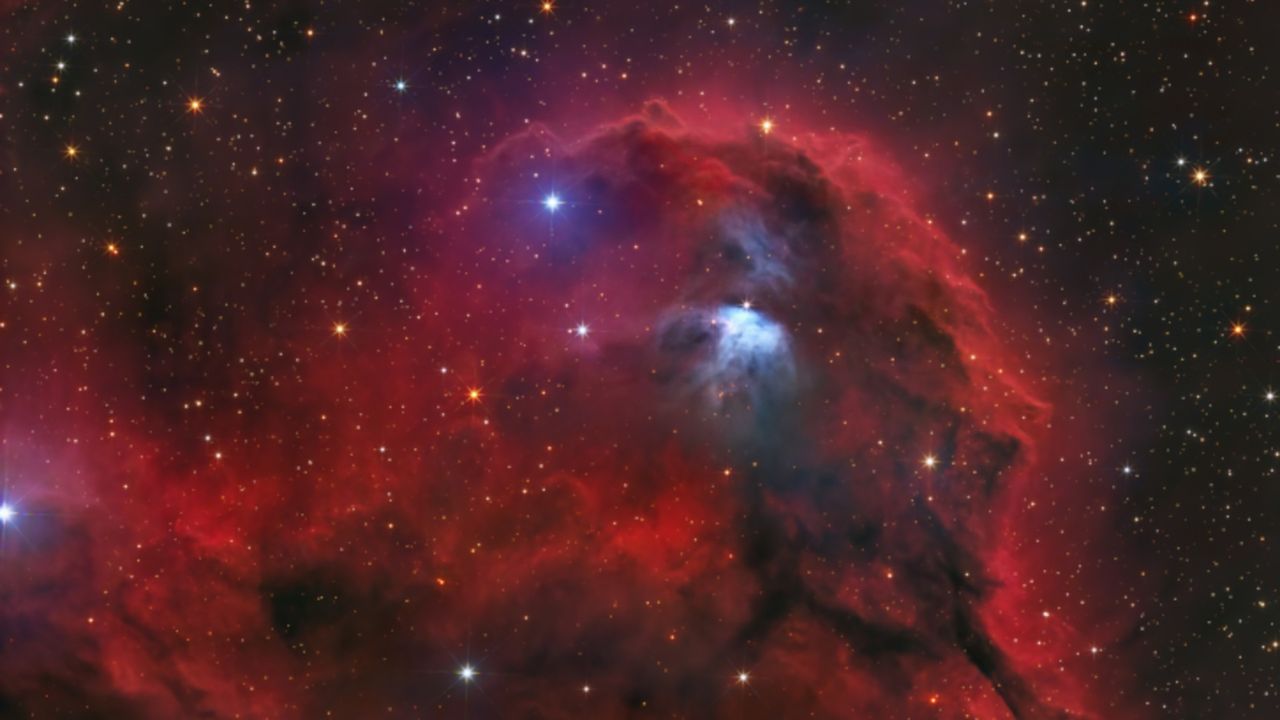
Astrophotographer Emil Andronic has dedicated nearly 70 hours to capturing the breathtaking light of a reflection nebula near the head of the hunter in the constellation Orion. This remarkable feat unfolded in late 2025, showcasing intricate details of the interstellar cloud as it illuminated the sky over the UK.
Andronic’s stunning image features the blue reflection nebula designated Cederblad 51, prominently glowing amid the vibrant red clouds of the giant nebula SH 2-264. This region, often referred to as Orion’s Head, is located near the bright star Lambda Orionis, which symbolizes the head of the celestial hunter. According to NASA, reflection nebulas are expansive clouds of interstellar dust that scatter the blue light of nearby stars, distinguishing them from emission nebulas, which emit their own light due to the influence of nearby star radiation.
In a conversation with Space.com, Andronic expressed his excitement about capturing this nebula, stating, “Ced 51 is a target that I wanted to capture for a very long time, but most of the time the conditions weren’t that great and every time I ended up shooting something else.”
Technical Achievements and Challenges
To achieve this stunning capture, Andronic employed a pair of 8-inch (200 mm) telescopes equipped with a variety of specialized filters, including red, green, blue, and H-alpha, along with cooled astronomy cameras. The data collection took place in Hertfordshire, England, as the constellation Orion ascended into the autumn sky.
Andronic elaborated on his process: “This time, I started to gather my data early in the autumn, when Orion was just coming up into the night sky, and this way…I managed to get 69 hours and 15 minutes worth of HaLRGB data.” He acknowledged the challenges posed by light pollution from Greater London, which is not far from his home. “Shooting LRGB in the South is a bit tricky, but after a careful selection of the best subs (exposures), I got a result that I am very pleased with.”
The meticulous work did not end with data collection. Andronic carefully stacked and edited the individual exposures using the astronomy software PixInsight and Adobe Photoshop. The final result is a breathtaking nebula image adorned with the multicolored light of countless stars.
Encouragement for Aspiring Astrophotographers
For those inspired by Andronic’s achievement and interested in pursuing astrophotography, resources are available to help beginners get started. A collection of the best cameras and lenses for astrophotography, as well as guides on capturing the Milky Way with a DSLR camera, can be found online. Additionally, enthusiasts can explore recommendations for smart telescopes, which offer the potential for capturing stunning images of galaxies and nebulas.
Andronic’s journey serves as a reminder of the dedication and skill required in the field of astrophotography. Those wishing to share their own astrophotography experiences and images are encouraged to send their submissions to Space.com for potential publication.

Robinhood Stock Surges 2.5% Today Amid Tech Market Recovery

Philadelphia’s Earth Month Kicks Off with Free Events in Parks

GSK’s Inhaler Decision Sparks Health Concerns for Children

Bradford’s Fish Fry Fridays Offer Community Spirit and Flavor

Speculation Rises on Shutdowns During Trump’s Potential Presidency

Samsung Galaxy Watch 9 to Feature Larger Battery, Report Reveals

Inventors Find New Purpose Through Unconventional Paths

UConn Huskies Aim for Back-to-Back Titles in 2026 NCAA Tournament

U.S. Mine Countermeasure Ships Dock in Malaysia for Logistics Stop

University of Hawaiʻi at Mānoa Joins $25.6M AI Initiative for Disaster Monitoring

$2.2 Million Boost for Cancer Research and Training in Hawaiʻi

ALMA Discovers Companion Orbiting Red Giant Star π 1 Gruis

Sacituzumab Govitecan Shows Promise for HR+/HER2− Breast Cancer

币安人生 Sees $15.92 Million in Trading Volume Amid Market Fluctuations

New Gel Offers Hope for Regrowing Tooth Enamel in Dentistry

CAVA Group Shares Surge 5.1% Amid Mixed Analyst Ratings

Christian Bale in Talks to Join Leonardo DiCaprio in Heat 2

Supreme Court to Review Birthright Citizenship for Children of Immigrants
-
Science9 months ago
University of Hawaiʻi at Mānoa Joins $25.6M AI Initiative for Disaster Monitoring
-
 Health7 months ago
$2.2 Million Boost for Cancer Research and Training in Hawaiʻi
-
 Science9 months ago
ALMA Discovers Companion Orbiting Red Giant Star π 1 Gruis
-
 Health7 months ago
Sacituzumab Govitecan Shows Promise for HR+/HER2− Breast Cancer
-
Politics5 months ago
币安人生 Sees $15.92 Million in Trading Volume Amid Market Fluctuations
-
 Health9 months ago
New Gel Offers Hope for Regrowing Tooth Enamel in Dentistry
-
 Business8 months ago
CAVA Group Shares Surge 5.1% Amid Mixed Analyst Ratings
-
 Entertainment8 months ago
Christian Bale in Talks to Join Leonardo DiCaprio in Heat 2
-
 Politics8 months ago
Supreme Court to Review Birthright Citizenship for Children of Immigrants
-

 Lifestyle8 months ago
Art Deco and Traditional Designs Set to Transform Homes in 2026
-

 Lifestyle8 months ago
Fernando Mendoza Secures Maxwell and O’Brien Awards Ahead of Heisman
-

 World8 months ago
Swiss Residents Reject 50% Inheritance Tax on Wealthy