
Science
Scientists Discover Nickel Vapor in Interstellar Comet 3I/ATLAS

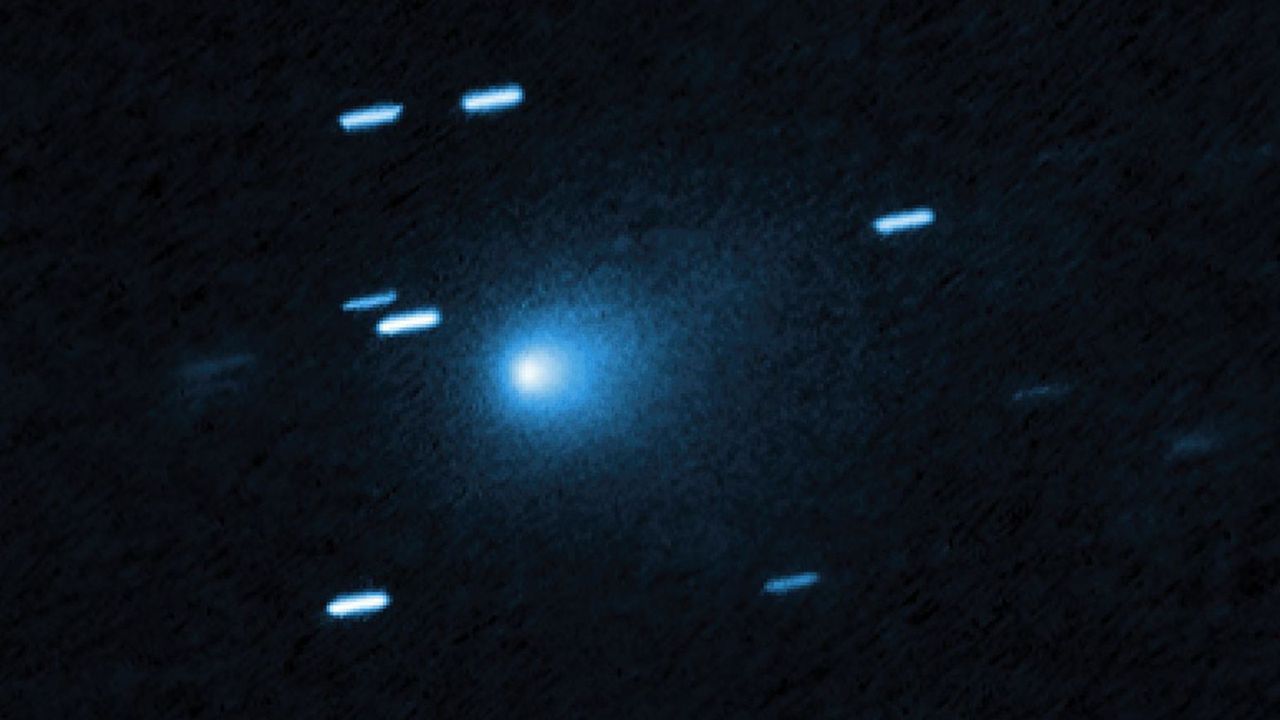
In a significant scientific breakthrough, researchers have detected glowing nickel vapor in the gas surrounding the interstellar comet 3I/ATLAS, challenging existing understandings of chemical processes in space. This discovery marks a critical moment for astrophysics, providing insights into materials originating from beyond our solar system. The findings were made by an international team led by Rohan Rahatgaonkar, a Ph.D. student at the Instituto de Astrofísica-Pontificia Universidad Católica de Chile, alongside Darryl Z. Seligman, an Assistant Professor of Physics and Astronomy at Michigan State University.
On July 1, 2025, the Asteroid Terrestrial-impact Last Alert System (ATLAS) identified 3I/ATLAS as only the third confirmed interstellar object, following the notable discoveries of ‘Oumuamua and comet Borisov. Unlike these previous visitors, 3I/ATLAS was detected early in its approach, allowing scientists a unique opportunity to observe its chemical evolution in real-time as it nears the sun.
Unveiling the Chemical Awakening
The research team utilized the Very Large Telescope (VLT) in Chile, employing advanced spectroscopic techniques to analyze the comet’s atmosphere. Initial observations revealed faint but consistent spectral lines indicative of atomic nickel vapor at a distance of 3.88 astronomical units (AU) from the sun, nearly four times the distance between Earth and the sun. This unexpected discovery of nickel at such a cold distance, where metals typically do not vaporize, suggests that the comet is undergoing a complex chemical activation process.
As the comet approached the sun, the team recorded a surge in nickel vapor emissions. By mid-August 2025, when 3I/ATLAS was approximately 3.07 AU from the sun, they detected the spectral signature of cyanogen (CN) gas, a common emission found in solar system comets. These findings reveal a fascinating pattern of chemical activity that could reshape our understanding of interstellar objects.
Implications for Cosmic Chemistry
The detection of nickel without corresponding levels of iron presents intriguing questions about the processes at play. Traditional models suggest that metals vaporize through sublimation, a process requiring high temperatures. However, the unique chemical signature of 3I/ATLAS indicates that nickel might be released from complex molecules that can disintegrate under sunlight, potentially involving compounds bound to carbon monoxide or other organic materials.
This discovery aligns with data from the James Webb Space Telescope (JWST), which indicated an unusual composition in the comet’s coma, revealing higher levels of carbon dioxide compared to typical solar system comets. The presence of water ice and carbon monoxide also suggests a diverse mixture of frozen materials that are becoming active as the comet approaches the sun.
The ongoing study of 3I/ATLAS not only enhances our understanding of this particular comet but also provides broader insights into the conditions and materials present in distant star systems. By comparing 3I/ATLAS with previous interstellar visitors, scientists aim to gather evidence that could illuminate how planetary systems form across the galaxy.
As 3I/ATLAS continues its journey towards perihelion, or its closest approach to the sun, expected on October 29, 2025, the international research team remains poised to collect further data. They anticipate increased activity and potentially new chemical species emerging as temperatures rise.
The implications of these findings extend beyond the individual comet, touching on fundamental questions about the building blocks of planetary systems. The research underscores the importance of methodical, evidence-based inquiry in unraveling the complexities of the universe.
In conclusion, the unexpected detection of nickel vapor in 3I/ATLAS not only enriches our knowledge of this interstellar wanderer but also ignites curiosity about the materials that populate our cosmos. With continued observations, scientists hope to unlock further secrets of this cosmic messenger before it departs the solar system, carrying its ancient materials back into the vast interstellar void.

Robinhood Stock Surges 2.5% Today Amid Tech Market Recovery

Philadelphia’s Earth Month Kicks Off with Free Events in Parks

GSK’s Inhaler Decision Sparks Health Concerns for Children

Bradford’s Fish Fry Fridays Offer Community Spirit and Flavor

Speculation Rises on Shutdowns During Trump’s Potential Presidency

Samsung Galaxy Watch 9 to Feature Larger Battery, Report Reveals

Inventors Find New Purpose Through Unconventional Paths

UConn Huskies Aim for Back-to-Back Titles in 2026 NCAA Tournament

U.S. Mine Countermeasure Ships Dock in Malaysia for Logistics Stop

University of Hawaiʻi at Mānoa Joins $25.6M AI Initiative for Disaster Monitoring

$2.2 Million Boost for Cancer Research and Training in Hawaiʻi

ALMA Discovers Companion Orbiting Red Giant Star π 1 Gruis

Sacituzumab Govitecan Shows Promise for HR+/HER2− Breast Cancer

币安人生 Sees $15.92 Million in Trading Volume Amid Market Fluctuations

New Gel Offers Hope for Regrowing Tooth Enamel in Dentistry

CAVA Group Shares Surge 5.1% Amid Mixed Analyst Ratings

Christian Bale in Talks to Join Leonardo DiCaprio in Heat 2

Supreme Court to Review Birthright Citizenship for Children of Immigrants
-
Science9 months ago
University of Hawaiʻi at Mānoa Joins $25.6M AI Initiative for Disaster Monitoring
-
 Health7 months ago
$2.2 Million Boost for Cancer Research and Training in Hawaiʻi
-
 Science9 months ago
ALMA Discovers Companion Orbiting Red Giant Star π 1 Gruis
-
 Health7 months ago
Sacituzumab Govitecan Shows Promise for HR+/HER2− Breast Cancer
-
Politics5 months ago
币安人生 Sees $15.92 Million in Trading Volume Amid Market Fluctuations
-
 Health9 months ago
New Gel Offers Hope for Regrowing Tooth Enamel in Dentistry
-
 Business8 months ago
CAVA Group Shares Surge 5.1% Amid Mixed Analyst Ratings
-
 Entertainment8 months ago
Christian Bale in Talks to Join Leonardo DiCaprio in Heat 2
-
 Politics8 months ago
Supreme Court to Review Birthright Citizenship for Children of Immigrants
-

 Lifestyle8 months ago
Art Deco and Traditional Designs Set to Transform Homes in 2026
-

 Lifestyle8 months ago
Fernando Mendoza Secures Maxwell and O’Brien Awards Ahead of Heisman
-

 World8 months ago
Swiss Residents Reject 50% Inheritance Tax on Wealthy