
Business
Global Drone Services Market Set to Reach USD 142.22 Billion by 2035

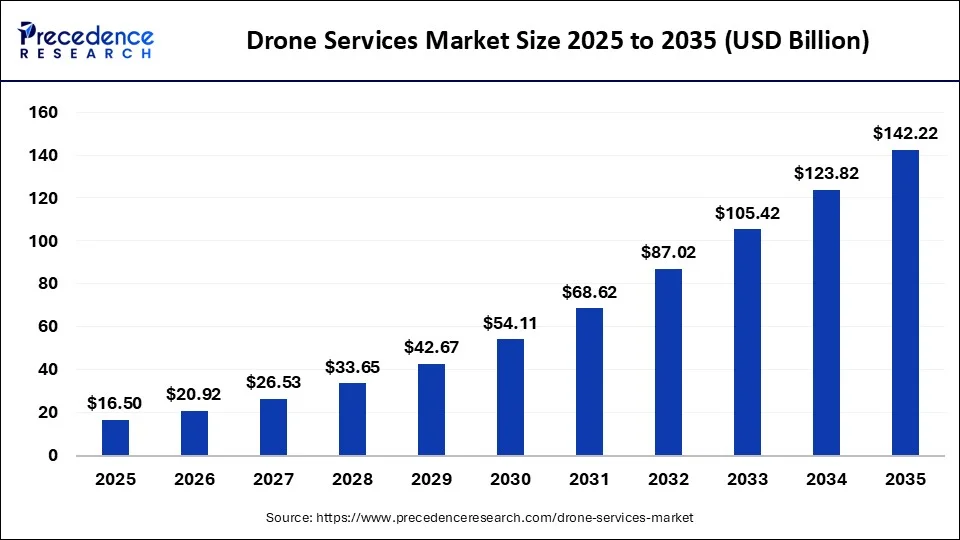
The global drone services market is poised for significant growth, projected to expand from a valuation of USD 16.50 billion in 2025 to approximately USD 142.22 billion by 2035. This growth reflects a compound annual growth rate (CAGR) of 24.04% from 2026 to 2035. This surge in market size is largely driven by the increasing adoption of drone technology across various sectors such as agriculture, logistics, and infrastructure.
Drone services are utilized in a myriad of applications, including power inspection, traffic monitoring, environmental protection, agricultural insurance, and post-disaster rescue. The demand for these services is escalating as industries seek more efficient and safer operational methods.
Market Dynamics and Regional Insights
North America dominated the drone services market in 2025, capturing a significant 36% share. The region benefits from a robust presence of drone service providers, favorable regulatory environments, and widespread adoption across multiple industries. In contrast, the Asia-Pacific region is expected to register the fastest growth rate during the forecast period, fueled by increasing industrial investments and supportive government initiatives.
The drone platform services segment led the market in 2025, accounting for 41% of the total revenue. Aerial photography emerged as the dominant application, reflecting the growing interest in capturing high-resolution imagery for various purposes. In terms of end-users, the agricultural sector held the leading position, but the logistics segment is anticipated to witness the fastest growth moving forward.
Government Initiatives Supporting Drone Services
Several government initiatives are fostering the growth of drone services. The Drone Shakti Initiative promotes the “Drone-as-a-Service” model by supporting startups and offering vocational training in drone technology. The Kisan Drone Scheme aims to modernize agriculture through financial subsidies for drone purchases, facilitating crop assessment and efficient land management.
Additionally, other initiatives such as the Namo Drone Didi Scheme empower women-led self-help groups with drones to provide agricultural services, while the Production-Linked Incentive (PLI) Scheme encourages domestic drone manufacturing.
Advancements in drone technology also play a crucial role in the market’s expansion. Service providers are increasingly integrating artificial intelligence into their operations. This shift from basic drone functions to comprehensive platforms enables real-time object detection, automated defect identification, and predictive analytics, enhancing efficiency across sectors.
Moreover, the expansion of Beyond Visual Line of Sight (BVLOS) operations is transforming commercial drone use. Regulatory frameworks, such as the upcoming FAA Part 108, are facilitating large-scale deployment of drones for long-range tasks like pipeline monitoring and medical deliveries.
The prospect of using drones in medical services further underscores the potential of this market. Drones are being deployed to monitor healthcare supply chains, ensuring timely delivery of medical tools and supplies, thus optimizing inventory levels and enhancing care effectiveness. They also assist in disease outbreak monitoring, providing crucial data for effective healthcare management.
As the drone services market continues to evolve, the integration of sophisticated technology and supportive government frameworks will likely drive its expansion, creating vast opportunities across various sectors.

Robinhood Stock Surges 2.5% Today Amid Tech Market Recovery

Philadelphia’s Earth Month Kicks Off with Free Events in Parks

GSK’s Inhaler Decision Sparks Health Concerns for Children

Bradford’s Fish Fry Fridays Offer Community Spirit and Flavor

Speculation Rises on Shutdowns During Trump’s Potential Presidency

Samsung Galaxy Watch 9 to Feature Larger Battery, Report Reveals

Inventors Find New Purpose Through Unconventional Paths

UConn Huskies Aim for Back-to-Back Titles in 2026 NCAA Tournament

U.S. Mine Countermeasure Ships Dock in Malaysia for Logistics Stop

University of Hawaiʻi at Mānoa Joins $25.6M AI Initiative for Disaster Monitoring

$2.2 Million Boost for Cancer Research and Training in Hawaiʻi

ALMA Discovers Companion Orbiting Red Giant Star π 1 Gruis

Sacituzumab Govitecan Shows Promise for HR+/HER2− Breast Cancer

币安人生 Sees $15.92 Million in Trading Volume Amid Market Fluctuations

New Gel Offers Hope for Regrowing Tooth Enamel in Dentistry

CAVA Group Shares Surge 5.1% Amid Mixed Analyst Ratings

Christian Bale in Talks to Join Leonardo DiCaprio in Heat 2

Supreme Court to Review Birthright Citizenship for Children of Immigrants
-
Science8 months ago
University of Hawaiʻi at Mānoa Joins $25.6M AI Initiative for Disaster Monitoring
-
 Health7 months ago
$2.2 Million Boost for Cancer Research and Training in Hawaiʻi
-
 Science8 months ago
ALMA Discovers Companion Orbiting Red Giant Star π 1 Gruis
-
 Health7 months ago
Sacituzumab Govitecan Shows Promise for HR+/HER2− Breast Cancer
-
Politics4 months ago
币安人生 Sees $15.92 Million in Trading Volume Amid Market Fluctuations
-
 Health8 months ago
New Gel Offers Hope for Regrowing Tooth Enamel in Dentistry
-
 Business7 months ago
CAVA Group Shares Surge 5.1% Amid Mixed Analyst Ratings
-
 Entertainment8 months ago
Christian Bale in Talks to Join Leonardo DiCaprio in Heat 2
-
 Politics7 months ago
Supreme Court to Review Birthright Citizenship for Children of Immigrants
-

 Lifestyle8 months ago
Art Deco and Traditional Designs Set to Transform Homes in 2026
-

 Lifestyle7 months ago
Fernando Mendoza Secures Maxwell and O’Brien Awards Ahead of Heisman
-

 World8 months ago
Swiss Residents Reject 50% Inheritance Tax on Wealthy