
Politics
Carlsbad Homeowner Challenges Coastal Commission’s $2.4M Fine

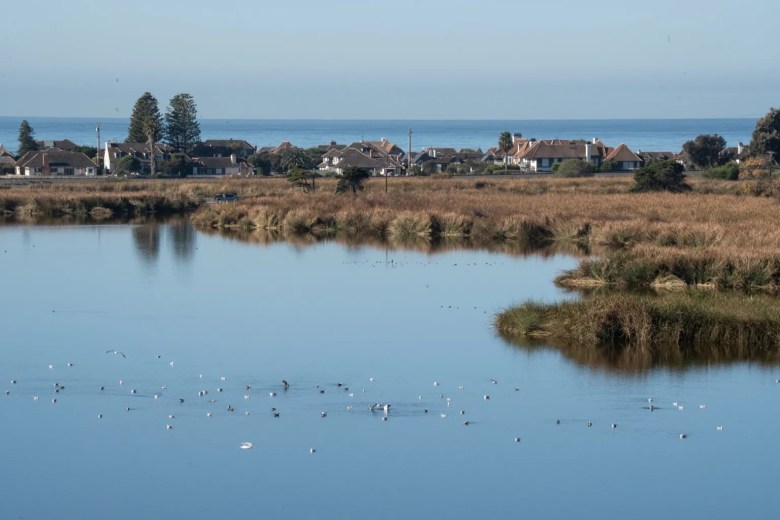
A homeowner in Carlsbad, California, has initiated legal action against the state’s Coastal Commission, contesting a substantial fine of $2.4 million. The penalty arises from allegations that he obstructed public access to the beach and negatively impacted the habitat of local wildlife at Buena Vista Lagoon.
The lawsuit, filed by John Levy, centers around several contentious issues, including the presence of two locked gates, the removal of native vegetation, and the construction of a pickleball court on his property. Levy also questions the commission’s authority to impose such large fines without judicial oversight, arguing that the process violates his rights.
The Coastal Commission, which is responsible for protecting public access and environmental quality along California’s coastline, has accused Levy of various violations. These include blocking access to the beach, removing shorebird habitats, and constructing the pickleball court without the necessary permits. According to commission representatives, these actions warranted the significant financial penalty.
Levy contends that the two gates in question involve complex property rights issues. He maintains that he has complied with environmental protections and is actively collaborating with the city to rectify any issues regarding the permits for his pickleball court. He stated, “If in fact I was guilty of blocking public access or not being compliant with my coastal permit, then I would have acquiesced, or settled.”
Legal Disputes Over Coastal Access
Levy’s property, known as “Levyland,” has been a source of contention since its purchase in 1998. He obtained a coastal development permit to construct his estate but quickly found himself at odds with the Coastal Commission over permit conditions. California law generally mandates that beaches remain open to the public, compelling property owners to provide access across their land.
The commission argues that Levy’s permit requires “lateral access,” allowing visitors to reach the beach from adjacent areas. In contrast, Levy claims that the permit’s terms do not accommodate disabled beachgoers, which is a significant point of contention. The commission insists that Levy must facilitate access from Mountain View Drive, while Levy maintains that existing paths leading to the beach are impeded by locked gates.
Levy asserts that he is amenable to providing public access but is hindered by ownership and easement complications. He noted that he had received permission from the homeowners association to install the gate at the road leading to the beach, and now requires their consent to remove it.
Additionally, Levy claims he offered the city of Carlsbad an easement for a footpath to facilitate access to the beach. However, city officials have stated that the easement was never formally accepted, raising questions about its validity.
Environmental Violations and Ongoing Conflict
The Coastal Commission has also fined Levy for alleged violations related to coastal development, including unauthorized alterations to his property. His estate, which borders the lagoon on two sides, is home to endangered species such as the light-footed Ridgeway’s rail and the California least tern. Levy was mandated to maintain a buffer of native vegetation to protect these species, but the commission alleges he cleared the area to create a parking lot for events.
While Levy admits he built the pickleball court without the necessary permissions, he is currently seeking an “after-the-fact” permit. He argues that he has not operated a wedding venue, although he has allowed weddings to take place at his rental property.
Nonprofit organizations, including the Surfrider Foundation and Disability Rights California, have urged the commission to enforce penalties against Levy. They assert the need to address violations concerning coastal access and habitat preservation.
As the legal battle unfolds, Levy’s attorney, Jeremy Talcott of the Pacific Legal Foundation, posits that such property law matters should be resolved in court rather than through the commission, which may lack impartiality in adjudicating its own penalties. Talcott stated, “There’s not a neutral adjudicator in that hearing.”
The Coastal Commission has defended its actions, emphasizing its role in ensuring compliance with the California Coastal Act. At an October hearing, enforcement counsel Rob Moddelmog remarked that Levy had multiple opportunities to resolve the issues but chose not to comply with the regulations.
The implications of this case extend beyond Levy’s personal disputes. Critics argue that the Coastal Commission has amassed significant authority over coastal property owners, often imposing hefty fines that can amount to millions of dollars. Violations can incur fines of up to $11,250 per day for each infraction, accumulating rapidly over time.
Levy’s lawsuit challenges the commission’s approach, arguing that the penalties represent “quasi-criminal” sanctions that should be subject to judicial scrutiny. Legal experts recognize the validity of Levy’s argument, noting that punitive measures typically require a higher level of review than what the commission provides.
As this conflict continues, Levy has expressed determination to pursue the case to the highest courts if necessary. He stated, “I’m 74 and I don’t care how much I have to spend, but I’m going to bring this to the forefront of the U.S. and California.”
The outcome of Levy’s lawsuit could have significant implications for property rights and environmental regulations along California’s coastline, making it a case to watch closely in the coming months.

Robinhood Stock Surges 2.5% Today Amid Tech Market Recovery

Philadelphia’s Earth Month Kicks Off with Free Events in Parks

GSK’s Inhaler Decision Sparks Health Concerns for Children

Bradford’s Fish Fry Fridays Offer Community Spirit and Flavor

Speculation Rises on Shutdowns During Trump’s Potential Presidency

Samsung Galaxy Watch 9 to Feature Larger Battery, Report Reveals

Inventors Find New Purpose Through Unconventional Paths

UConn Huskies Aim for Back-to-Back Titles in 2026 NCAA Tournament

U.S. Mine Countermeasure Ships Dock in Malaysia for Logistics Stop

University of Hawaiʻi at Mānoa Joins $25.6M AI Initiative for Disaster Monitoring

$2.2 Million Boost for Cancer Research and Training in Hawaiʻi

ALMA Discovers Companion Orbiting Red Giant Star π 1 Gruis

Sacituzumab Govitecan Shows Promise for HR+/HER2− Breast Cancer

币安人生 Sees $15.92 Million in Trading Volume Amid Market Fluctuations

New Gel Offers Hope for Regrowing Tooth Enamel in Dentistry

CAVA Group Shares Surge 5.1% Amid Mixed Analyst Ratings

Christian Bale in Talks to Join Leonardo DiCaprio in Heat 2

Supreme Court to Review Birthright Citizenship for Children of Immigrants
-
Science9 months ago
University of Hawaiʻi at Mānoa Joins $25.6M AI Initiative for Disaster Monitoring
-
 Health7 months ago
$2.2 Million Boost for Cancer Research and Training in Hawaiʻi
-
 Science8 months ago
ALMA Discovers Companion Orbiting Red Giant Star π 1 Gruis
-
 Health7 months ago
Sacituzumab Govitecan Shows Promise for HR+/HER2− Breast Cancer
-
Politics5 months ago
币安人生 Sees $15.92 Million in Trading Volume Amid Market Fluctuations
-
 Health9 months ago
New Gel Offers Hope for Regrowing Tooth Enamel in Dentistry
-
 Business7 months ago
CAVA Group Shares Surge 5.1% Amid Mixed Analyst Ratings
-
 Entertainment8 months ago
Christian Bale in Talks to Join Leonardo DiCaprio in Heat 2
-
 Politics7 months ago
Supreme Court to Review Birthright Citizenship for Children of Immigrants
-

 Lifestyle8 months ago
Art Deco and Traditional Designs Set to Transform Homes in 2026
-

 Lifestyle7 months ago
Fernando Mendoza Secures Maxwell and O’Brien Awards Ahead of Heisman
-

 World8 months ago
Swiss Residents Reject 50% Inheritance Tax on Wealthy