
Politics
Protests Outside Portland ICE Facility Prompt Legal Action on Tear Gas Use

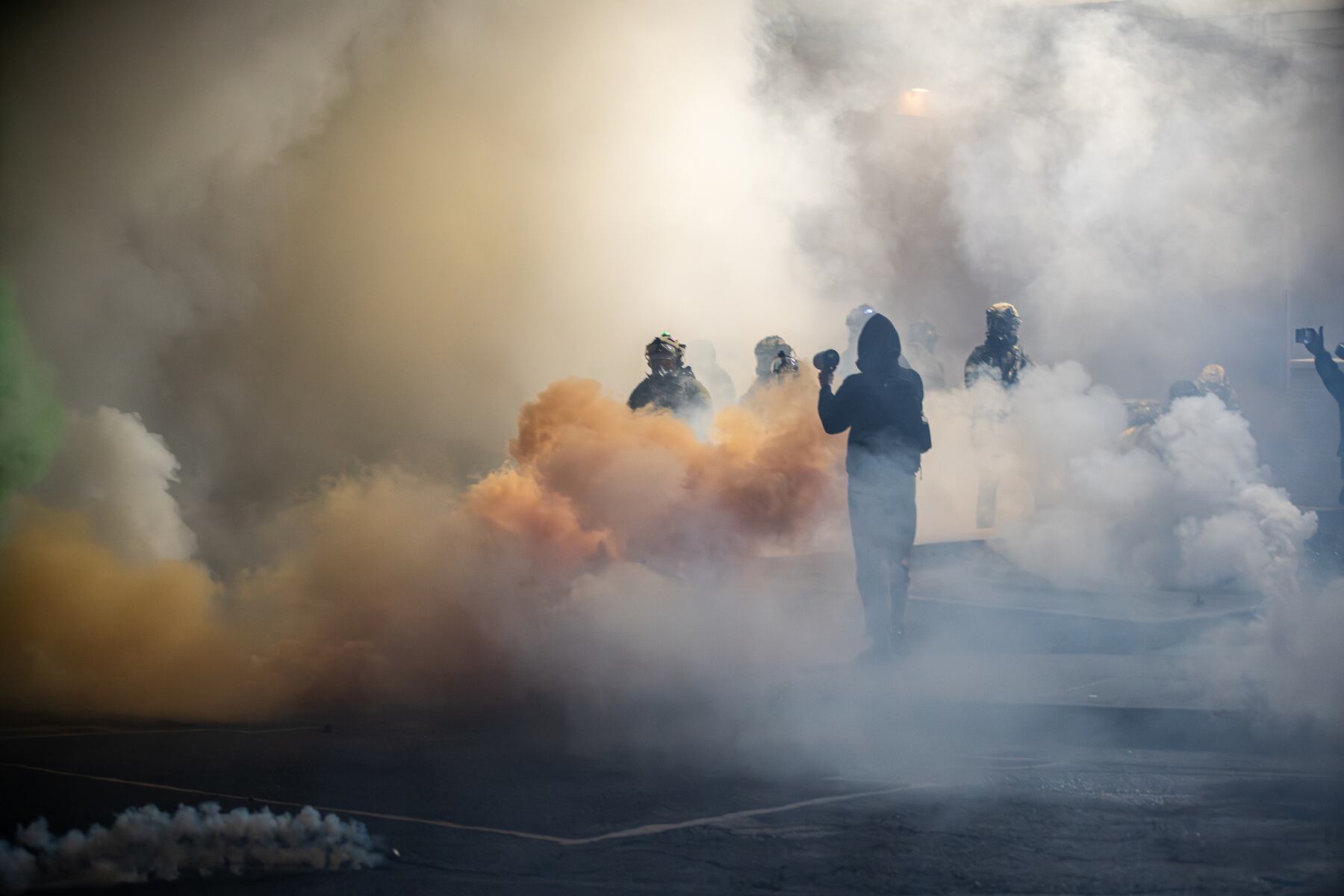
U.S. District Judge Michael H. Simon is set to rule on the legality of federal officers’ use of tear gas and less-lethal munitions against protesters outside the U.S. Immigration and Customs Enforcement (ICE) facility in Portland, Oregon. The judge’s decision will follow a weekend of significant protests and failed negotiations between U.S. Department of Homeland Security officials and attorneys representing demonstrators and journalists.
On March 1, 2024, a hearing was held where both sides were encouraged to reach an agreement regarding temporary restrictions on the use of chemical agents and munitions against passive protesters. This came as the protests intensified, with demonstrators gathering outside the ICE building, heavily impacted by tear gas deployed by federal officers.
The legal action stems from a lawsuit filed by protesters and journalists in January, supported by the American Civil Liberties Union (ACLU). The suit challenges the federal government’s response to ongoing protests that have been occurring since the summer of 2023, particularly after former President Donald Trump’s attempts to deploy National Guard troops to the city.
According to the plaintiffs’ legal representatives, Homeland Security officials have persistently refused to limit the use of chemical munitions against nonviolent protesters, who often engage in passive resistance. The lawyers argued that this approach contradicts U.S. Customs and Border Protection’s own use-of-force policy and precedents set by the 9th U.S. Circuit Court of Appeals.
In court filings, the plaintiffs cited a 2012 case from California, which established that failure to comply with an officer’s orders does not equate to active resistance warranting the use of force. They referenced a statement from Gregory Bovino, a former Customs and Border Patrol commander, indicating that agency policy restricts the use of chemical irritants to situations involving at least “active resistance.”
The protests have drawn a diverse crowd, including families and various community groups. On March 2, 2024, thousands marched to the ICE building, with notable participants like Jack Dickinson, known for his costumed appearances, and 84-year-old Laurie Eckman, who previously suffered injuries from police munitions. During the recent protests, Eckman was reportedly affected by tear gas despite her efforts to maintain distance from the confrontation zones.
Federal officers escalated their response during the protests, employing flash-bang grenades and tear gas. Reports indicated that some officers fired munitions from elevated positions, further complicating the situation for demonstrators. The Department of Justice’s lawyer, Andrew Warden, expressed skepticism about reaching an agreement with the protesters’ lawyers, stating that there remains a significant divide on the issue.
The proposed terms from Homeland Security included requirements for officers to issue verbal warnings before using force and to provide a reasonable opportunity for compliance. They also specified that less-lethal munitions may be used only when deemed “objectively reasonable and necessary,” and not for targeting individuals unless they pose an assaultive threat.
Despite these conditions, ACLU attorneys sought stricter prohibitions against the use of less-lethal munitions, arguing for restrictions aimed solely at addressing imminent threats and preventing intentional targeting of vulnerable areas such as the head or torso. They also expressed concerns about liability for injuries resulting from incidental exposure to crowd control devices.
During Monday’s arguments before Judge Simon, attorney Matthew Borden emphasized the need for immediate intervention, citing instances of children and elderly individuals being exposed to tear gas. He urged the judge to issue a temporary restraining order to limit the use of force at the protests.
Warden countered that any relief provided by the court should be narrowly focused, addressing only the specific circumstances of named plaintiffs rather than extending to broader concerns. Judge Simon indicated that his ruling would likely be confined to the protests at the Portland ICE facility, with a decision expected on Tuesday.
As the situation continues to develop, the outcome of this legal battle could set significant precedents regarding the use of force by federal authorities in response to civil protests.

Robinhood Stock Surges 2.5% Today Amid Tech Market Recovery

Philadelphia’s Earth Month Kicks Off with Free Events in Parks

GSK’s Inhaler Decision Sparks Health Concerns for Children

Bradford’s Fish Fry Fridays Offer Community Spirit and Flavor

Speculation Rises on Shutdowns During Trump’s Potential Presidency

Samsung Galaxy Watch 9 to Feature Larger Battery, Report Reveals

Inventors Find New Purpose Through Unconventional Paths

UConn Huskies Aim for Back-to-Back Titles in 2026 NCAA Tournament

U.S. Mine Countermeasure Ships Dock in Malaysia for Logistics Stop

University of Hawaiʻi at Mānoa Joins $25.6M AI Initiative for Disaster Monitoring

$2.2 Million Boost for Cancer Research and Training in Hawaiʻi

ALMA Discovers Companion Orbiting Red Giant Star π 1 Gruis

Sacituzumab Govitecan Shows Promise for HR+/HER2− Breast Cancer

币安人生 Sees $15.92 Million in Trading Volume Amid Market Fluctuations

New Gel Offers Hope for Regrowing Tooth Enamel in Dentistry

CAVA Group Shares Surge 5.1% Amid Mixed Analyst Ratings

Christian Bale in Talks to Join Leonardo DiCaprio in Heat 2

Supreme Court to Review Birthright Citizenship for Children of Immigrants
-
Science9 months ago
University of Hawaiʻi at Mānoa Joins $25.6M AI Initiative for Disaster Monitoring
-
 Health7 months ago
$2.2 Million Boost for Cancer Research and Training in Hawaiʻi
-
 Science8 months ago
ALMA Discovers Companion Orbiting Red Giant Star π 1 Gruis
-
 Health7 months ago
Sacituzumab Govitecan Shows Promise for HR+/HER2− Breast Cancer
-
Politics5 months ago
币安人生 Sees $15.92 Million in Trading Volume Amid Market Fluctuations
-
 Health9 months ago
New Gel Offers Hope for Regrowing Tooth Enamel in Dentistry
-
 Business7 months ago
CAVA Group Shares Surge 5.1% Amid Mixed Analyst Ratings
-
 Entertainment8 months ago
Christian Bale in Talks to Join Leonardo DiCaprio in Heat 2
-
 Politics7 months ago
Supreme Court to Review Birthright Citizenship for Children of Immigrants
-

 Lifestyle8 months ago
Art Deco and Traditional Designs Set to Transform Homes in 2026
-

 Lifestyle7 months ago
Fernando Mendoza Secures Maxwell and O’Brien Awards Ahead of Heisman
-

 World8 months ago
Swiss Residents Reject 50% Inheritance Tax on Wealthy