
Politics
Trump Unveils Global Tariffs, Markets React with Extreme Volatility

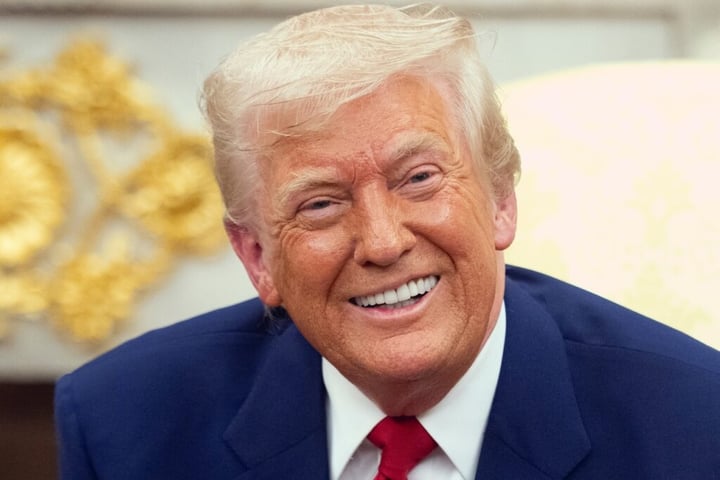
In a bold move on April 2, 2025, President Donald Trump announced a sweeping 10% baseline global tariff and reciprocal duties ranging from 11% to 50% on numerous countries, an event he termed “Liberation Day.” This declaration sent shockwaves through global financial markets, leading to significant volatility in stock prices and investor sentiment.
The immediate aftermath of the tariff announcement was marked by one of the most turbulent weeks in financial history. The major stock indexes experienced extreme fluctuations, culminating in both their worst two-day sell-off since the onset of the COVID-19 pandemic and one of their most substantial single-day rallies. According to data from Benzinga Pro, the performance of the U.S. markets in the days following the announcement was as follows:
Market Reaction: A Rollercoaster Week
The market witnessed a drastic response to the tariffs, with the Dow Jones, S&P 500, and Nasdaq all suffering heavy losses before staging a remarkable recovery. Here are the daily movements for the key indexes during that pivotal week:
– **April 3**: Initial fears of a global trade war led to a decline of 3.98% (-1,679 points) for the Dow Jones and an even sharper decline of 5.97% for the Nasdaq.
– **April 4**: Selling pressure intensified as China retaliated with its own 34% tariff, causing the Dow to drop another 5.20%.
– **April 7**: Market uncertainty led to wild swings, with unverified rumors of a delay resulting in a 2,500-point intra-day fluctuation.
– **April 8**: As the baseline 10% tariff came into effect, the indexes continued to decline, with the Dow dropping 0.80%.
– **April 9**: Following an announcement by Trump of a 90-day pause on the highest reciprocal rates for many allies, the markets rebounded sharply, with a 7.90% increase in the Dow.
– **April 10**: The euphoria was short-lived as the U.S. raised specific tariffs on China to 145%, leading to a 2.50% drop in the Dow.
The two-day loss from April 3 to April 4 resulted in an astonishing $6.6 trillion in market capitalization wiped out, according to the Wall Street Journal. Tech giants were particularly hard hit, with Apple shares plunging 9.4%, costing the company roughly $315 billion in market value.
Negotiation Tactics and Market Stabilization
Following the initial turmoil, Trump’s administration began to leverage trade policy as a negotiation tool. On April 9, the President’s announcement of a 90-day pause on reciprocal tariffs for countries that did not retaliate signaled a shift in strategy aimed at stabilizing the markets. By mid-summer, this led to truce agreements with countries such as the U.K., Japan, and South Korea, which replaced blanket tariffs with more targeted investment frameworks.
The dramatic fluctuations in market performance during this period highlighted the high levels of uncertainty among investors. The S&P 500’s 9.5% surge on April 9 marked its third-best single-day performance since 1940, indicating how much the market had reacted in anticipation of the worst-case scenario.
As 2025 draws to a close, the markets have shown a remarkable recovery. The S&P 500, tracked by the SPDR S&P 500 ETF Trust (NYSE:SPY), has increased by approximately 17%, rebounding over 30% from its lows in April. The Dow Jones, tracked by the SPDR Dow Jones Industrial Average ETF Trust (NYSE:DIA), gained 13% during the year and is up 28% from its April lows. Meanwhile, the Nasdaq 100, tracked by the Invesco QQQ Trust (NASDAQ:QQQ), has risen more than 21% in 2025 and is up over 50% from its lows.
While the Nasdaq is currently about 2.25% off its all-time high set on October 29, 2025, it has emerged as the top-performing major U.S. index for the year. The market’s response to Trump’s tariffs underscores the complexities of global trade and its direct impact on investor confidence and market stability.

Robinhood Stock Surges 2.5% Today Amid Tech Market Recovery

Philadelphia’s Earth Month Kicks Off with Free Events in Parks

GSK’s Inhaler Decision Sparks Health Concerns for Children

Bradford’s Fish Fry Fridays Offer Community Spirit and Flavor

Speculation Rises on Shutdowns During Trump’s Potential Presidency

Samsung Galaxy Watch 9 to Feature Larger Battery, Report Reveals

Inventors Find New Purpose Through Unconventional Paths

UConn Huskies Aim for Back-to-Back Titles in 2026 NCAA Tournament

U.S. Mine Countermeasure Ships Dock in Malaysia for Logistics Stop

University of Hawaiʻi at Mānoa Joins $25.6M AI Initiative for Disaster Monitoring

$2.2 Million Boost for Cancer Research and Training in Hawaiʻi

ALMA Discovers Companion Orbiting Red Giant Star π 1 Gruis

Sacituzumab Govitecan Shows Promise for HR+/HER2− Breast Cancer

币安人生 Sees $15.92 Million in Trading Volume Amid Market Fluctuations

New Gel Offers Hope for Regrowing Tooth Enamel in Dentistry

CAVA Group Shares Surge 5.1% Amid Mixed Analyst Ratings

Christian Bale in Talks to Join Leonardo DiCaprio in Heat 2

Supreme Court to Review Birthright Citizenship for Children of Immigrants
-
Science9 months ago
University of Hawaiʻi at Mānoa Joins $25.6M AI Initiative for Disaster Monitoring
-
 Health8 months ago
$2.2 Million Boost for Cancer Research and Training in Hawaiʻi
-
 Science9 months ago
ALMA Discovers Companion Orbiting Red Giant Star π 1 Gruis
-
 Health7 months ago
Sacituzumab Govitecan Shows Promise for HR+/HER2− Breast Cancer
-
Politics5 months ago
币安人生 Sees $15.92 Million in Trading Volume Amid Market Fluctuations
-
 Health9 months ago
New Gel Offers Hope for Regrowing Tooth Enamel in Dentistry
-
 Business8 months ago
CAVA Group Shares Surge 5.1% Amid Mixed Analyst Ratings
-
 Entertainment9 months ago
Christian Bale in Talks to Join Leonardo DiCaprio in Heat 2
-
 Politics8 months ago
Supreme Court to Review Birthright Citizenship for Children of Immigrants
-

 Lifestyle9 months ago
Art Deco and Traditional Designs Set to Transform Homes in 2026
-

 Lifestyle8 months ago
Fernando Mendoza Secures Maxwell and O’Brien Awards Ahead of Heisman
-

 World8 months ago
Swiss Residents Reject 50% Inheritance Tax on Wealthy