
Science
Ancient Rock Art Reveals Human Migration Insights in Sulawesi

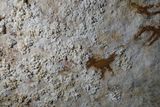
A recent study has identified rock art in Sulawesi, Indonesia, as the oldest known example of human artistic expression, dating back approximately 67,800 years. This discovery not only highlights the region’s rich cultural heritage but also provides critical insights into the early migrations of Homo sapiens from Asia to Australia.
The artwork, a stencil of a human hand found in the Liang Metanduno cave on the island of Muna, challenges previous timelines regarding the emergence of rock art. Researchers determined that this stencil predates other known cave paintings in the region by around 16,600 years. According to study author Maxime Aubert from the Griffith Centre for Social and Cultural Research, this finding indicates that Sulawesi was home to one of the world’s oldest artistic cultures, with roots tracing back to the earliest human settlement on the island.
Significance of Sulawesi in Human History
Sulawesi has emerged as a crucial site in understanding human history and migration patterns. The island not only showcases some of the oldest artistic expressions, including the depiction of human and animal figures, but it may have also acted as a stepping stone for early humans migrating to Sahul, the paleocontinent that once connected Australia, New Guinea, and Tasmania.
The newly discovered stencil, which has a claw-like appearance, was created by an artist likely related to the ancestors of Aboriginal Australians. Study co-author Adhi Agus Oktaviana, from Indonesia’s National Research and Innovation Agency, stated, “It is very likely that the people who made these paintings in Sulawesi were part of the broader population that would later spread through the region and ultimately reach Australia.” This further strengthens the hypothesis that the ancestors of the First Australians occupied Sahul by 65,000 years ago.
The research team utilized advanced dating techniques, including uranium-series dating and mineral deposit analysis, to accurately date the stencil. The findings are detailed in a study published in the journal Nature.
Tracing Migration Routes and Artistic Heritage
Previous studies suggested two primary timelines for the arrival of H. sapiens in Sahul: the “long chronology” around 65,000 years ago and the “short chronology” around 50,000 years ago. These studies proposed that early humans arrived through either a northern route via Sulawesi or a southern route through Timor.
The Liang Metanduno cave is significant not only for its ancient art but also for the presence of younger paintings, indicating a long period of human occupation—possibly exceeding 35,000 years. “With the dating of this extremely ancient rock art in Sulawesi, we now have the oldest direct evidence for the presence of modern humans along this northern migration corridor into Sahul,” noted Renaud Joannes-Boyau from Southern Cross University.
Looking ahead, the research team plans to explore additional sites along the northern migration route, emphasizing the archaeological importance of other Indonesian islands between Sulawesi and New Guinea. “These discoveries underscore the archaeological importance of the many other Indonesian islands between Sulawesi and New Guinea,” Aubert commented, highlighting the ongoing quest to understand human artistic and migratory history.
As this study reveals, the art found in Sulawesi serves as a vital link to understanding the early journeys of our ancestors. The implications of these findings extend far beyond the cave walls, offering a glimpse into the lives and movements of ancient human populations.

Robinhood Stock Surges 2.5% Today Amid Tech Market Recovery

Philadelphia’s Earth Month Kicks Off with Free Events in Parks

GSK’s Inhaler Decision Sparks Health Concerns for Children

Bradford’s Fish Fry Fridays Offer Community Spirit and Flavor

Speculation Rises on Shutdowns During Trump’s Potential Presidency

Samsung Galaxy Watch 9 to Feature Larger Battery, Report Reveals

Inventors Find New Purpose Through Unconventional Paths

UConn Huskies Aim for Back-to-Back Titles in 2026 NCAA Tournament

U.S. Mine Countermeasure Ships Dock in Malaysia for Logistics Stop

University of Hawaiʻi at Mānoa Joins $25.6M AI Initiative for Disaster Monitoring

$2.2 Million Boost for Cancer Research and Training in Hawaiʻi

ALMA Discovers Companion Orbiting Red Giant Star π 1 Gruis

Sacituzumab Govitecan Shows Promise for HR+/HER2− Breast Cancer

币安人生 Sees $15.92 Million in Trading Volume Amid Market Fluctuations

New Gel Offers Hope for Regrowing Tooth Enamel in Dentistry

CAVA Group Shares Surge 5.1% Amid Mixed Analyst Ratings

Christian Bale in Talks to Join Leonardo DiCaprio in Heat 2

Supreme Court to Review Birthright Citizenship for Children of Immigrants
-
Science9 months ago
University of Hawaiʻi at Mānoa Joins $25.6M AI Initiative for Disaster Monitoring
-
 Health7 months ago
$2.2 Million Boost for Cancer Research and Training in Hawaiʻi
-
 Science8 months ago
ALMA Discovers Companion Orbiting Red Giant Star π 1 Gruis
-
 Health7 months ago
Sacituzumab Govitecan Shows Promise for HR+/HER2− Breast Cancer
-
Politics5 months ago
币安人生 Sees $15.92 Million in Trading Volume Amid Market Fluctuations
-
 Health9 months ago
New Gel Offers Hope for Regrowing Tooth Enamel in Dentistry
-
 Business7 months ago
CAVA Group Shares Surge 5.1% Amid Mixed Analyst Ratings
-
 Entertainment8 months ago
Christian Bale in Talks to Join Leonardo DiCaprio in Heat 2
-
 Politics7 months ago
Supreme Court to Review Birthright Citizenship for Children of Immigrants
-

 Lifestyle8 months ago
Art Deco and Traditional Designs Set to Transform Homes in 2026
-

 Lifestyle7 months ago
Fernando Mendoza Secures Maxwell and O’Brien Awards Ahead of Heisman
-

 World8 months ago
Swiss Residents Reject 50% Inheritance Tax on Wealthy