
Science
Astronomers Unravel Mystery of Seven-Hour Gamma-Ray Burst

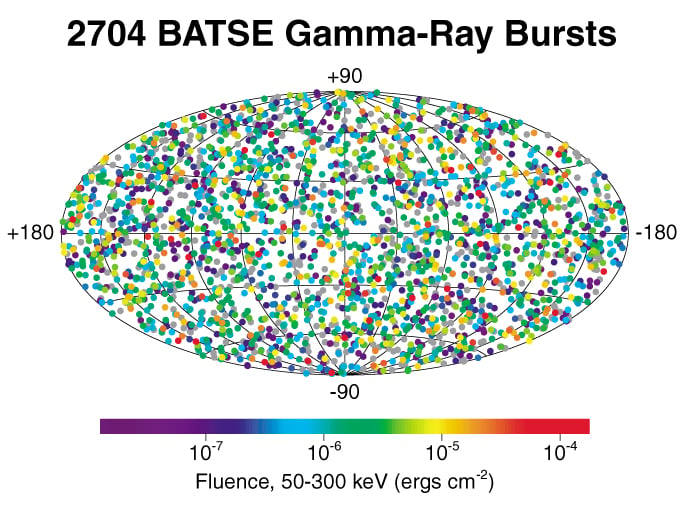
On July 2, 2025, astronomers observed a remarkable event in the cosmos: a gamma-ray burst that lasted for an unprecedented seven hours. Identified as GRB 250702B by NASA’s Fermi Gamma-ray Space Telescope, this burst is the longest of its kind ever recorded, surpassing the duration of approximately 15,000 previously catalogued gamma-ray bursts since the phenomenon was first recognized in 1973. Unlike typical gamma-ray bursts, which are fleeting and typically result from cataclysmic events such as neutron star collisions or the collapse of massive stars, GRB 250702B displayed a series of three distinct bursts throughout the day, followed by an afterglow that continued for months.
The groundbreaking nature of this discovery has prompted extensive investigation among astronomers. “This is certainly an outburst unlike any other we’ve seen in the past 50 years,” remarked a member of the detection team. The search for an explanation has become a focal point for researchers eager to understand this unique cosmic event.
Exploring the Intermediate Mass Black Hole Theory
A recent paper published in the Monthly Notices of the Royal Astronomical Society proposes a compelling theory: that GRB 250702B may have originated from an intermediate mass black hole (IMBH). These black holes, which range from a few hundred to a hundred thousand solar masses, have remained elusive in astronomical research. While stellar mass black holes form from the remnants of massive stars, and supermassive black holes reside at the centers of galaxies, IMBHs represent a largely uncharted territory.
The proposed mechanism behind GRB 250702B suggests that a star similar to our Sun wandered too close to an IMBH. Tidal forces from the black hole could have torn the star apart, with the fragmented material spiraling inward and powering a relativistic jet of particles moving nearly at the speed of light. This process could explain the extraordinary gamma-ray emissions detected by Fermi.
The repeated bursts observed during the event align with this theory. Researchers theorize that the star might not have been entirely destroyed in a single encounter. Instead, it could have been partially stripped during multiple close passes, each generating bursts of emissions that account for the spacing of the three Fermi triggers.
Significance of the Discovery
Adding to the intrigue, the location of GRB 250702B is approximately 5.7 kiloparsecs from the center of its host galaxy, positioning it well away from the supermassive black hole typically found at a galaxy’s core. This distance supports the idea that an IMBH could be lurking nearby. If confirmed, GRB 250702B would mark the first instance of humanity witnessing a relativistic jet produced by an IMBH actively consuming a star. The implications of such a discovery would be profound, positioning it as one of the most significant astronomical events of the decade.
Despite the potential breakthrough, the scientific community remains cautious. Competing models still exist, and the evidence surrounding the event is not universally accepted. The field of astronomy thrives on such puzzles, where the most illuminating discoveries often emerge unexpectedly. A seven-hour explosion that defies conventional explanations may lead to new insights into the universe’s enigmatic phenomena.

Robinhood Stock Surges 2.5% Today Amid Tech Market Recovery

Philadelphia’s Earth Month Kicks Off with Free Events in Parks

GSK’s Inhaler Decision Sparks Health Concerns for Children

Bradford’s Fish Fry Fridays Offer Community Spirit and Flavor

Speculation Rises on Shutdowns During Trump’s Potential Presidency

Samsung Galaxy Watch 9 to Feature Larger Battery, Report Reveals

Inventors Find New Purpose Through Unconventional Paths

UConn Huskies Aim for Back-to-Back Titles in 2026 NCAA Tournament

U.S. Mine Countermeasure Ships Dock in Malaysia for Logistics Stop

University of Hawaiʻi at Mānoa Joins $25.6M AI Initiative for Disaster Monitoring

$2.2 Million Boost for Cancer Research and Training in Hawaiʻi

ALMA Discovers Companion Orbiting Red Giant Star π 1 Gruis

Sacituzumab Govitecan Shows Promise for HR+/HER2− Breast Cancer

币安人生 Sees $15.92 Million in Trading Volume Amid Market Fluctuations

New Gel Offers Hope for Regrowing Tooth Enamel in Dentistry

CAVA Group Shares Surge 5.1% Amid Mixed Analyst Ratings

Christian Bale in Talks to Join Leonardo DiCaprio in Heat 2

Supreme Court to Review Birthright Citizenship for Children of Immigrants
-
Science9 months ago
University of Hawaiʻi at Mānoa Joins $25.6M AI Initiative for Disaster Monitoring
-
 Health7 months ago
$2.2 Million Boost for Cancer Research and Training in Hawaiʻi
-
 Science9 months ago
ALMA Discovers Companion Orbiting Red Giant Star π 1 Gruis
-
 Health7 months ago
Sacituzumab Govitecan Shows Promise for HR+/HER2− Breast Cancer
-
Politics5 months ago
币安人生 Sees $15.92 Million in Trading Volume Amid Market Fluctuations
-
 Health9 months ago
New Gel Offers Hope for Regrowing Tooth Enamel in Dentistry
-
 Business8 months ago
CAVA Group Shares Surge 5.1% Amid Mixed Analyst Ratings
-
 Entertainment8 months ago
Christian Bale in Talks to Join Leonardo DiCaprio in Heat 2
-
 Politics8 months ago
Supreme Court to Review Birthright Citizenship for Children of Immigrants
-

 Lifestyle8 months ago
Art Deco and Traditional Designs Set to Transform Homes in 2026
-

 Lifestyle8 months ago
Fernando Mendoza Secures Maxwell and O’Brien Awards Ahead of Heisman
-

 World8 months ago
Swiss Residents Reject 50% Inheritance Tax on Wealthy