
Science
Innovative Vaccine Design Uses Deformable Adjuvants to Boost Immunity

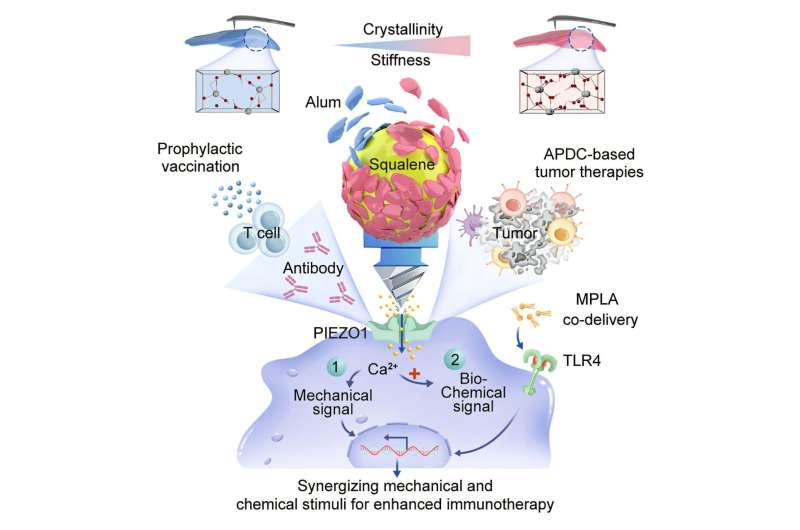
A research team led by Prof. Xia Yufei from the Institute of Process Engineering (IPE) of the Chinese Academy of Sciences has made significant strides in vaccine development by enhancing immune activation through innovative adjuvant design. Published on January 8, 2026, in the journal Cell Biomaterials, the study reveals that redesigning conventional aluminum adjuvants into a deformable, three-dimensional interface can markedly improve immune responses, particularly in elderly or low-responsive populations.
Traditional vaccine adjuvants primarily rely on molecular binding and biochemical stimulation to activate the immune system. However, these methods often yield limited efficacy, especially in aging individuals. The challenge has been to effectively introduce physical regulation into immune activation processes. The new approach taken by the researchers involves the construction of aluminum-stabilized Pickering emulsions (ASPEs). These emulsions enable dendritic cells (DCs) to engage actively with mechanical cues at the interface, leading to a significant boost in immune responses.
The ASPE droplets deform upon contact with DC membranes, which increases the interfacial contact area and delivers precise mechanical stress. By adjusting the crystallinity of aluminum nanoparticles, the researchers can regulate the interfacial stiffness, allowing for controlled mechanical stimulation. This is particularly important as stronger mechanical cues activate the mechanosensitive ion channel PIEZO1, triggering a calcium influx that promotes antigen cross-presentation.
In a notable advancement, when the ASPE platform is combined with the TLR4 agonist monophosphoryl lipid A (MPLA), it achieves a synergistic effect. The results indicate that the ASPE-M formulation induces stronger dendritic cell maturation compared to the conventional Alum+MPLA formulation. Additionally, it enhances Th1-biased immunity and elicits robust responses from CD8+ T-cells.
The effectiveness of this innovative approach is particularly pronounced in aged mouse models, where it significantly improves therapeutic outcomes in dendritic cell-based melanoma immunotherapy. The synergy with PD-1 blockade further amplifies these benefits, suggesting a promising avenue for enhancing immunotherapy in challenging patient populations.
Overall, this research establishes that interfacial mechanics play a critical role in immune regulation, complementing traditional biochemical signaling methods. The findings present a new strategy for vaccine and immunotherapy design, with significant potential for improving immune efficacy in aging and immunocompromised populations.
For further details on this study, refer to the original publication: Yali Ming et al., “Drilling dendritic cell activation: Engineering interfacial mechano-biochemical cues for enhanced immunotherapy,” in Cell Biomaterials (2025). DOI: 10.1016/j.celbio.2025.100281.

Robinhood Stock Surges 2.5% Today Amid Tech Market Recovery

Philadelphia’s Earth Month Kicks Off with Free Events in Parks

GSK’s Inhaler Decision Sparks Health Concerns for Children

Bradford’s Fish Fry Fridays Offer Community Spirit and Flavor

Speculation Rises on Shutdowns During Trump’s Potential Presidency

Samsung Galaxy Watch 9 to Feature Larger Battery, Report Reveals

Inventors Find New Purpose Through Unconventional Paths

UConn Huskies Aim for Back-to-Back Titles in 2026 NCAA Tournament

U.S. Mine Countermeasure Ships Dock in Malaysia for Logistics Stop

University of Hawaiʻi at Mānoa Joins $25.6M AI Initiative for Disaster Monitoring

$2.2 Million Boost for Cancer Research and Training in Hawaiʻi

ALMA Discovers Companion Orbiting Red Giant Star π 1 Gruis

Sacituzumab Govitecan Shows Promise for HR+/HER2− Breast Cancer

币安人生 Sees $15.92 Million in Trading Volume Amid Market Fluctuations

New Gel Offers Hope for Regrowing Tooth Enamel in Dentistry

CAVA Group Shares Surge 5.1% Amid Mixed Analyst Ratings

Christian Bale in Talks to Join Leonardo DiCaprio in Heat 2

Supreme Court to Review Birthright Citizenship for Children of Immigrants
-
Science9 months ago
University of Hawaiʻi at Mānoa Joins $25.6M AI Initiative for Disaster Monitoring
-
 Health7 months ago
$2.2 Million Boost for Cancer Research and Training in Hawaiʻi
-
 Science9 months ago
ALMA Discovers Companion Orbiting Red Giant Star π 1 Gruis
-
 Health7 months ago
Sacituzumab Govitecan Shows Promise for HR+/HER2− Breast Cancer
-
Politics5 months ago
币安人生 Sees $15.92 Million in Trading Volume Amid Market Fluctuations
-
 Health9 months ago
New Gel Offers Hope for Regrowing Tooth Enamel in Dentistry
-
 Business8 months ago
CAVA Group Shares Surge 5.1% Amid Mixed Analyst Ratings
-
 Entertainment8 months ago
Christian Bale in Talks to Join Leonardo DiCaprio in Heat 2
-
 Politics8 months ago
Supreme Court to Review Birthright Citizenship for Children of Immigrants
-

 Lifestyle8 months ago
Art Deco and Traditional Designs Set to Transform Homes in 2026
-

 Lifestyle8 months ago
Fernando Mendoza Secures Maxwell and O’Brien Awards Ahead of Heisman
-

 World8 months ago
Swiss Residents Reject 50% Inheritance Tax on Wealthy