
Science
Medieval Burials Reveal Menga Dolmen’s Cultural Legacy

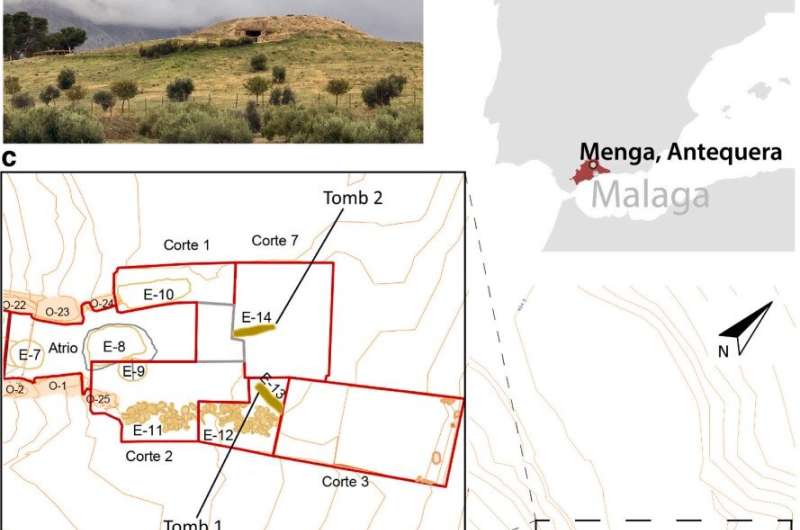
The Menga dolmen, an ancient Neolithic monument located in Antequera, Spain, has revealed new insights into its cultural significance through a study that combines DNA analysis of medieval burials with historical context. Dating back to the fourth millennium BCE, this UNESCO World Heritage site has served as a burial and ritual location for various communities over thousands of years. The findings were published on January 14, 2026, in the Journal of Archaeological Science: Reports.
This megalithic structure, characterized by a long chamber and access corridor covered by an earthen mound, was originally used for collective burials by Neolithic communities. Evidence from pottery and human remains indicates that the dolmen continued to be utilized during later historical periods, especially between the 2nd and 4th centuries AD, when significant funerary activities occurred. The recent study highlights two specific burials from medieval times, dated approximately to the 8th century AD and the 11th century AD, based on radiocarbon dating of skeletal remains.
The research team noted that the remains were poorly preserved, making it difficult to establish genetic relationships between the individuals. Despite this, similarities in the positioning of the burials were evident. Both individuals were found with their heads lying on their right side and facing southwest, aligned with the monument’s axis of symmetry. Their faces were directed toward the southeast, a detail that suggests a potential connection to Islamic burial practices.
At the time of these burials, the Iberian Peninsula was under Islamic rule, coexisting with Christian, Jewish, and possibly pagan communities. The blending of burial rituals observed in these remains reflects the complex cultural tapestry of medieval Iberia. The authors of the study stated, “The position and orientation of the remains, together with the radiocarbon dates, could be indicative of Islamic burials.” However, they also acknowledged that the symbolic alignment with the Menga dolmen’s axis complicates the interpretation of these burials within the multicultural society of the time.
DNA analysis conducted on the individuals revealed a diverse genetic lineage, particularly for the individual designated as “Menga1.” This male displayed a European Y-chromosome lineage, while his mitochondrial DNA (mtDNA) was found to share connections with some modern North Africans. The autosomal DNA analysis uncovered a mix of 44% Iberian, 18% North African, and 37% Levantine ancestry.
The study’s authors highlighted that North African-related ancestry had been present in southern Iberia since at least the 3rd or 4th centuries CE, likely due to extensive trade and movement across the Mediterranean fostered by Greek, Phoenician, and Carthaginian interactions, as well as later Roman influences. With the onset of the Islamic period in 711 CE, these connections with North Africa likely intensified, facilitated by shared political and cultural practices.
This research not only sheds light on the cultural diversity in medieval Spain but also emphasizes the Menga dolmen’s prolonged usage and significance over the millennia. The authors concluded, “Whoever these two individuals were—and regardless of what faith they practiced—the fact that they were both given inhumations aligned with the axis of a megalithic monument, in a site of remarkable prominence in the landscape of Antequera, approximately two centuries apart, highlights the continuity of Menga as a symbolic location for over 5000 years—and possibly even longer—well beyond the Neolithic period.”
These findings underscore the importance of the Menga dolmen as a crucial site for understanding the rich cultural history of the region, reflecting the interactions and beliefs of its diverse communities through the ages. The study, led by researchers including Marina Silva, showcases the enduring legacy of this ancient monument and its role in the historical narrative of Spain.

Robinhood Stock Surges 2.5% Today Amid Tech Market Recovery

Philadelphia’s Earth Month Kicks Off with Free Events in Parks

GSK’s Inhaler Decision Sparks Health Concerns for Children

Bradford’s Fish Fry Fridays Offer Community Spirit and Flavor

Speculation Rises on Shutdowns During Trump’s Potential Presidency

Samsung Galaxy Watch 9 to Feature Larger Battery, Report Reveals

Inventors Find New Purpose Through Unconventional Paths

UConn Huskies Aim for Back-to-Back Titles in 2026 NCAA Tournament

U.S. Mine Countermeasure Ships Dock in Malaysia for Logistics Stop

University of Hawaiʻi at Mānoa Joins $25.6M AI Initiative for Disaster Monitoring

$2.2 Million Boost for Cancer Research and Training in Hawaiʻi

ALMA Discovers Companion Orbiting Red Giant Star π 1 Gruis

Sacituzumab Govitecan Shows Promise for HR+/HER2− Breast Cancer

币安人生 Sees $15.92 Million in Trading Volume Amid Market Fluctuations

New Gel Offers Hope for Regrowing Tooth Enamel in Dentistry

CAVA Group Shares Surge 5.1% Amid Mixed Analyst Ratings

Christian Bale in Talks to Join Leonardo DiCaprio in Heat 2

Supreme Court to Review Birthright Citizenship for Children of Immigrants
-
Science9 months ago
University of Hawaiʻi at Mānoa Joins $25.6M AI Initiative for Disaster Monitoring
-
 Health7 months ago
$2.2 Million Boost for Cancer Research and Training in Hawaiʻi
-
 Science8 months ago
ALMA Discovers Companion Orbiting Red Giant Star π 1 Gruis
-
 Health7 months ago
Sacituzumab Govitecan Shows Promise for HR+/HER2− Breast Cancer
-
Politics5 months ago
币安人生 Sees $15.92 Million in Trading Volume Amid Market Fluctuations
-
 Health9 months ago
New Gel Offers Hope for Regrowing Tooth Enamel in Dentistry
-
 Business7 months ago
CAVA Group Shares Surge 5.1% Amid Mixed Analyst Ratings
-
 Entertainment8 months ago
Christian Bale in Talks to Join Leonardo DiCaprio in Heat 2
-
 Politics7 months ago
Supreme Court to Review Birthright Citizenship for Children of Immigrants
-

 Lifestyle8 months ago
Art Deco and Traditional Designs Set to Transform Homes in 2026
-

 Lifestyle7 months ago
Fernando Mendoza Secures Maxwell and O’Brien Awards Ahead of Heisman
-

 World8 months ago
Swiss Residents Reject 50% Inheritance Tax on Wealthy