
Science
Yale Students Launch Scroll Toll App to Curb Screen Time and Aid Charity

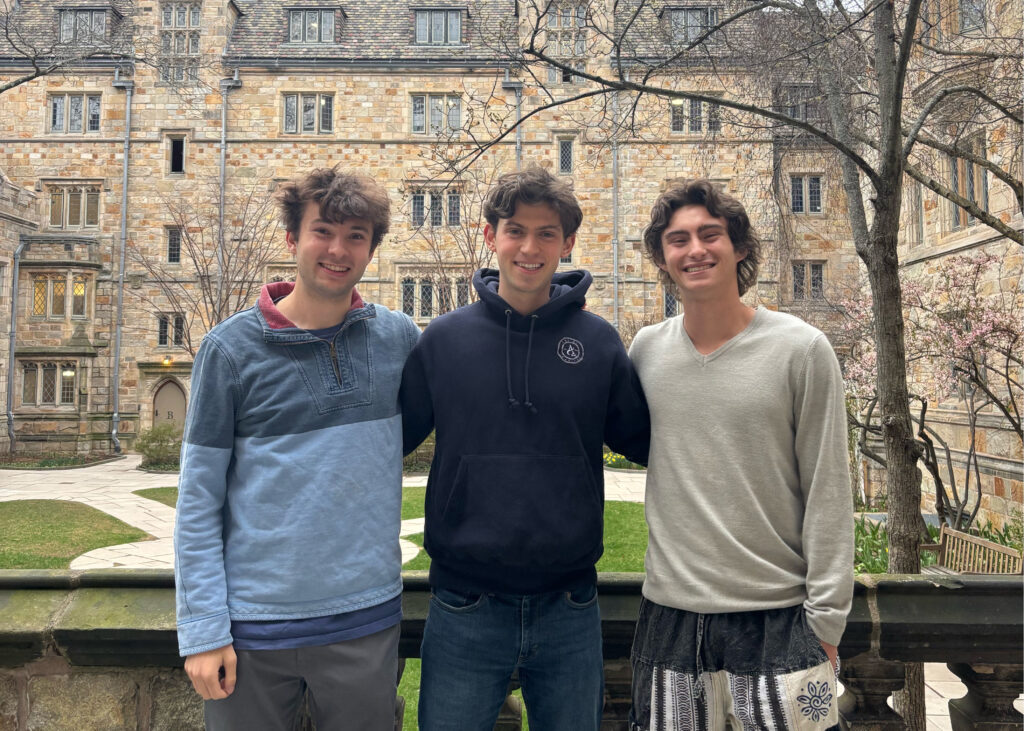
Three students from Yale University have introduced an innovative app, **Scroll Toll**, designed to help users reduce their screen time while supporting charitable organizations. Launched in **November 2023** by **Asher Barondes** (Class of 2026), **Benjamin Siegel** (Class of 2029), and **Chase Reynders** (Class of 2026), the app allows individuals to set limits on their app usage. When users exceed these limits, Scroll Toll encourages them to make a donation to one of several selected charities.
Barondes, who is responsible for the app’s interface and marketing, explained the motivation behind the app. “We wanted to add more friction to really get people off their phones,” he stated. By tying financial consequences to excessive usage, the app aims to promote social good through charitable contributions. Users can choose a donation amount for every time they exceed their set limits. For instance, a user might opt to donate **$0.25** for every additional five minutes spent on social media platforms like Instagram.
Upon downloading Scroll Toll, users establish their desired app usage limits and select their donation preferences. The app also offers an option for “scheduled fulfillment,” allowing users to automate their donations or choose to donate manually. This flexibility enables users to manage their donations according to their circumstances.
Siegel emphasized the importance of establishing a balance between time and money in changing behavior. He drew a parallel to congestion pricing in urban settings, suggesting that financial incentives can effectively influence app usage habits.
The trio’s collaboration began when Barondes and Siegel, who were both independently working on similar projects, connected through mutual friends. They soon invited Reynders to join their efforts. Siegel’s experience during a gap year, where he gained significant social media exposure through his Instagram account, influenced his perspective on screen time. Reflecting on his past, he realized how quickly time can slip away in the digital realm.
As of **January 2024**, Scroll Toll has attracted **130 users**, and initial feedback has been promising. Barondes noted that even with a modest sample size of **65 users**, they observed an average reduction of **20% to 30%** in screen time. Users have reported a greater awareness of their phone usage and a newfound ability to set realistic limits.
One user, **Evan Daneker** (Class of 2026), expressed his appreciation for Scroll Toll’s approach. He noted that unlike other screen time management apps that completely block access to certain applications, Scroll Toll allows users to set their own boundaries. This more flexible approach keeps users engaged rather than driving them to uninstall the app.
Another user, **Sofia Jacobson** (Class of 2026), who had never used a screen time blocker before, found Scroll Toll helpful in creating manageable limits. The app prompted her to reconsider her phone habits, particularly when it came to aimless scrolling.
The developers are also keen to enhance their collaboration with partner charities and plan to introduce monthly challenges, such as focusing on charities linked to breast cancer during **Breast Cancer Awareness Month** in **October**.
While they recognize that not every user may respond to financial incentives—especially for donations that might total **$6 or $7** per month—Barondes, Siegel, and Reynders believe there is a specific audience that will benefit from their app. Reynders concluded, “We know this isn’t for everybody, but for those it is for, it really is for.”
With their innovative approach to managing screen time and supporting charitable initiatives, the Scroll Toll team aims to foster healthier digital habits while contributing to meaningful causes.

Robinhood Stock Surges 2.5% Today Amid Tech Market Recovery

Philadelphia’s Earth Month Kicks Off with Free Events in Parks

GSK’s Inhaler Decision Sparks Health Concerns for Children

Bradford’s Fish Fry Fridays Offer Community Spirit and Flavor

Speculation Rises on Shutdowns During Trump’s Potential Presidency

Samsung Galaxy Watch 9 to Feature Larger Battery, Report Reveals

Inventors Find New Purpose Through Unconventional Paths

UConn Huskies Aim for Back-to-Back Titles in 2026 NCAA Tournament

U.S. Mine Countermeasure Ships Dock in Malaysia for Logistics Stop

University of Hawaiʻi at Mānoa Joins $25.6M AI Initiative for Disaster Monitoring

$2.2 Million Boost for Cancer Research and Training in Hawaiʻi

ALMA Discovers Companion Orbiting Red Giant Star π 1 Gruis

Sacituzumab Govitecan Shows Promise for HR+/HER2− Breast Cancer

币安人生 Sees $15.92 Million in Trading Volume Amid Market Fluctuations

New Gel Offers Hope for Regrowing Tooth Enamel in Dentistry

CAVA Group Shares Surge 5.1% Amid Mixed Analyst Ratings

Christian Bale in Talks to Join Leonardo DiCaprio in Heat 2

Supreme Court to Review Birthright Citizenship for Children of Immigrants
-
Science9 months ago
University of Hawaiʻi at Mānoa Joins $25.6M AI Initiative for Disaster Monitoring
-
 Health7 months ago
$2.2 Million Boost for Cancer Research and Training in Hawaiʻi
-
 Science8 months ago
ALMA Discovers Companion Orbiting Red Giant Star π 1 Gruis
-
 Health7 months ago
Sacituzumab Govitecan Shows Promise for HR+/HER2− Breast Cancer
-
Politics5 months ago
币安人生 Sees $15.92 Million in Trading Volume Amid Market Fluctuations
-
 Health9 months ago
New Gel Offers Hope for Regrowing Tooth Enamel in Dentistry
-
 Business7 months ago
CAVA Group Shares Surge 5.1% Amid Mixed Analyst Ratings
-
 Entertainment8 months ago
Christian Bale in Talks to Join Leonardo DiCaprio in Heat 2
-
 Politics7 months ago
Supreme Court to Review Birthright Citizenship for Children of Immigrants
-

 Lifestyle8 months ago
Art Deco and Traditional Designs Set to Transform Homes in 2026
-

 Lifestyle7 months ago
Fernando Mendoza Secures Maxwell and O’Brien Awards Ahead of Heisman
-

 World8 months ago
Swiss Residents Reject 50% Inheritance Tax on Wealthy