
Top Stories
Indianapolis Reverses One-Way Streets to Boost Safety, Community

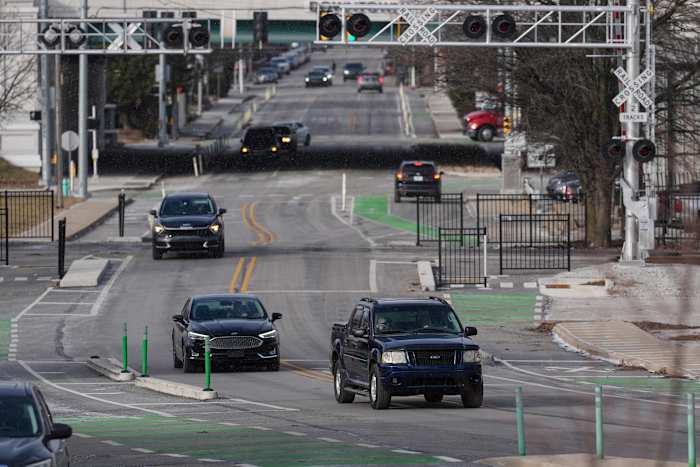
UPDATE: Indianapolis city officials have just announced a major transformation of local traffic patterns, reversing the long-standing trend of one-way streets in favor of two-way routes. This change aims to enhance safety and revitalize community engagement along Michigan and New York Streets, which were notorious for excessive speeding.
Residents often referred to these parallel roads as a “racetrack,” a nod to the nearby Indianapolis Motor Speedway. Originally converted to one-way streets in the 1970s to facilitate the commute for thousands of RCA employees, these roads became hazardous after the plant’s closure in 1995. The city’s decision to revert them back to two-way streets last year marks a pivotal shift in urban planning.
James Taylor, who runs a community center near the former RCA site, expressed optimism about the transformation. “The opening and conversion of those streets has just been transformative for how people think about that corridor,” he stated. The initiative aligns with a growing trend among U.S. midsize cities aiming to improve safety and attractiveness for shoppers, diners, and potential residents.
The rationale behind the shift is clear. According to Dave Amos, an assistant professor of city and regional planning, “One-way streets are designed for moving cars quickly and efficiently.” This design prioritizes vehicles over pedestrians and cyclists, making them more vulnerable.
Moreover, Wade Walker, an engineer with Kittelson & Associates, highlighted a common misconception: “There is a misperception that one-way streets are safer because people on foot only have to look one direction.” The reality is more complex. Intersecting one-way and two-way streets create numerous potential conflicts for pedestrians, complicating safe crossings.
Cities across the nation are taking note. Louisville, Kentucky, just two hours south of Indianapolis, is also restoring one-way streets to their original two-way format. This includes a significant redesign along Main Street that connects major cultural landmarks. Michael King, Louisville’s assistant director of transportation planning, remarked on the negative impact of past one-way conversions, stating that they “decimated neighborhoods” and stifled local businesses.
Indianapolis is not alone in recognizing the value of two-way streets. In Chattanooga, Tennessee, the conversion of two-way streets to one-way resulted in a surge of business vacancies and cut off access to the University of Tennessee. Walker noted that post-conversion, the campus saw rapid growth and revitalization.
As communities adjust to these changes, some skeptics have shifted their perspectives. Rodney Taylor, a restaurant owner in Lynchburg, Virginia, initially feared that converting Main Street back to two-way would harm his business. After the project was completed in 2021, he admitted, “An important thing to do is to admit when you’re wrong.”
In Austin, Texas, local leaders are advocating for a complete reversal of their one-way street system after witnessing the benefits of recent conversions. “It just worked,” said Adam Greenfield, executive director of Safe Streets Austin.
In contrast, Chicago faced backlash after converting several two-way streets to one-way in a busy restaurant district, prompting confusion among residents. Alderman Bill Conway criticized the lack of community input in the decision-making process.
Looking ahead, Indianapolis plans to convert an additional 10 streets, with an estimated cost of $60 million, partially funded by a $25 million federal grant received in 2023. Mark St. John, chief engineer for the city’s Department of Public Works, confirmed these upcoming projects are aimed at further enhancing safety and fostering community interactions.
As Indianapolis embarks on this transformative journey, Taylor reflects on the changing landscape: “It’s all kind of familiar, but you’re coming at it from a whole different perspective.” The community eagerly anticipates the positive impacts of these changes in the coming months.
Stay tuned for more updates on Indianapolis’ ongoing urban revitalization efforts.

Robinhood Stock Surges 2.5% Today Amid Tech Market Recovery

Philadelphia’s Earth Month Kicks Off with Free Events in Parks

GSK’s Inhaler Decision Sparks Health Concerns for Children

Bradford’s Fish Fry Fridays Offer Community Spirit and Flavor

Speculation Rises on Shutdowns During Trump’s Potential Presidency

Samsung Galaxy Watch 9 to Feature Larger Battery, Report Reveals

Inventors Find New Purpose Through Unconventional Paths

UConn Huskies Aim for Back-to-Back Titles in 2026 NCAA Tournament

U.S. Mine Countermeasure Ships Dock in Malaysia for Logistics Stop

University of Hawaiʻi at Mānoa Joins $25.6M AI Initiative for Disaster Monitoring

$2.2 Million Boost for Cancer Research and Training in Hawaiʻi

ALMA Discovers Companion Orbiting Red Giant Star π 1 Gruis

Sacituzumab Govitecan Shows Promise for HR+/HER2− Breast Cancer

币安人生 Sees $15.92 Million in Trading Volume Amid Market Fluctuations

New Gel Offers Hope for Regrowing Tooth Enamel in Dentistry

CAVA Group Shares Surge 5.1% Amid Mixed Analyst Ratings

Christian Bale in Talks to Join Leonardo DiCaprio in Heat 2

Supreme Court to Review Birthright Citizenship for Children of Immigrants
-
Science9 months ago
University of Hawaiʻi at Mānoa Joins $25.6M AI Initiative for Disaster Monitoring
-
 Health7 months ago
$2.2 Million Boost for Cancer Research and Training in Hawaiʻi
-
 Science8 months ago
ALMA Discovers Companion Orbiting Red Giant Star π 1 Gruis
-
 Health7 months ago
Sacituzumab Govitecan Shows Promise for HR+/HER2− Breast Cancer
-
Politics5 months ago
币安人生 Sees $15.92 Million in Trading Volume Amid Market Fluctuations
-
 Health9 months ago
New Gel Offers Hope for Regrowing Tooth Enamel in Dentistry
-
 Business7 months ago
CAVA Group Shares Surge 5.1% Amid Mixed Analyst Ratings
-
 Entertainment8 months ago
Christian Bale in Talks to Join Leonardo DiCaprio in Heat 2
-
 Politics7 months ago
Supreme Court to Review Birthright Citizenship for Children of Immigrants
-

 Lifestyle8 months ago
Art Deco and Traditional Designs Set to Transform Homes in 2026
-

 Lifestyle7 months ago
Fernando Mendoza Secures Maxwell and O’Brien Awards Ahead of Heisman
-

 World8 months ago
Swiss Residents Reject 50% Inheritance Tax on Wealthy