
World
New Delhi Chokes on Hazardous Air Quality After Diwali Celebrations

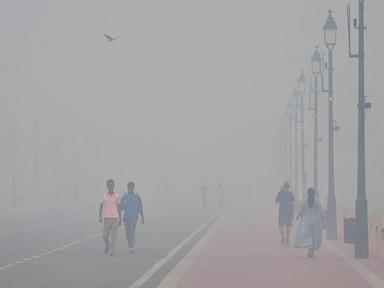
Thick smog enveloped New Delhi on November 14, 2023, following the widespread use of fireworks during the Hindu festival of Diwali. Millions of revelers celebrated late into the night, igniting firecrackers that significantly increased air pollution levels across the city. By Tuesday morning, the Air Quality Index (AQI) had surged above 350 in several neighborhoods, categorizing the air quality as “severe” and posing serious health risks, according to the World Health Organization’s guidelines.
Visibility dropped dramatically in various areas of the capital, with a gray haze obscuring streets, high-rises, and historical landmarks. “I have never seen anything like this before. We can’t see anything here because of pollution,” remarked Vedant Pachkande, a tourist visiting New Delhi.
Regulations and Enforcement Challenges
In a bid to address the pollution crisis, India’s Supreme Court had recently lifted a blanket ban on firecrackers for Diwali, permitting the use of “green firecrackers.” These alternative products, developed by federal research institutes, are designed to emit approximately 30% fewer pollutants. The court allowed their use during specified hours from November 11 to November 14, but enforcement proved challenging, as many residents ignored the restrictions.
New Delhi, along with its metropolitan area, is home to over 30 million people and consistently ranks among the world’s most polluted cities, especially during winter. This period coincides with both Diwali celebrations and agricultural burning in nearby states, which exacerbate the air quality crisis. Authorities have implemented measures such as limiting construction activities and restricting the operation of diesel generators to combat pollution levels.
Long-Term Solutions Needed
Despite these short-term interventions, environmentalists stress that sustainable solutions are crucial. They advocate for cleaner energy sources and stricter vehicle emission regulations to effectively mitigate the annual pollution crisis.
Recent studies highlight the broader implications of rising pollution levels, including a decrease in sunshine hours across India. Research published in Scientific Reports reveals that the amount of strong sunlight reaching the Earth has steadily declined due to increasing aerosols—tiny particles from industrial emissions, biomass burning, and vehicle pollution. “We see a greater impact in more polluted regions such as northern India,” stated Manoj K. Srivastava, a scientist at Banaras Hindu University and one of the study’s authors.
The reduction in sunlight could significantly impact India’s solar energy generation and agricultural productivity, in addition to affecting public health and the local environment.
As New Delhi grapples with the aftermath of Diwali celebrations, the urgent need for comprehensive strategies to address air pollution becomes increasingly clear. Without meaningful action, the city may continue to face hazardous air quality levels each year during festive periods.

Robinhood Stock Surges 2.5% Today Amid Tech Market Recovery

Philadelphia’s Earth Month Kicks Off with Free Events in Parks

GSK’s Inhaler Decision Sparks Health Concerns for Children

Bradford’s Fish Fry Fridays Offer Community Spirit and Flavor

Speculation Rises on Shutdowns During Trump’s Potential Presidency

Samsung Galaxy Watch 9 to Feature Larger Battery, Report Reveals

Inventors Find New Purpose Through Unconventional Paths

UConn Huskies Aim for Back-to-Back Titles in 2026 NCAA Tournament

U.S. Mine Countermeasure Ships Dock in Malaysia for Logistics Stop

University of Hawaiʻi at Mānoa Joins $25.6M AI Initiative for Disaster Monitoring

$2.2 Million Boost for Cancer Research and Training in Hawaiʻi

ALMA Discovers Companion Orbiting Red Giant Star π 1 Gruis

Sacituzumab Govitecan Shows Promise for HR+/HER2− Breast Cancer

币安人生 Sees $15.92 Million in Trading Volume Amid Market Fluctuations

New Gel Offers Hope for Regrowing Tooth Enamel in Dentistry

CAVA Group Shares Surge 5.1% Amid Mixed Analyst Ratings

Christian Bale in Talks to Join Leonardo DiCaprio in Heat 2

Supreme Court to Review Birthright Citizenship for Children of Immigrants
-
Science9 months ago
University of Hawaiʻi at Mānoa Joins $25.6M AI Initiative for Disaster Monitoring
-
 Health7 months ago
$2.2 Million Boost for Cancer Research and Training in Hawaiʻi
-
 Science9 months ago
ALMA Discovers Companion Orbiting Red Giant Star π 1 Gruis
-
 Health7 months ago
Sacituzumab Govitecan Shows Promise for HR+/HER2− Breast Cancer
-
Politics5 months ago
币安人生 Sees $15.92 Million in Trading Volume Amid Market Fluctuations
-
 Health9 months ago
New Gel Offers Hope for Regrowing Tooth Enamel in Dentistry
-
 Business8 months ago
CAVA Group Shares Surge 5.1% Amid Mixed Analyst Ratings
-
 Entertainment9 months ago
Christian Bale in Talks to Join Leonardo DiCaprio in Heat 2
-
 Politics8 months ago
Supreme Court to Review Birthright Citizenship for Children of Immigrants
-

 Lifestyle8 months ago
Art Deco and Traditional Designs Set to Transform Homes in 2026
-

 Lifestyle8 months ago
Fernando Mendoza Secures Maxwell and O’Brien Awards Ahead of Heisman
-

 World8 months ago
Swiss Residents Reject 50% Inheritance Tax on Wealthy