
Science
Ancient Rock Art in Sulawesi Reveals Insights on Early Humans

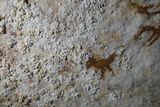
A remarkable discovery has emerged from the Liang Metanduno cave in Sulawesi, Indonesia, where a stencil of a human hand has been dated to over 67,800 years ago. This finding, detailed in a recent study published in Nature, marks the oldest known rock art, providing crucial insights into the movements of early human populations that may have migrated towards Australia.
The hand stencil, faint and claw-like in appearance, is believed to represent a significant cultural memory of a population linked to the ancestors of modern Aboriginal Australians. According to Maxime Aubert, a researcher at the Griffith Centre for Social and Cultural Research, this discovery reveals that Sulawesi was home to a rich artistic culture dating back to the earliest human occupation of the island.
Significance of Sulawesi in Human History
Sulawesi holds a pivotal role in the narrative of human history, characterized by its ancient artistic expressions. Previous studies have identified various cave paintings on the island, including depictions of human and animal figures that hint at hunting scenes. The recent research not only adds to this artistic legacy but also suggests that Sulawesi served as a stepping stone for Homo sapiens migrating from Asia to Sahul, the paleocontinent that once connected Australia, New Guinea, and Tasmania.
The study’s authors employed advanced techniques such as uranium-series dating and mineral deposit analysis to establish the age of the stencil. They concluded that it was created by an artist from a population likely connected to those who later spread throughout the region and reached Australia. In the words of Adhi Agus Oktaviana from Indonesia’s National Research and Innovation Agency, “This discovery strongly supports the idea that the ancestors of the First Australians were in Sahul by 65,000 years ago.”
New Evidence of Migration Patterns
Prior research suggested that Homo sapiens arrived in Sahul through two possible timelines: the “long chronology” around 65,000 years ago and the “short chronology” approximately 50,000 years ago. Evidence indicates that these early humans took one of two island-hopping routes to arrive in Sahul, with the northern route passing through Sulawesi.
The Liang Metanduno cave also contains more recent paintings, indicating a prolonged period of human habitation that could span over 35,000 years. According to Renaud Joannes-Boyau from Southern Cross University, “With the dating of this extremely ancient rock art in Sulawesi, we now have the oldest direct evidence for the presence of modern humans along this northern migration corridor into Sahul.”
This groundbreaking research opens new avenues for understanding the complex interactions of early human populations in Southeast Asia. The authors express a desire to continue exploring the archaeological significance of various islands in Indonesia, emphasizing their potential to yield further insights into early human art and migration.
The findings from Sulawesi underscore the importance of the Indonesian archipelago in the broader narrative of human history. As researchers continue their investigations, the discoveries may illuminate the paths taken by our ancient ancestors and enrich our understanding of their cultural expressions.

Robinhood Stock Surges 2.5% Today Amid Tech Market Recovery

Philadelphia’s Earth Month Kicks Off with Free Events in Parks

GSK’s Inhaler Decision Sparks Health Concerns for Children

Bradford’s Fish Fry Fridays Offer Community Spirit and Flavor

Speculation Rises on Shutdowns During Trump’s Potential Presidency

Samsung Galaxy Watch 9 to Feature Larger Battery, Report Reveals

Inventors Find New Purpose Through Unconventional Paths

UConn Huskies Aim for Back-to-Back Titles in 2026 NCAA Tournament

U.S. Mine Countermeasure Ships Dock in Malaysia for Logistics Stop

University of Hawaiʻi at Mānoa Joins $25.6M AI Initiative for Disaster Monitoring

$2.2 Million Boost for Cancer Research and Training in Hawaiʻi

ALMA Discovers Companion Orbiting Red Giant Star π 1 Gruis

Sacituzumab Govitecan Shows Promise for HR+/HER2− Breast Cancer

币安人生 Sees $15.92 Million in Trading Volume Amid Market Fluctuations

New Gel Offers Hope for Regrowing Tooth Enamel in Dentistry

CAVA Group Shares Surge 5.1% Amid Mixed Analyst Ratings

Christian Bale in Talks to Join Leonardo DiCaprio in Heat 2

Supreme Court to Review Birthright Citizenship for Children of Immigrants
-
Science9 months ago
University of Hawaiʻi at Mānoa Joins $25.6M AI Initiative for Disaster Monitoring
-
 Health7 months ago
$2.2 Million Boost for Cancer Research and Training in Hawaiʻi
-
 Science8 months ago
ALMA Discovers Companion Orbiting Red Giant Star π 1 Gruis
-
 Health7 months ago
Sacituzumab Govitecan Shows Promise for HR+/HER2− Breast Cancer
-
Politics5 months ago
币安人生 Sees $15.92 Million in Trading Volume Amid Market Fluctuations
-
 Health9 months ago
New Gel Offers Hope for Regrowing Tooth Enamel in Dentistry
-
 Business7 months ago
CAVA Group Shares Surge 5.1% Amid Mixed Analyst Ratings
-
 Entertainment8 months ago
Christian Bale in Talks to Join Leonardo DiCaprio in Heat 2
-
 Politics7 months ago
Supreme Court to Review Birthright Citizenship for Children of Immigrants
-

 Lifestyle8 months ago
Art Deco and Traditional Designs Set to Transform Homes in 2026
-

 Lifestyle7 months ago
Fernando Mendoza Secures Maxwell and O’Brien Awards Ahead of Heisman
-

 World8 months ago
Swiss Residents Reject 50% Inheritance Tax on Wealthy