
Science
China Tests Long March-10 Rocket, Moves Closer to Moon Mission

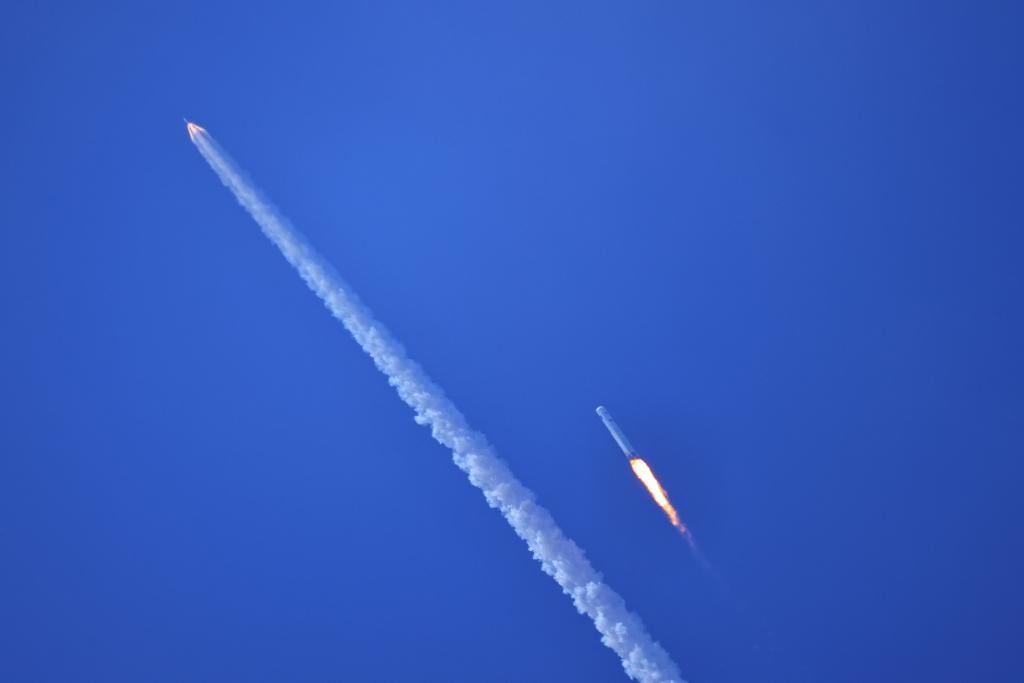
China has made significant strides in its ambitious space program, successfully testing its new Long March-10 rocket and the Mengzhou spacecraft on February 11, 2026. This achievement positions China closer to its goal of landing astronauts on the Moon by the end of the decade as part of its International Lunar Research Station (ILRS) initiative, which aims to rival NASA’s Artemis Program.
The comprehensive test took place at the Wenchang Spacecraft Launch Site in southern Hainan Province. It included a low-altitude demonstration of the Long March-10 and an in-flight abort test of the Mengzhou capsule, also known as the “Dream Vessel.” This was the first ignition flight of the Long March-10, which is designed for crewed lunar missions.
During the test, the rocket successfully navigated through its most challenging phase of ascent known as maximum dynamic pressure (Max Q). This critical moment occurs as the rocket accelerates through the lower atmosphere, where aerodynamic stress peaks. The in-flight abort test assessed the safety system of the Mengzhou spacecraft, which is designed to separate from the rocket in case of an emergency. Both the rocket’s first stage and the capsule performed as expected, safely landing in their designated recovery zones.
Ji Qiming, a spokesperson for the China Manned Spaceflight Agency (CMSA), described the Long March-10 as a next-generation partially reusable launch system. This rocket has two configurations: one with three stages and two strap-on boosters, and another, the 10A variant, featuring two stages without boosters. The Long March-10 is powered by seven liquid oxygen (LOX) and kerosene engines working in parallel.
The Mengzhou spacecraft is designed to carry between six and seven astronauts and is a reusable vehicle. After the capsule separated from the rocket, the Long March-10 continued ascending until it reached its predetermined height and speed, at which point its engines were shut down. The rocket then entered a glide phase, adjusting its orientation multiple times before deploying its four grid fins in preparation for landing.
At an altitude of approximately 110 kilometers (68 miles), the rocket reignited two of its engines for the powered deceleration phase. Following this, it relied solely on its grid fins during the aerodynamic deceleration phase. In the final landing phase, three engines were reignited, allowing the rocket to maneuver toward its designated landing site. Just above sea level, the rocket hovered while ground crews tested an onboard tether mechanism to simulate recovery using a net system. The rocket ultimately splashed down in the ocean, where recovery crews successfully retrieved it.
Zhu Pingping of the China Aerospace Science and Technology Corporation stated that this successful test propels China closer to its goal of sending astronauts to the Moon by 2030. Additionally, China is planning to expand its Tiangong space station and conduct robotic missions to explore a Near Earth Asteroid (NEA) and a Main Belt comet, as well as a Mars Sample Return mission.
With these developments, China is positioning itself as a leading player in the international space arena, aiming to establish a robust presence beyond Earth. The successful test of the Long March-10 rocket and the Mengzhou spacecraft marks a pivotal moment in China’s ongoing efforts to enhance its capabilities in space exploration.

Robinhood Stock Surges 2.5% Today Amid Tech Market Recovery

Philadelphia’s Earth Month Kicks Off with Free Events in Parks

GSK’s Inhaler Decision Sparks Health Concerns for Children

Bradford’s Fish Fry Fridays Offer Community Spirit and Flavor

Speculation Rises on Shutdowns During Trump’s Potential Presidency

Samsung Galaxy Watch 9 to Feature Larger Battery, Report Reveals

Inventors Find New Purpose Through Unconventional Paths

UConn Huskies Aim for Back-to-Back Titles in 2026 NCAA Tournament

U.S. Mine Countermeasure Ships Dock in Malaysia for Logistics Stop

University of Hawaiʻi at Mānoa Joins $25.6M AI Initiative for Disaster Monitoring

$2.2 Million Boost for Cancer Research and Training in Hawaiʻi

ALMA Discovers Companion Orbiting Red Giant Star π 1 Gruis

Sacituzumab Govitecan Shows Promise for HR+/HER2− Breast Cancer

币安人生 Sees $15.92 Million in Trading Volume Amid Market Fluctuations

New Gel Offers Hope for Regrowing Tooth Enamel in Dentistry

CAVA Group Shares Surge 5.1% Amid Mixed Analyst Ratings

Christian Bale in Talks to Join Leonardo DiCaprio in Heat 2

Supreme Court to Review Birthright Citizenship for Children of Immigrants
-
Science9 months ago
University of Hawaiʻi at Mānoa Joins $25.6M AI Initiative for Disaster Monitoring
-
 Health7 months ago
$2.2 Million Boost for Cancer Research and Training in Hawaiʻi
-
 Science8 months ago
ALMA Discovers Companion Orbiting Red Giant Star π 1 Gruis
-
 Health7 months ago
Sacituzumab Govitecan Shows Promise for HR+/HER2− Breast Cancer
-
Politics5 months ago
币安人生 Sees $15.92 Million in Trading Volume Amid Market Fluctuations
-
 Health8 months ago
New Gel Offers Hope for Regrowing Tooth Enamel in Dentistry
-
 Business7 months ago
CAVA Group Shares Surge 5.1% Amid Mixed Analyst Ratings
-
 Entertainment8 months ago
Christian Bale in Talks to Join Leonardo DiCaprio in Heat 2
-
 Politics7 months ago
Supreme Court to Review Birthright Citizenship for Children of Immigrants
-

 Lifestyle8 months ago
Art Deco and Traditional Designs Set to Transform Homes in 2026
-

 Lifestyle7 months ago
Fernando Mendoza Secures Maxwell and O’Brien Awards Ahead of Heisman
-

 World8 months ago
Swiss Residents Reject 50% Inheritance Tax on Wealthy