
Science
Innovator Captures Laser Beam at 2 Billion Frames Per Second

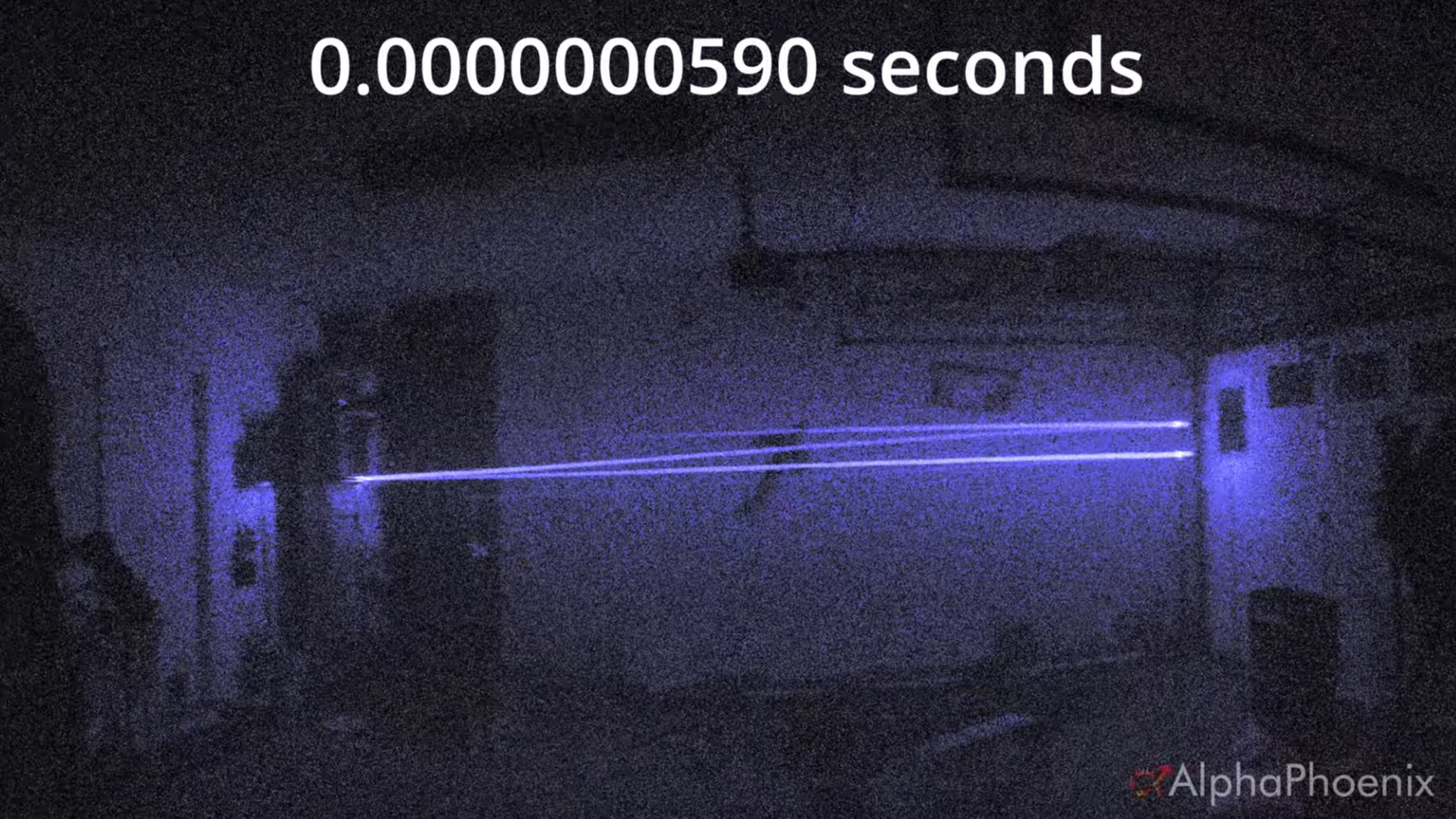
Filmmaker and innovator Brian Haidet has made headlines by successfully capturing a laser beam at an astonishing 2 billion frames per second. This groundbreaking experiment, showcased on his AlphaPhoenix channel, involves a one-pixel video that he meticulously repeats to create a full rendering. The achievement marks a significant leap from his previous work, where he recorded at 1,000,000,000 fps in December 2022.
In his latest endeavor, Haidet completely overhauled his equipment to reach this new milestone. He upgraded various components, including the motors, hardware, oscilloscope, signaling, recording software, and processing software. This comprehensive rebuild reflects his commitment to advancing the field of high-speed photography.
Exploring the Effects of Light
One of the most intriguing results of Haidet’s experiment is the visual representation of light’s behavior. When the laser beam reflects off fog particles closer to the camera, it appears to travel faster than when those reflections come from further away. This phenomenon offers a practical illustration of special relativity, demonstrating how light can behave differently based on its distance from the observer.
Haidet’s project not only showcases technical prowess but also serves as an educational tool, allowing viewers to grasp complex scientific concepts in a visually engaging manner. The experiment’s implications extend beyond mere curiosity; they invite discussions about the nature of light and the principles of physics.
For those interested in delving deeper into this fascinating project, Haidet has also provided additional content that further explains the technical aspects and the science behind his findings. The combination of innovation and educational outreach positions Haidet as a prominent figure in the realm of scientific exploration through media.
This remarkable achievement not only highlights Haidet’s creativity but also underscores the potential of technology to push the boundaries of what is visually possible. As advancements continue, the implications for various fields, such as physics, photography, and education, remain immense.

Robinhood Stock Surges 2.5% Today Amid Tech Market Recovery

Philadelphia’s Earth Month Kicks Off with Free Events in Parks

GSK’s Inhaler Decision Sparks Health Concerns for Children

Bradford’s Fish Fry Fridays Offer Community Spirit and Flavor

Speculation Rises on Shutdowns During Trump’s Potential Presidency

Samsung Galaxy Watch 9 to Feature Larger Battery, Report Reveals

Inventors Find New Purpose Through Unconventional Paths

UConn Huskies Aim for Back-to-Back Titles in 2026 NCAA Tournament

U.S. Mine Countermeasure Ships Dock in Malaysia for Logistics Stop

University of Hawaiʻi at Mānoa Joins $25.6M AI Initiative for Disaster Monitoring

$2.2 Million Boost for Cancer Research and Training in Hawaiʻi

ALMA Discovers Companion Orbiting Red Giant Star π 1 Gruis

Sacituzumab Govitecan Shows Promise for HR+/HER2− Breast Cancer

币安人生 Sees $15.92 Million in Trading Volume Amid Market Fluctuations

New Gel Offers Hope for Regrowing Tooth Enamel in Dentistry

CAVA Group Shares Surge 5.1% Amid Mixed Analyst Ratings

Christian Bale in Talks to Join Leonardo DiCaprio in Heat 2

Supreme Court to Review Birthright Citizenship for Children of Immigrants
-
Science9 months ago
University of Hawaiʻi at Mānoa Joins $25.6M AI Initiative for Disaster Monitoring
-
 Health7 months ago
$2.2 Million Boost for Cancer Research and Training in Hawaiʻi
-
 Science9 months ago
ALMA Discovers Companion Orbiting Red Giant Star π 1 Gruis
-
 Health7 months ago
Sacituzumab Govitecan Shows Promise for HR+/HER2− Breast Cancer
-
Politics5 months ago
币安人生 Sees $15.92 Million in Trading Volume Amid Market Fluctuations
-
 Health9 months ago
New Gel Offers Hope for Regrowing Tooth Enamel in Dentistry
-
 Business8 months ago
CAVA Group Shares Surge 5.1% Amid Mixed Analyst Ratings
-
 Entertainment8 months ago
Christian Bale in Talks to Join Leonardo DiCaprio in Heat 2
-
 Politics8 months ago
Supreme Court to Review Birthright Citizenship for Children of Immigrants
-

 Lifestyle8 months ago
Art Deco and Traditional Designs Set to Transform Homes in 2026
-

 Lifestyle8 months ago
Fernando Mendoza Secures Maxwell and O’Brien Awards Ahead of Heisman
-

 World8 months ago
Swiss Residents Reject 50% Inheritance Tax on Wealthy