
Science
New Research Unveils Mechanosensor Behind Venus Flytrap’s Rapid Response

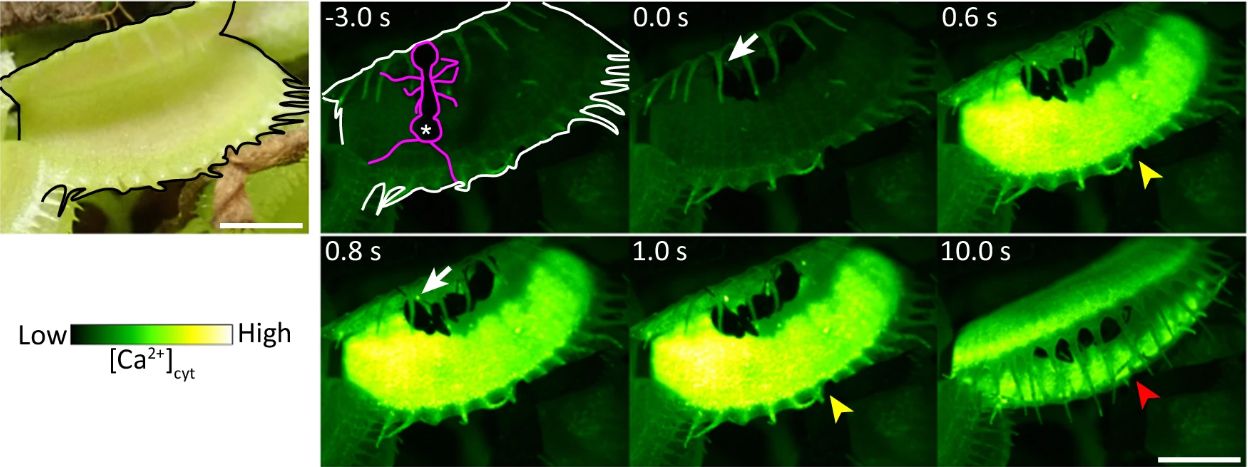
Carnivorous plants continue to captivate researchers, especially the Venus flytrap (Dionaea muscipula), which employs a remarkable spring-loaded mechanism to trap its prey. Recent research published in Nature Communications by a team led by Hiraku Suda sheds light on the mechanosensor responsible for the plant’s quick reflexes, revealing insights into how these fascinating organisms interact with their environment.
The study identifies a mechanosensor named DmMSL10, crucial for the rapid calcium response seen in the Venus flytrap. Previous research acknowledged that the sensory hairs along the plant’s leaves respond to specific stimuli through calcium threshold signals, yet the underlying mechanism remained largely unexplored.
Suda and his colleagues conducted experiments that involved creating a knockout variant of the D. muscipula where the DmMSL10 channel was absent. This alteration allowed them to assess the role of this stretch-activated chloride ion channel in the plant’s sensory response. They found that while both the wild-type and knockout variants experienced calcium ion release upon mechanical stimulation, the knockout variant exhibited a significantly reduced rate of action potential generation.
In a practical demonstration, ants were allowed to roam on the leaves of both plant types. The wild-type Venus flytrap successfully captured the first ant that ventured onto its leaf, while the knockout variant showed no movement even after multiple ants failed to elicit a calcium signal strong enough to trigger the leaf’s closure.
This research provides a clearer understanding of how D. muscipula and similar plants generate long-range calcium signals, critical for their predatory habits. The findings not only enhance our grasp of plant biology but also pave the way for further studies on the evolution of similar mechanisms in animals.
As scientists continue to explore the intricacies of plant responses, this study marks a significant advancement in understanding the rapid movements of carnivorous plants, potentially unraveling mysteries of their evolutionary adaptations over time.

Robinhood Stock Surges 2.5% Today Amid Tech Market Recovery

Philadelphia’s Earth Month Kicks Off with Free Events in Parks

GSK’s Inhaler Decision Sparks Health Concerns for Children

Bradford’s Fish Fry Fridays Offer Community Spirit and Flavor

Speculation Rises on Shutdowns During Trump’s Potential Presidency

Samsung Galaxy Watch 9 to Feature Larger Battery, Report Reveals

Inventors Find New Purpose Through Unconventional Paths

UConn Huskies Aim for Back-to-Back Titles in 2026 NCAA Tournament

U.S. Mine Countermeasure Ships Dock in Malaysia for Logistics Stop

University of Hawaiʻi at Mānoa Joins $25.6M AI Initiative for Disaster Monitoring

$2.2 Million Boost for Cancer Research and Training in Hawaiʻi

ALMA Discovers Companion Orbiting Red Giant Star π 1 Gruis

Sacituzumab Govitecan Shows Promise for HR+/HER2− Breast Cancer

币安人生 Sees $15.92 Million in Trading Volume Amid Market Fluctuations

New Gel Offers Hope for Regrowing Tooth Enamel in Dentistry

CAVA Group Shares Surge 5.1% Amid Mixed Analyst Ratings

Christian Bale in Talks to Join Leonardo DiCaprio in Heat 2

Supreme Court to Review Birthright Citizenship for Children of Immigrants
-
Science9 months ago
University of Hawaiʻi at Mānoa Joins $25.6M AI Initiative for Disaster Monitoring
-
 Health7 months ago
$2.2 Million Boost for Cancer Research and Training in Hawaiʻi
-
 Science9 months ago
ALMA Discovers Companion Orbiting Red Giant Star π 1 Gruis
-
 Health7 months ago
Sacituzumab Govitecan Shows Promise for HR+/HER2− Breast Cancer
-
Politics5 months ago
币安人生 Sees $15.92 Million in Trading Volume Amid Market Fluctuations
-
 Health9 months ago
New Gel Offers Hope for Regrowing Tooth Enamel in Dentistry
-
 Business8 months ago
CAVA Group Shares Surge 5.1% Amid Mixed Analyst Ratings
-
 Entertainment8 months ago
Christian Bale in Talks to Join Leonardo DiCaprio in Heat 2
-
 Politics8 months ago
Supreme Court to Review Birthright Citizenship for Children of Immigrants
-

 Lifestyle8 months ago
Art Deco and Traditional Designs Set to Transform Homes in 2026
-

 Lifestyle8 months ago
Fernando Mendoza Secures Maxwell and O’Brien Awards Ahead of Heisman
-

 World8 months ago
Swiss Residents Reject 50% Inheritance Tax on Wealthy