
Science
German Scientists Redefine Thermodynamics with Quantum Breakthrough

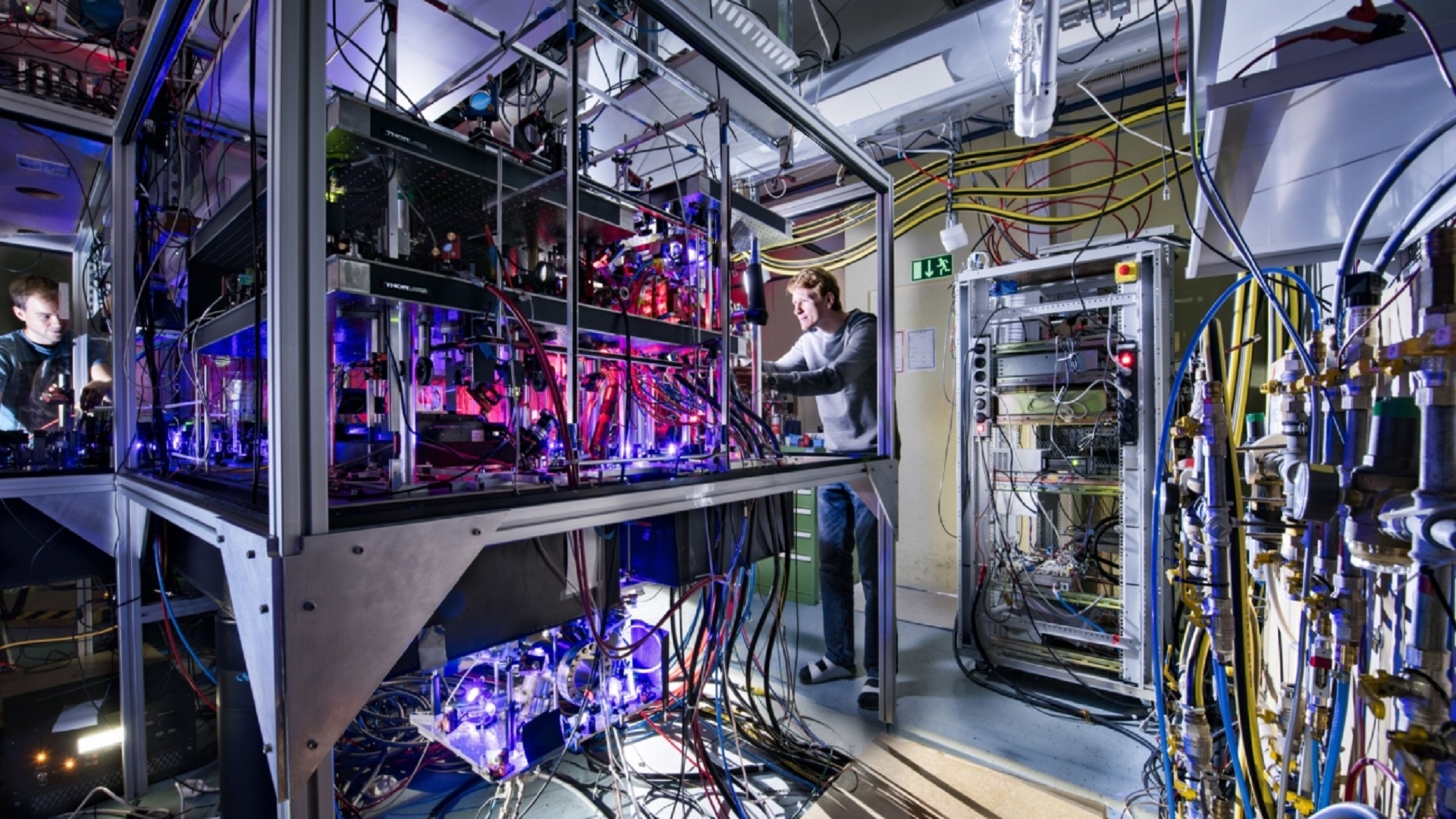
A team of researchers at the University of Stuttgart, Germany, has made a groundbreaking discovery that challenges a fundamental principle of physics established over 200 years ago. Led by Eric Lutz, PhD, and Milton Aguilar, PhD, the scientists have shown that the Carnot principle, a cornerstone of thermodynamics, does not apply in the same way to quantum systems. Their findings suggest that atomic-scale machines can operate with efficiencies that exceed those defined by this long-standing law.
The Carnot principle, formulated by French physicist Nicolas Léonard Sadi Carnot in 1824, stipulates that no heat engine operating between two thermal reservoirs can exceed the efficiency of a reversible heat engine. This principle has been a guiding framework for understanding thermodynamic systems involving macroscopic objects, such as steam turbines. However, the new research indicates that this principle must be revised when applied to the quantum realm.
Breaking Established Limits
According to Lutz and Aguilar, Carnot’s findings were primarily focused on large-scale systems. They assert that the principle’s limitations become apparent when examining smaller, quantum-scale systems. “While Carnot demonstrated that a greater temperature difference leads to higher efficiency, this principle overlooks the effects of quantum correlations,” they explained. This insight led the researchers to explore the behavior of quantum particles that can become entangled and interact in ways that defy classical physics.
Their research reveals that when particles are correlated, thermal machines operating at the atomic scale can convert not only heat but also these quantum correlations into usable work. As a result, the efficiency of quantum engines can surpass the conventional Carnot limit. “These are special bonds that form between particles on a very small scale,” they added. “For the first time, we have derived generalized laws of thermodynamics that fully account for these correlations.”
Future Implications for Technology
The implications of this research extend beyond theoretical physics. The findings pave the way for the development of ultra-efficient quantum engines and nanotechnology. “Tiny motors, no larger than a single atom, could become a reality in the future,” Lutz noted in a press release. He emphasized that these quantum engines could perform tasks with greater efficiency than their larger counterparts.
The study, titled “Correlated quantum machines beyond the standard second law,” published in the journal Science Advances, outlines how improved understanding of quantum mechanics at the atomic level can lead to practical applications. The researchers believe that as scientists gain deeper insights into these physical laws, they will be able to harness them to create advanced technologies.
“Perhaps one day, such motors will power medical nanobots or control machines that process materials at the atomic level,” Lutz and Aguilar concluded. “The potential applications are enormously diverse.” Their work not only challenges established scientific norms but also opens new avenues for innovation in fields ranging from medicine to materials science.

Robinhood Stock Surges 2.5% Today Amid Tech Market Recovery

Philadelphia’s Earth Month Kicks Off with Free Events in Parks

GSK’s Inhaler Decision Sparks Health Concerns for Children

Bradford’s Fish Fry Fridays Offer Community Spirit and Flavor

Speculation Rises on Shutdowns During Trump’s Potential Presidency

Samsung Galaxy Watch 9 to Feature Larger Battery, Report Reveals

Inventors Find New Purpose Through Unconventional Paths

UConn Huskies Aim for Back-to-Back Titles in 2026 NCAA Tournament

U.S. Mine Countermeasure Ships Dock in Malaysia for Logistics Stop

University of Hawaiʻi at Mānoa Joins $25.6M AI Initiative for Disaster Monitoring

$2.2 Million Boost for Cancer Research and Training in Hawaiʻi

ALMA Discovers Companion Orbiting Red Giant Star π 1 Gruis

Sacituzumab Govitecan Shows Promise for HR+/HER2− Breast Cancer

币安人生 Sees $15.92 Million in Trading Volume Amid Market Fluctuations

New Gel Offers Hope for Regrowing Tooth Enamel in Dentistry

CAVA Group Shares Surge 5.1% Amid Mixed Analyst Ratings

Christian Bale in Talks to Join Leonardo DiCaprio in Heat 2

Supreme Court to Review Birthright Citizenship for Children of Immigrants
-
Science9 months ago
University of Hawaiʻi at Mānoa Joins $25.6M AI Initiative for Disaster Monitoring
-
 Health7 months ago
$2.2 Million Boost for Cancer Research and Training in Hawaiʻi
-
 Science9 months ago
ALMA Discovers Companion Orbiting Red Giant Star π 1 Gruis
-
 Health7 months ago
Sacituzumab Govitecan Shows Promise for HR+/HER2− Breast Cancer
-
Politics5 months ago
币安人生 Sees $15.92 Million in Trading Volume Amid Market Fluctuations
-
 Health9 months ago
New Gel Offers Hope for Regrowing Tooth Enamel in Dentistry
-
 Business8 months ago
CAVA Group Shares Surge 5.1% Amid Mixed Analyst Ratings
-
 Entertainment8 months ago
Christian Bale in Talks to Join Leonardo DiCaprio in Heat 2
-
 Politics8 months ago
Supreme Court to Review Birthright Citizenship for Children of Immigrants
-

 Lifestyle8 months ago
Art Deco and Traditional Designs Set to Transform Homes in 2026
-

 Lifestyle8 months ago
Fernando Mendoza Secures Maxwell and O’Brien Awards Ahead of Heisman
-

 World8 months ago
Swiss Residents Reject 50% Inheritance Tax on Wealthy