
Science
New Plant and Fungal Species Unveiled by Kew Gardens Researchers

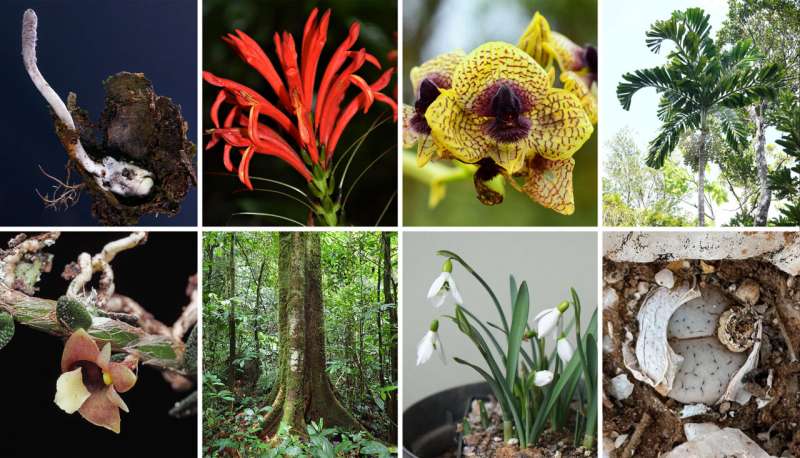
Scientists from the Royal Botanic Gardens, Kew, and their international collaborators have identified ten remarkable new species of plants and fungi in 2025. This discovery highlights the ongoing need for biodiversity research and conservation efforts, particularly as many newly identified species are already facing the threat of extinction.
Each year, Kew’s taxonomists, alongside partners around the globe, contribute to the understanding of the natural world. In the past year alone, they named 125 plants and 65 fungi, revealing the vast diversity that remains largely unexplored. The annual list includes fascinating species, such as a “zombie” fungus that preys on spiders in Brazil and a “bloodstained” orchid from Ecuador.
Notable New Species
One of the most intriguing discoveries is the “zombie” fungus, named Purpureocillium atlanticum, which infects trapdoor spiders in Brazil’s Atlantic rainforest. This fungus envelops its host in a white mycelium before producing a fruiting body that emerges from the spider’s burrow to release spores. The research team employed cutting-edge genome technology to study this species, led by Dr. Joao Araujo from Kew and the University of Copenhagen.
Another striking addition is the “bloodstained” orchid, Telipogon cruentilabrum, found in the high Andean forests of Ecuador. This species grows on tree daisies and is known for its vibrant, red-veined flowers. Unfortunately, much of its habitat has been lost due to agricultural expansion and mining activities, leading to its classification as endangered.
The new species Aphelandra calciferi, named after a character from the film *Howl’s Moving Castle*, showcases bright orange and yellow flowers. This species, discovered in Peru, has potential as an ornamental plant. Other noteworthy finds include a new subspecies of “living stones,” Lithops gracilidelineata subsp. mopane, and a snowdrop species, Galanthus subalpinus, from the Balkans.
Conservation Challenges
Despite the excitement surrounding these new discoveries, many species are already at risk. For instance, the newly described Cryptacanthus ebo from Cameroon may have already become extinct in its native habitat. According to Kew’s State of the World’s Plants and Fungi 2023 report, approximately three in four unidentified plant species are currently threatened with extinction.
Dr. Martin Cheek, Senior Research Leader at Kew, emphasized the importance of naming new species. He stated, “It is difficult to protect what we do not know, understand, and have a scientific name for. Each identification of a new species helps us better understand ecosystems.” He also noted that human activities are eroding natural habitats, causing extinction rates to rise.
The Kew team aims to address these threats by collaborating with local partners to protect species in their natural environments, integrating them into a network of Important Plant Areas (IPAs). Additionally, conservation efforts include the preservation of seeds at national seed banks, such as Kew’s Millennium Seed Bank, which celebrated its 25th anniversary in 2025.
With an estimated 100,000 plant species and 2-3 million species of fungi yet to be described, the task ahead remains daunting. Dr. Irina Druzhinina, Senior Research Leader in Fungal Diversity and Systematics at Kew, remarked on the vastness of fungal diversity yet to be discovered, calling it one of science’s most exciting frontiers.
As Kew Gardens continues to unveil new species, the imperative for global biodiversity conservation grows stronger. The discoveries not only enrich our understanding of the natural world but also underscore the urgent need for action to preserve it for future generations.

Robinhood Stock Surges 2.5% Today Amid Tech Market Recovery

Philadelphia’s Earth Month Kicks Off with Free Events in Parks

GSK’s Inhaler Decision Sparks Health Concerns for Children

Bradford’s Fish Fry Fridays Offer Community Spirit and Flavor

Speculation Rises on Shutdowns During Trump’s Potential Presidency

Samsung Galaxy Watch 9 to Feature Larger Battery, Report Reveals

Inventors Find New Purpose Through Unconventional Paths

UConn Huskies Aim for Back-to-Back Titles in 2026 NCAA Tournament

U.S. Mine Countermeasure Ships Dock in Malaysia for Logistics Stop

University of Hawaiʻi at Mānoa Joins $25.6M AI Initiative for Disaster Monitoring

$2.2 Million Boost for Cancer Research and Training in Hawaiʻi

ALMA Discovers Companion Orbiting Red Giant Star π 1 Gruis

Sacituzumab Govitecan Shows Promise for HR+/HER2− Breast Cancer

币安人生 Sees $15.92 Million in Trading Volume Amid Market Fluctuations

New Gel Offers Hope for Regrowing Tooth Enamel in Dentistry

CAVA Group Shares Surge 5.1% Amid Mixed Analyst Ratings

Christian Bale in Talks to Join Leonardo DiCaprio in Heat 2

Supreme Court to Review Birthright Citizenship for Children of Immigrants
-
Science9 months ago
University of Hawaiʻi at Mānoa Joins $25.6M AI Initiative for Disaster Monitoring
-
 Health7 months ago
$2.2 Million Boost for Cancer Research and Training in Hawaiʻi
-
 Science9 months ago
ALMA Discovers Companion Orbiting Red Giant Star π 1 Gruis
-
 Health7 months ago
Sacituzumab Govitecan Shows Promise for HR+/HER2− Breast Cancer
-
Politics5 months ago
币安人生 Sees $15.92 Million in Trading Volume Amid Market Fluctuations
-
 Health9 months ago
New Gel Offers Hope for Regrowing Tooth Enamel in Dentistry
-
 Business8 months ago
CAVA Group Shares Surge 5.1% Amid Mixed Analyst Ratings
-
 Entertainment8 months ago
Christian Bale in Talks to Join Leonardo DiCaprio in Heat 2
-
 Politics8 months ago
Supreme Court to Review Birthright Citizenship for Children of Immigrants
-

 Lifestyle8 months ago
Art Deco and Traditional Designs Set to Transform Homes in 2026
-

 Lifestyle8 months ago
Fernando Mendoza Secures Maxwell and O’Brien Awards Ahead of Heisman
-

 World8 months ago
Swiss Residents Reject 50% Inheritance Tax on Wealthy