
Science
Researchers Enhance Genetic Tools for Sulfolobus islandicus Applications

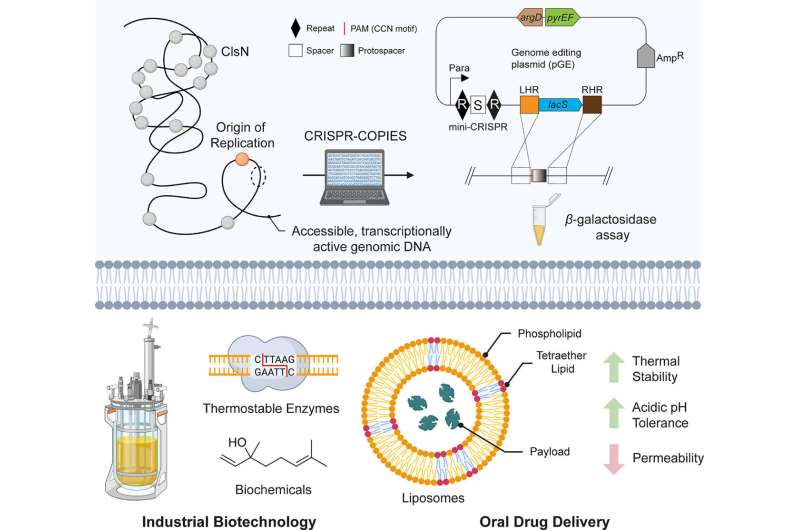
A research team at the University of Illinois at Urbana-Champaign has made significant strides in expanding the genetic toolkit for the archaeal organism Sulfolobus islandicus. This organism, known for its resilience in extreme environments characterized by low pH and high temperatures, has potential applications in metabolic engineering and synthetic biology. However, previous limitations due to the lack of well-defined chromosomal integration sites have hindered its development as a cellular factory.
By employing the CRISPR-COPIES pipeline alongside a multi-omics strategy, the researchers integrated genomics and epigenomics to identify genomic regions suitable for integration. Their findings were published on January 7, 2026, in the journal Trends in Biotechnology. The team successfully identified 66 CRISPR RNA (crRNA) sequences that target 21 intergenic regions, which show promise for gene integration.
The researchers further validated 13 of these crRNAs corresponding to eight sites using a β-galactosidase activity assay, demonstrating the functional potential of these integration sites. Notably, they overexpressed the gene GrsB, which encodes for glycerol dibiphytanyl glycerol tetraether (GDGT) ring synthase B, at one of the identified sites. This manipulation resulted in a modulated lipid ether composition, significantly increasing the number of cyclopentane moieties present.
The implications of this research are substantial. The expanded genetic toolbox enhances the capabilities of non-conventional hosts, paving the way for more robust platforms in synthetic biology and industrial biotechnology. The team’s work not only addresses existing limitations but also opens new avenues for innovative applications in biotechnology.
This research exemplifies the continuing evolution of genetic engineering techniques and their potential to revolutionize various scientific fields. The study, led by Aashutosh Girish Boob and reviewed by Robert Egan, underscores the importance of developing versatile tools that can facilitate advancements in biotechnology.
For further details, refer to the publication: Aashutosh Girish Boob et al, “Discovery, characterization, and application of chromosomal integration sites in the hyperthermophilic archaeon Sulfolobus islandicus,” Trends in Biotechnology (2025). DOI: 10.1016/j.tibtech.2025.11.003.

Robinhood Stock Surges 2.5% Today Amid Tech Market Recovery

Philadelphia’s Earth Month Kicks Off with Free Events in Parks

GSK’s Inhaler Decision Sparks Health Concerns for Children

Bradford’s Fish Fry Fridays Offer Community Spirit and Flavor

Speculation Rises on Shutdowns During Trump’s Potential Presidency

Samsung Galaxy Watch 9 to Feature Larger Battery, Report Reveals

Inventors Find New Purpose Through Unconventional Paths

UConn Huskies Aim for Back-to-Back Titles in 2026 NCAA Tournament

U.S. Mine Countermeasure Ships Dock in Malaysia for Logistics Stop

University of Hawaiʻi at Mānoa Joins $25.6M AI Initiative for Disaster Monitoring

$2.2 Million Boost for Cancer Research and Training in Hawaiʻi

ALMA Discovers Companion Orbiting Red Giant Star π 1 Gruis

Sacituzumab Govitecan Shows Promise for HR+/HER2− Breast Cancer

币安人生 Sees $15.92 Million in Trading Volume Amid Market Fluctuations

New Gel Offers Hope for Regrowing Tooth Enamel in Dentistry

CAVA Group Shares Surge 5.1% Amid Mixed Analyst Ratings

Christian Bale in Talks to Join Leonardo DiCaprio in Heat 2

Supreme Court to Review Birthright Citizenship for Children of Immigrants
-
Science9 months ago
University of Hawaiʻi at Mānoa Joins $25.6M AI Initiative for Disaster Monitoring
-
 Health7 months ago
$2.2 Million Boost for Cancer Research and Training in Hawaiʻi
-
 Science9 months ago
ALMA Discovers Companion Orbiting Red Giant Star π 1 Gruis
-
 Health7 months ago
Sacituzumab Govitecan Shows Promise for HR+/HER2− Breast Cancer
-
Politics5 months ago
币安人生 Sees $15.92 Million in Trading Volume Amid Market Fluctuations
-
 Health9 months ago
New Gel Offers Hope for Regrowing Tooth Enamel in Dentistry
-
 Business8 months ago
CAVA Group Shares Surge 5.1% Amid Mixed Analyst Ratings
-
 Entertainment8 months ago
Christian Bale in Talks to Join Leonardo DiCaprio in Heat 2
-
 Politics8 months ago
Supreme Court to Review Birthright Citizenship for Children of Immigrants
-

 Lifestyle8 months ago
Art Deco and Traditional Designs Set to Transform Homes in 2026
-

 Lifestyle8 months ago
Fernando Mendoza Secures Maxwell and O’Brien Awards Ahead of Heisman
-

 World8 months ago
Swiss Residents Reject 50% Inheritance Tax on Wealthy