
Science
Researchers Uncover Microbial Swimming Strategies for Light Optimization

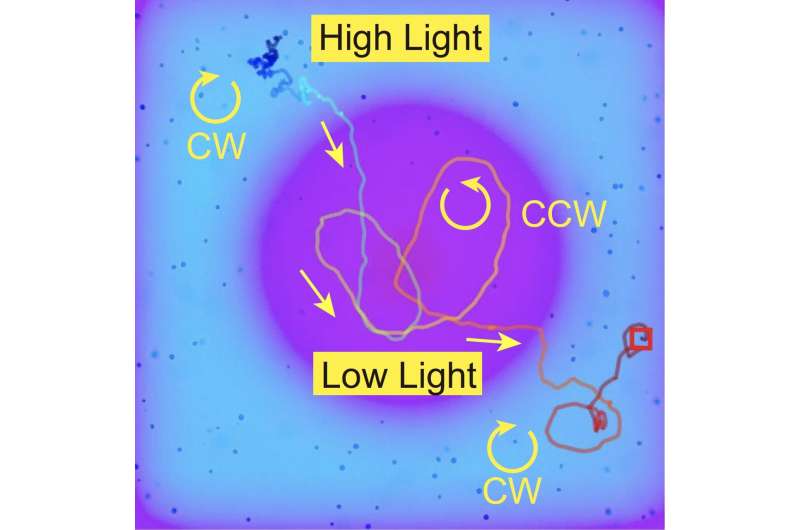
Researchers from Hong Kong and the UK have discovered how a specific type of self-propelling microbe adjusts its swimming technique based on light availability. This finding, published in Physical Review Letters on March 2, 2026, sheds light on the behavioral adaptations of the microbe Chlamydomonas reinhardtii, a single-celled green alga known for its unique swimming capabilities.
Mechanics of Microbial Motion
Many microorganisms, including Chlamydomonas reinhardtii, navigate their environments using flagella—hair-like appendages that beat rhythmically. Their swimming strategies can vary significantly. Some bacteria utilize a “run-and-tumble” method characterized by straight runs followed by rapid direction changes, while others navigate smoothly by altering their swimming paths in response to chemical signals. Understanding these diverse strategies is essential, as many microbes can switch between different modes based on their surroundings.
In a notable study conducted in 2021 by researchers Kirsty Wan and Dario Cortese from the University of Exeter, they investigated the swimming patterns of Chlamydomonas reinhardtii. They tracked individual cells in three dimensions, revealing that these organisms follow corkscrew-shaped trajectories. These paths can be adjusted by modifying the frequency and amplitude of the flagella’s movements, particularly when exposed to light, which tends to draw them closer to the source. Nonetheless, the specific mechanisms behind this light-responsive steering remained largely unexplored.
Light-Dependent Behavioral Changes
Building on earlier findings, Zhao Wang and his team at the University of Hong Kong conducted a more detailed analysis of the swimming dynamics of Chlamydomonas reinhardtii. Utilizing high-speed imaging, they examined how the two flagella operated under varying light intensities. Their observations indicated a consistent pattern: under low light conditions, the microbe swam in counterclockwise circles. This behavior was attributed to the flagellum closest to the cell’s light-sensitive structure, known as the eyespot, which beat with greater force, thus dominating movement.
Upon reaching a threshold light intensity, the swimming pattern changed abruptly. Instead of one flagellum overpowering the other, a shift occurred in the phase relationship between their beats, leading to a clockwise trajectory that directed the microbe towards the light source. This adaptability enables the microbe to optimize its light absorption for photosynthesis.
Wang’s research team suggests that this evolutionary adaptation allows Chlamydomonas reinhardtii to manage its exposure to light effectively. By modifying its swimming behavior in response to illumination, the microbe can navigate away from less favorable conditions, maximizing the light available for photosynthesis.
The insights gleaned from this research may also have broader implications. The team envisions that understanding the mechanisms behind microbial navigation could influence the design of microscopic swimming robots. With improved control over trajectory and direction, these engineered devices could perform intricate tasks in confined spaces, such as delivering drugs within the human body in a targeted and minimally invasive manner.
This study highlights the complexity of microbial behavior and its potential applications in technology. As researchers continue to explore these fascinating organisms, the hope is to harness their natural capabilities for innovative solutions in various fields.

Robinhood Stock Surges 2.5% Today Amid Tech Market Recovery

Philadelphia’s Earth Month Kicks Off with Free Events in Parks

GSK’s Inhaler Decision Sparks Health Concerns for Children

Bradford’s Fish Fry Fridays Offer Community Spirit and Flavor

Speculation Rises on Shutdowns During Trump’s Potential Presidency

Samsung Galaxy Watch 9 to Feature Larger Battery, Report Reveals

Inventors Find New Purpose Through Unconventional Paths

UConn Huskies Aim for Back-to-Back Titles in 2026 NCAA Tournament

U.S. Mine Countermeasure Ships Dock in Malaysia for Logistics Stop

University of Hawaiʻi at Mānoa Joins $25.6M AI Initiative for Disaster Monitoring

$2.2 Million Boost for Cancer Research and Training in Hawaiʻi

ALMA Discovers Companion Orbiting Red Giant Star π 1 Gruis

Sacituzumab Govitecan Shows Promise for HR+/HER2− Breast Cancer

币安人生 Sees $15.92 Million in Trading Volume Amid Market Fluctuations

New Gel Offers Hope for Regrowing Tooth Enamel in Dentistry

CAVA Group Shares Surge 5.1% Amid Mixed Analyst Ratings

Christian Bale in Talks to Join Leonardo DiCaprio in Heat 2

Supreme Court to Review Birthright Citizenship for Children of Immigrants
-
Science8 months ago
University of Hawaiʻi at Mānoa Joins $25.6M AI Initiative for Disaster Monitoring
-
 Health7 months ago
$2.2 Million Boost for Cancer Research and Training in Hawaiʻi
-
 Science8 months ago
ALMA Discovers Companion Orbiting Red Giant Star π 1 Gruis
-
 Health7 months ago
Sacituzumab Govitecan Shows Promise for HR+/HER2− Breast Cancer
-
Politics4 months ago
币安人生 Sees $15.92 Million in Trading Volume Amid Market Fluctuations
-
 Health8 months ago
New Gel Offers Hope for Regrowing Tooth Enamel in Dentistry
-
 Business7 months ago
CAVA Group Shares Surge 5.1% Amid Mixed Analyst Ratings
-
 Entertainment8 months ago
Christian Bale in Talks to Join Leonardo DiCaprio in Heat 2
-
 Politics7 months ago
Supreme Court to Review Birthright Citizenship for Children of Immigrants
-

 Lifestyle7 months ago
Fernando Mendoza Secures Maxwell and O’Brien Awards Ahead of Heisman
-

 Lifestyle8 months ago
Art Deco and Traditional Designs Set to Transform Homes in 2026
-

 World7 months ago
Swiss Residents Reject 50% Inheritance Tax on Wealthy