
World
Israel Demolishes Homes in West Bank Amid Settlement Expansion

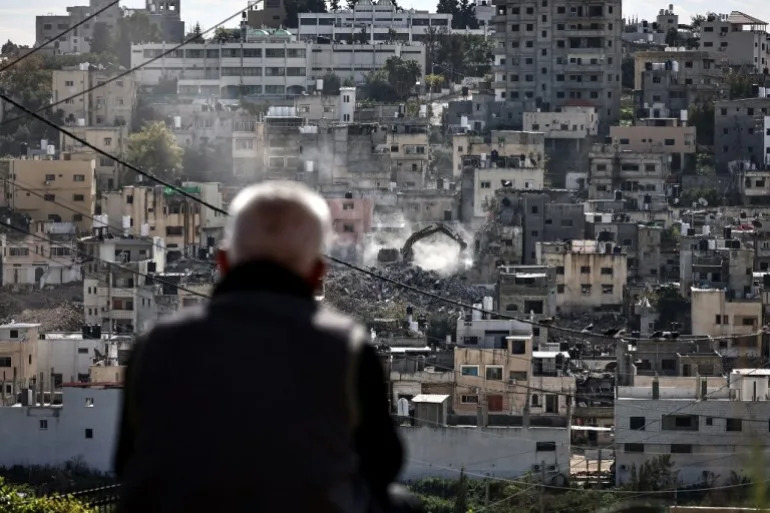
Israeli forces have commenced the demolition of numerous buildings in the northern occupied West Bank, specifically targeting the Nur Shams refugee camp. This action has resulted in significant displacement of Palestinian families just as winter approaches, leaving many without adequate shelter. On Wednesday, Israeli military bulldozers and cranes razed residential blocks, displacing approximately 100 families.
Thick clouds of dust enveloped the camp as residents watched helplessly. Mutaz Mahr, a local resident whose home was destroyed, expressed the emotional toll of the demolitions, stating, “Being torn away from our homes, our neighbourhoods, and our memories is deeply painful.” He noted that he and about 25 relatives are now confined to a small apartment of 100 square meters (120 square yards) after being forced out of their homes. Mahr referred to the ongoing displacement as a continuation of a historical pattern, recalling that his grandparents had also faced displacement.
The Israeli military justified the demolitions as part of a broader operation against Palestinian resistance groups, although this claim has not been independently verified. Palestinian residents and various rights organizations argue that such actions constitute collective punishment and forced displacement. According to Nihaya al-Jendi, a member of the Nur Shams popular committee, the crisis had already reached critical levels before the demolitions began. “Today, more than 1,500 families from the camp are still unable to return,” she stated, calling it “a major catastrophe – a real humanitarian disaster for Palestinian refugees – unfolding before the eyes of the world.”
Impact of Demolitions on Refugee Camps
This wave of demolitions is part of a security operation initiated by Israel earlier this year, targeting several refugee camps in the northern West Bank, including Nur Shams, Tulkarem, and Jenin. According to data from Human Rights Watch, over 850 homes have either been demolished or severely damaged across these camps. The organization used satellite imagery to analyze the extent of destruction, indicating that the demolitions aim to create “clear buffer” zones and permanently alter the urban landscape, thereby tightening Israeli control over the area.
As homes are reduced to rubble, Israel is simultaneously advancing plans for illegal settlement expansion. On the same day as the demolitions, Israeli authorities approved construction for 126 housing units for settlers in the Sa-Nur outpost, as reported by Israeli media. The High Planning Council, operating under Israel’s Civil Administration, has authorized the return of settlers to Sa-Nur, which had been evacuated in 2005 as part of then-Prime Minister Ariel Sharon’s disengagement plan. This policy was reversed in March 2024 when Israel’s parliament repealed the disengagement law through the “Cancellation of the Disengagement Law.” Reports suggest that the new construction plan could be implemented within two months.
UNRWA and Humanitarian Concerns
The recent demolitions and the expansion of settlements coincide with escalating tensions between Israel and the United Nations Relief and Works Agency for Palestine Refugees in the Near East (UNRWA). UN Secretary-General Antonio Guterres condemned Israel’s recent actions to cut electricity and water supply to UNRWA facilities. His spokesperson noted that such measures would “further impede” the agency’s operations, which are critical for supporting Palestinian refugees.
UNRWA Commissioner-General Philippe Lazzarini characterized these actions as part of a “systematic campaign to discredit UNRWA and thereby obstruct” its humanitarian efforts. In 2024, Israel’s parliament passed legislation prohibiting UNRWA from operating within the country and restricting contact with its officials. Despite these challenges, UNRWA continues to provide essential services, including education and healthcare, to millions of Palestinians across Gaza, the West Bank, Jordan, Lebanon, and Syria.
As the situation in Gaza worsens, critics argue that the simultaneous assault on UNRWA and the communities in the West Bank signals a broader strategy to dismantle the refugee issue altogether. The ongoing conflict and the humanitarian crisis highlight urgent needs for international attention and intervention in the region.

Robinhood Stock Surges 2.5% Today Amid Tech Market Recovery

Philadelphia’s Earth Month Kicks Off with Free Events in Parks

GSK’s Inhaler Decision Sparks Health Concerns for Children

Bradford’s Fish Fry Fridays Offer Community Spirit and Flavor

Speculation Rises on Shutdowns During Trump’s Potential Presidency

Samsung Galaxy Watch 9 to Feature Larger Battery, Report Reveals

Inventors Find New Purpose Through Unconventional Paths

UConn Huskies Aim for Back-to-Back Titles in 2026 NCAA Tournament

U.S. Mine Countermeasure Ships Dock in Malaysia for Logistics Stop

University of Hawaiʻi at Mānoa Joins $25.6M AI Initiative for Disaster Monitoring

$2.2 Million Boost for Cancer Research and Training in Hawaiʻi

ALMA Discovers Companion Orbiting Red Giant Star π 1 Gruis

Sacituzumab Govitecan Shows Promise for HR+/HER2− Breast Cancer

币安人生 Sees $15.92 Million in Trading Volume Amid Market Fluctuations

New Gel Offers Hope for Regrowing Tooth Enamel in Dentistry

CAVA Group Shares Surge 5.1% Amid Mixed Analyst Ratings

Christian Bale in Talks to Join Leonardo DiCaprio in Heat 2

Supreme Court to Review Birthright Citizenship for Children of Immigrants
-
Science9 months ago
University of Hawaiʻi at Mānoa Joins $25.6M AI Initiative for Disaster Monitoring
-
 Health8 months ago
$2.2 Million Boost for Cancer Research and Training in Hawaiʻi
-
 Science9 months ago
ALMA Discovers Companion Orbiting Red Giant Star π 1 Gruis
-
 Health7 months ago
Sacituzumab Govitecan Shows Promise for HR+/HER2− Breast Cancer
-
Politics5 months ago
币安人生 Sees $15.92 Million in Trading Volume Amid Market Fluctuations
-
 Health9 months ago
New Gel Offers Hope for Regrowing Tooth Enamel in Dentistry
-
 Business8 months ago
CAVA Group Shares Surge 5.1% Amid Mixed Analyst Ratings
-
 Entertainment9 months ago
Christian Bale in Talks to Join Leonardo DiCaprio in Heat 2
-
 Politics8 months ago
Supreme Court to Review Birthright Citizenship for Children of Immigrants
-

 Lifestyle9 months ago
Art Deco and Traditional Designs Set to Transform Homes in 2026
-

 Lifestyle8 months ago
Fernando Mendoza Secures Maxwell and O’Brien Awards Ahead of Heisman
-

 World8 months ago
Swiss Residents Reject 50% Inheritance Tax on Wealthy